
Quick Summary
| Key Insight | What You Need to Know |
|---|---|
| What Is a Fake | What Is a Fake Comment on YouTube? How Fake Comments Differ From Authentic Engagement |
| How Fake Comments Differ | How Fake Comments Differ From Authentic Engagement |
| How Fake Comment Generators | How Fake Comment Generators Work UI Replication and Visual Mockups Customization Options and Real-Time Preview |
| UI Replication and Visual | UI Replication and Visual Mockups |
| Customization Options and Real-Time | Customization Options and Real-Time Preview |
| YouTube's Fake Engagement Policy | YouTube's Fake Engagement Policy and Community Guidelines |
Table of Contents
- What Is a Fake Comment on YouTube?
- How Fake Comment Generators Work
- YouTube's Fake Engagement Policy and Community Guidelines
- How to Spot YouTube Comment Bots and Inauthentic Activity
- YouTube Comment Scams and Malicious Fake Comments
- The Truth About Buying YouTube Comments
- Ethical and Legal Implications of Fake Comments
- How to Protect Your Channel From Fake Comments
Last Updated: July 23, 2026
What Is a Fake Comment on YouTube?
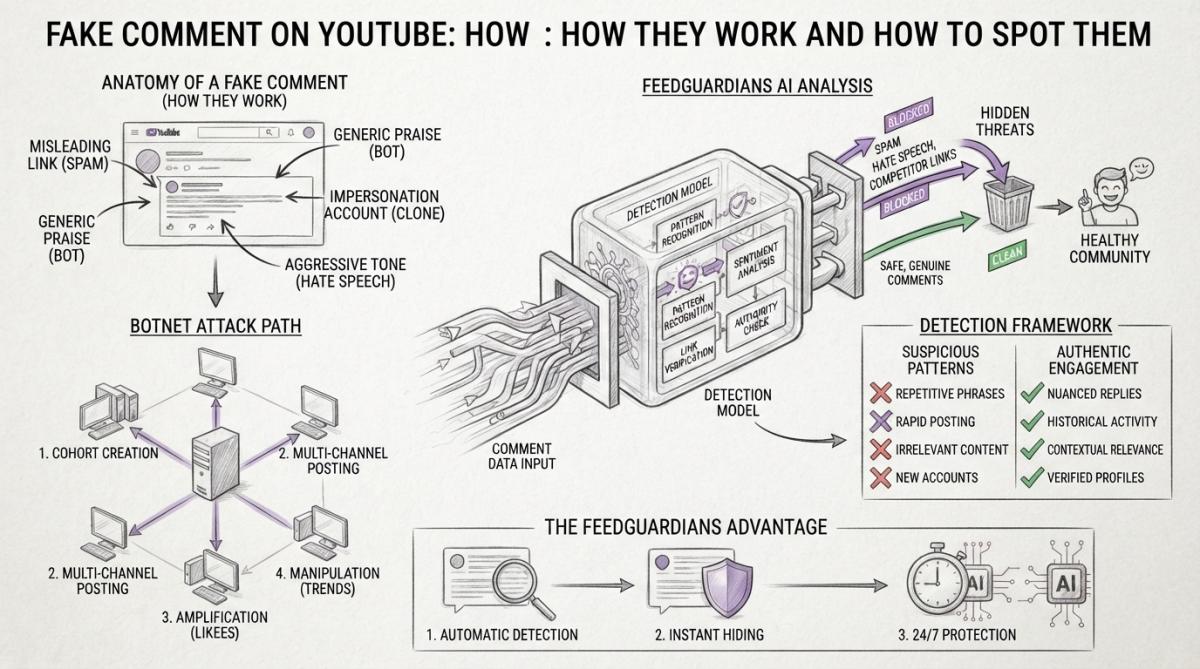
A fake comment on YouTube is a fabricated user response designed to mimic authentic engagement on videos. Fake comments typically fall into several categories: bot-generated responses using templated language, AI-generated text designed to appear human, manually created comments from fake accounts, or comments purchased from third-party services. Each type serves different purposes, from artificially boosting perceived popularity to conducting phishing scams or injecting competitor links.
According to YouTube's official community guidelines documentation, the platform explicitly prohibits artificial engagement manipulation, including purchased comments, coordinated inauthentic behavior, and spam. Understanding what constitutes a fake comment is the first step toward recognizing when your channel is being targeted.
How Fake Comments Differ From Authentic Engagement
Authentic YouTube comments reflect genuine viewer reactions: they reference specific moments in the video, ask clarifying questions, or engage in meaningful discussion. Real commenters invest time in crafting responses that demonstrate they actually watched the content.
Fake comments exhibit predictable patterns. They often use generic praise ("Great video!", "Love this content"), contain no specific references to video content, include suspicious links or promotional text, or appear in clusters from accounts with minimal history. Authentic engagement builds gradually, while fake engagement spikes unnaturally within hours of publishing.
How Fake Comment Generators Work
Fake comment generators are online tools that create mock YouTube comment screenshots or actual comments designed to look authentic. Image-based generators are most common: users input a username, profile picture, comment text, like count, and timestamp, then the tool renders a pixel-perfect replica of a YouTube comment.
UI Replication and Visual Mockups
The technical challenge in creating convincing fake YouTube comments lies in replicating YouTube's interface with precision. High-quality generators match YouTube's current font sizes, spacing, button styles, color schemes, and comment section layout. This requires understanding YouTube's design system and updating whenever YouTube changes its UI.
A quality generator captures subtle details: the exact shade of gray for usernames, spacing between avatar and text, like button size and color, timestamp format, and reply button positioning. Poor generators miss these details, making fake comments obviously artificial.
The challenge intensifies because YouTube regularly updates its interface. A generator built for 2024 design looks outdated by 2026. Maintaining visual accuracy requires continuous updates, which is why many free generators produce comments that look slightly off.
Customization Options and Real-Time Preview
Most fake comment generators offer customization features including username, profile picture, comment text, like count, reply count, timestamp, verified badge, and channel owner badge. Real-time preview functionality lets users see how their customized comment will look before downloading.
Some advanced generators allow batch creation, generating multiple comments at once with variations in usernames and text. This is useful for creating realistic comment sections for mockup purposes, though it also enables faster generation of large volumes of fake comments.
YouTube's Fake Engagement Policy and Community Guidelines
YouTube's Community Guidelines explicitly prohibit artificial engagement manipulation, including purchased comments, fake likes, and coordinated inauthentic behavior. The platform defines spam and deceptive practices as content or engagement intended to mislead viewers or artificially inflate channel metrics.
Violating these policies can result in comment removal, video demonetization, channel strikes, or complete channel termination. Additionally, YouTube's algorithm is designed to detect and suppress artificially inflated engagement, meaning fake comments don't actually boost visibility the way some services claim.
How to Spot YouTube Comment Bots and Inauthentic Activity
Detecting fake YouTube comments requires attention to several behavioral and contextual red flags. While individual suspicious comments might be innocent, patterns of suspicious activity across multiple comments indicate bot activity or purchased engagement.
Red Flags in Bot Behavior
Bot comments typically exhibit consistent patterns. The most obvious red flag is identical or near-identical comments appearing multiple times on the same video or across multiple videos. Bots often use templated responses like "Amazing content! Keep it up!"
Check the commenter's account history. Fake accounts typically have minimal activity: few or no uploads, no personalized channel art, generic profile pictures, and comment histories consisting entirely of generic praise on unrelated videos.
Timing patterns reveal bot activity. If a video receives 50 comments in the first hour, then nothing for 12 hours, then 40 comments in 20 minutes, that's suspicious. Authentic engagement builds gradually. Sudden spikes suggest purchased or bot-generated engagement.
Analyze comment content for specificity. Real comments reference specific moments or quote lines from the video. Generic comments like "Great video!" lack this specificity and suggest automated posting.
YouTube's Spam Filters and Detection Methods
YouTube employs machine learning systems that detect and suppress inauthentic engagement at scale. These systems analyze patterns across millions of comments daily, identifying characteristics of bot activity, purchased engagement, and coordinated campaigns.
The platform's spam filters examine multiple signals: account age and history, comment velocity, semantic similarity between comments, IP address patterns, and correlation with known bot networks. Comments flagged by these systems are often hidden from public view or removed entirely.
YouTube also monitors for comments containing malicious links, phishing attempts, or known spam domains. These comments are automatically hidden regardless of engagement metrics. The effectiveness of YouTube's filters means that purchasing fake comments typically provides no real benefit, as the comments get hidden anyway.
YouTube Comment Scams and Malicious Fake Comments
Beyond simple engagement inflation, fake comments are frequently used for malicious purposes: phishing, credential theft, malware distribution, and competitor sabotage.
Phishing and Credential Theft
Phishing comments typically impersonate YouTube staff, the channel creator, or trusted brands, claiming that the viewer's account requires urgent verification. The comment includes a link to a fake login page designed to capture credentials. These scams work because they exploit the authority of the YouTube platform itself.
Once attackers control a YouTube account, they can impersonate the account holder in comments on other videos, spreading the phishing link further and creating a self-amplifying attack vector.
Competitor Links and Spam Injection
Competitors sometimes inject fake comments containing links to their own content into rival channels' videos. These comments often use generic praise followed by a link: "This is great! Check out my similar content at [competitor-link]."
The damage is compounded when creators don't actively moderate their comments. A comment section filled with competitor links signals to viewers that the channel is neglected or untrustworthy and may impact YouTube's algorithm perception.
The Truth About Buying YouTube Comments
Services that sell YouTube comments promise to boost engagement metrics quickly and affordably. The reality is more complicated: these services violate YouTube's policies, provide minimal actual benefit, and expose your channel to serious risks.
Purchased comments come from bot networks, fake account networks, or services that incentivize real users to leave generic comments on channels they don't follow. Regardless of the source, the comments are inauthentic engagement intended to manipulate metrics.
Risks to Channel Legitimacy and Account Safety
YouTube's systems detect purchased engagement patterns and suppress or remove the comments. If the platform determines that your channel is engaged in coordinated inauthentic behavior, you face warnings, strikes, or channel termination.
If your audience discovers that your engagement metrics are artificially inflated, trust erodes. Creators caught buying comments face public criticism and loss of credibility. There's also a security risk: services requiring account access expose your account to compromise.
Ethical and Legal Implications of Fake Comments
Creating or distributing fake comments raises serious ethical and legal questions. The practice is deceptive by design, misrepresenting engagement metrics to viewers, advertisers, and platforms. This deception can violate consumer protection laws, platform terms of service, and advertising regulations.
Platform Violations and Account Penalties
YouTube's Community Guidelines are explicit: artificial engagement manipulation is prohibited. Violating these guidelines results in enforcement action. A creator who buys a small batch of comments might receive a warning; a coordinated campaign can result in permanent channel termination.
The FTC has guidance on deceptive practices and false endorsements. If fake comments are used to simulate genuine customer endorsements or to mislead consumers about product quality, they may violate FTC regulations regarding endorsement disclosure and deceptive advertising.
Consumer Protection and Deceptive Practices
Fake comments constitute deceptive practice when they're used to mislead consumers. If a product review video contains fake positive comments, those comments are false endorsements. Legal exposure extends to anyone involved in the scheme: the creator who buys comments, the service that provides them, and the accounts that post them.
Beyond legal risk, fake comments undermine the authenticity of online discourse and erode trust in user-generated content as a reliable signal of quality.
How to Protect Your Channel From Fake Comments
The best defense against fake comments is active moderation combined with awareness of common attack patterns. YouTube provides built-in tools for managing comments, and third-party solutions like FeedGuardians offer AI-powered moderation that scales to high-volume channels.
Moderation Best Practices
Enable YouTube's automatic filters to catch spam and potentially offensive comments. Review the filtered comments regularly to ensure legitimate comments aren't being hidden.
Manually review comments on high-profile videos. Look for red flags: generic text, suspicious accounts, and suspicious links. Respond to authentic comments and delete obvious spam. This signals to viewers that you're actively moderating.
Set comment settings to require approval for first-time commenters on your channel. Block accounts that post spam repeatedly.
AI-Powered Comment Management Solutions
For channels receiving hundreds or thousands of comments daily, manual moderation is impractical. AI-powered comment management tools like FeedGuardians automatically detect and hide spam, hate speech, competitor links, and inauthentic engagement with 98.7% accuracy.
FeedGuardians also delivers 24/7 AI-powered replies in your unique brand voice, transforming comments into conversations and conversions. The platform learns your tone, terminology, and guidelines, allowing it to respond authentically to genuine comments while filtering out spam automatically.
The advantage of AI moderation is scale and consistency. Tools like FeedGuardians apply the same detection standards across all comments and reduce the time investment required to maintain a healthy comment section, which is critical for creators managing multiple platforms or high-volume channels.
Fake comments are a persistent problem on YouTube, but they're not inevitable. Protecting your channel starts with understanding how fake comments work, recognizing red flags that indicate inauthentic engagement, and implementing moderation practices that maintain comment section quality. For creators managing high-volume engagement, AI-powered solutions like FeedGuardians provide automated detection and response capabilities that protect your channel reputation while turning genuine comments into meaningful conversations. Start for free and see how intelligent comment management transforms your YouTube presence.
Frequently Asked Questions
What exactly is a fake comment on YouTube, and how does it differ from authentic engagement?
A fake comment on YouTube is an inauthentic message posted by bots, automated scripts, or purchased services rather than real users. Unlike authentic engagement, where genuine viewers comment based on video content, fake comments are mass-generated, often irrelevant, and designed to artificially inflate comment counts or engagement metrics. Real comments reflect viewer opinions; fake ones serve manipulation goals.
How can I spot YouTube comment bots and identify inauthentic activity on my videos?
Watch for red flags: identical or near-identical comments across videos, generic praise with no specific video reference, comments from new accounts with no profile picture or upload history, suspicious timing patterns (many comments within seconds), broken grammar inconsistent with native speakers, and links to unrelated websites. YouTube's spam filters catch many, but reviewing comments manually helps identify remaining bot activity before it damages your channel credibility.
What are the risks of buying YouTube comments or using fake comment generators?
Buying YouTube comments violates YouTube's Community Guidelines and fake engagement policy, risking account suspension, video removal, or permanent channel termination. Beyond platform penalties, purchased comments damage credibility with real viewers, harm your algorithm performance (YouTube prioritizes authentic engagement), and expose your channel to scams. Malicious fake comments can inject competitor links, phishing attempts, or spam that damages your brand reputation and audience trust.
What should I do if I discover fake comments or bot activity on my channel?
Delete suspicious comments immediately using YouTube Studio's moderation tools. Enable comment filters to block links, spam keywords, and suspected bot patterns. Use automated AI-powered moderation solutions like FeedGuardians, which detects and hides spam and bot comments with 98.7% accuracy in real time. Report severe bot attacks to YouTube through the Help Center. Monitor comment sections regularly and consider enabling 'Approve all comments' temporarily if bot activity spikes significantly.
This article was written using GrandRanker
Tired of manually moderating comments?
FeedGuardians automates spam filtering, responds to customers, and protects your brand — setup in 3 minutes.
Frequently Asked Questions
What exactly is a fake comment on YouTube, and how does it differ from authentic engagement?
A fake comment on YouTube is an inauthentic message posted by bots, automated scripts, or purchased services rather than real users. Unlike authentic engagement—where genuine viewers comment based on video content—fake comments are mass-generated, often irrelevant, and designed to artificially inflate comment counts or engagement metrics. Real comments reflect viewer opinions; fake ones serve manipulation goals.
How can I spot YouTube comment bots and identify inauthentic activity on my videos?
Watch for red flags: identical or near-identical comments across videos, generic praise with no specific video reference, comments from new accounts with no profile picture or upload history, suspicious timing patterns (many comments within seconds), broken grammar inconsistent with native speakers, and links to unrelated websites. YouTube's spam filters catch many, but reviewing comments manually helps identify remaining bot activity before it damages your channel credibility.
What are the risks of buying YouTube comments or using fake comment generators?
Buying YouTube comments violates YouTube's Community Guidelines and fake engagement policy, risking account suspension, video removal, or permanent channel termination. Beyond platform penalties, purchased comments damage credibility with real viewers, harm your algorithm performance (YouTube prioritizes authentic engagement), and expose your channel to scams. Malicious fake comments can inject competitor links, phishing attempts, or spam that damages your brand reputation and audience trust.
What should I do if I discover fake comments or bot activity on my channel?
Delete suspicious comments immediately using YouTube Studio's moderation tools. Enable comment filters to block links, spam keywords, and suspected bot patterns. Use automated AI-powered moderation solutions like FeedGuardians, which detects and hides spam and bot comments with 98.7% accuracy in real time. Report severe bot attacks to YouTube through the Help Center. Monitor comment sections regularly and consider enabling 'Approve all comments' temporarily if bot activity spikes significantly.