
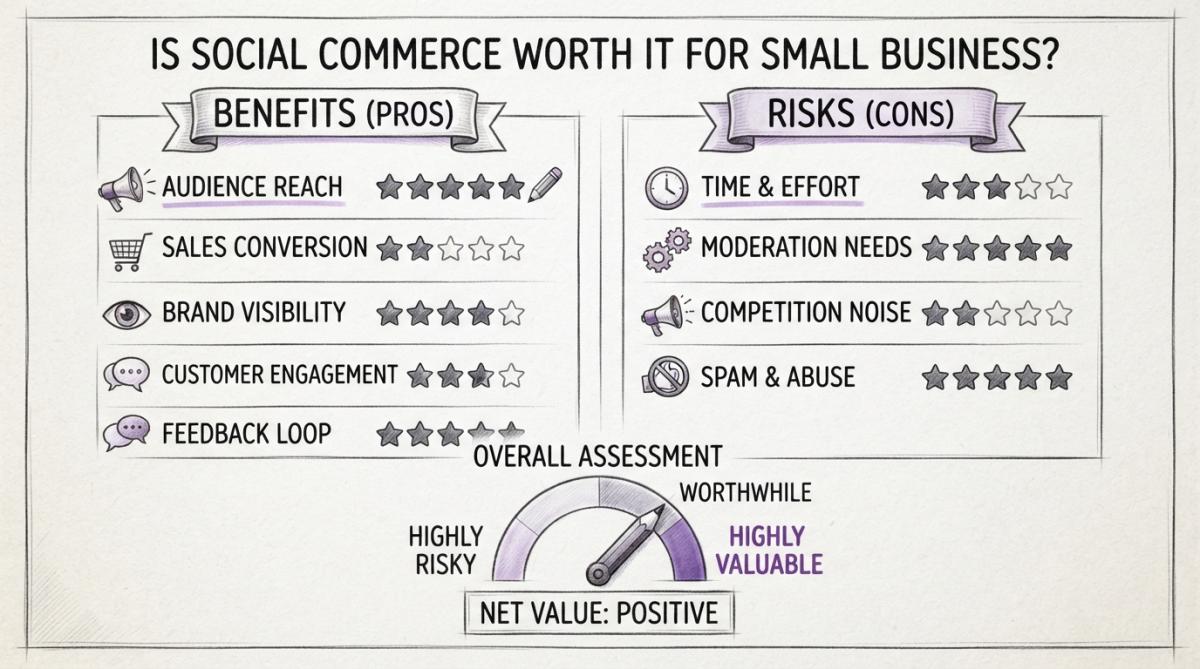
Quick Summary
| Key Insight | What You Need to Know |
|---|---|
| Is Social Commerce Worth | Is Social Commerce Worth It for Small Business? The Honest Verdict When It Makes Financial Sense When It Doesn't (Yet) |
| When It Makes Financial | When It Makes Financial Sense |
| When It Doesn't (Yet) | When It Doesn't (Yet) |
| Social Commerce Benefits for | Social Commerce Benefits for Small Business Lower Barrier to Entry vs. Traditional E-Commerce Shortening the Path-to-Purchase Leveraging Social Proof and User-Generated Content |
| Lower Barrier to Entry | Lower Barrier to Entry vs. Traditional E-Commerce |
| Shortening the Path-to-Purchase | Shortening the Path-to-Purchase |
Table of Contents
- Is Social Commerce Worth It for Small Business? The Honest Verdict
- Social Commerce Benefits for Small Business
- Social Commerce Challenges Small Business Must Address
- Social Commerce Platforms for Small Business: Which One Fits?
- Social Commerce Strategy for Small Business: Step-by-Step
- Integration Complexity and Hidden Costs
- Conclusion: Making the Right Call for Your Business
Last Updated: July 28, 2026
Is Social Commerce Worth It for Small Business? The Honest Verdict
The question of whether is social commerce worth it for small business has shifted from "should we?" to "can we afford not to?" Yet the answer remains genuinely uncertain for many entrepreneurs. The real issue isn't whether social commerce can work, it's whether the effort required to set it up, maintain inventory synchronization, manage real-time customer interactions, and protect your brand reputation is worth the incremental revenue it generates. For some businesses, particularly those selling impulse-buy items or using strong user-generated content, the answer is absolutely yes. For others, traditional e-commerce with targeted social media marketing delivers better ROI at lower operational friction.
This guide cuts through the hype and addresses the financial reality, platform-specific trade-offs, and hidden operational costs that most social commerce guides skip entirely.
When It Makes Financial Sense
Social commerce becomes financially viable when three conditions align: low barrier to entry on the platform, fast path-to-purchase that reduces friction, and the ability to use social proof without additional paid advertising.
The most compelling case exists for businesses with products under $50, high visual appeal, and an existing social media audience. Jewelry brands, apparel companies, beauty products, and handmade goods see the strongest conversion rates. Setup time for social storefronts is minimal, Instagram Shops and Facebook Shops require roughly 4-6 hours to configure your first catalog, assuming your inventory data is already organized.
The second advantage is shortening the path-to-purchase. Traditional e-commerce requires customers to leave social media, navigate to your website, browse products, and complete checkout. Social commerce removes those friction points. Shoppable posts let customers buy directly from an Instagram feed without leaving the app. This matters enormously for impulse purchases.
Customer acquisition cost (CAC) often drops when you're already investing in social media marketing. If you're running Instagram ads anyway, converting those ad clicks directly to purchases within the platform eliminates the cost of driving traffic to an external website.
When It Doesn't (Yet)
Social commerce makes less financial sense for businesses selling high-ticket items, products requiring detailed comparison, or goods with complex customization needs. If your average order value is over $500, customers typically want to research extensively before buying.
Cart abandonment becomes a significant problem when checkout integration is incomplete. Social commerce platforms don't yet match the abandoned cart recovery capabilities of dedicated e-commerce platforms. For businesses where cart abandonment recovery generates 10-15% of revenue, this gap is material.
Integration complexity also matters more than most guides acknowledge. If you're managing inventory across multiple channels, keeping stock levels synchronized becomes a real operational burden. One platform oversells while another shows out-of-stock. For small teams without dedicated operations staff, this overhead can outweigh the incremental sales.
Platform algorithm dependency is another real risk. Instagram and TikTok control your reach. Algorithm changes affect how many people see your shoppable posts. You can't build a sustainable business entirely dependent on platforms you don't control.
Social Commerce Benefits for Small Business
Lower Barrier to Entry vs. Traditional E-Commerce
Building a traditional e-commerce site requires domain registration, hosting, website builder costs, and payment processing setup. Total startup cost typically ranges from $500 to $5,000. Social storefronts require none of that. Instagram Shops and Facebook Shops are free. TikTok Shop has no platform fee for basic functionality.
This matters for small businesses testing new product categories or validating product-market fit before committing to a full e-commerce operation.
Shortening the Path-to-Purchase
Every step between customer interest and completed purchase is an opportunity for drop-off. Social commerce reduces it to 2-3 actions: see product, click, buy. This is particularly powerful for impulse purchases. Real-time engagement metrics show that shoppable posts generate 3-5x higher click-through rates than links to external websites. Conversion rates on shoppable posts are typically 1-3% compared to 0.5-1.5% on traditional e-commerce sites.
Using Social Proof and User-Generated Content
Social proof, reviews, ratings, customer testimonials, photos of real people using your product, converts better than brand-created content. When customers see a product alongside comments from other buyers and engagement metrics, they trust the product more.
User-generated content (UGC) is particularly valuable because it's free to acquire and more credible than brand messaging. A customer posting a photo of themselves wearing your product reaches their followers with authentic social proof.
Social Commerce Challenges Small Business Must Address
Cart Abandonment and Operational Complexity
Social commerce platforms don't have the same abandoned cart recovery infrastructure as dedicated e-commerce platforms. If a customer starts checkout and abandons it, you have limited tools to re-engage them.
Inventory management becomes complex when you're selling across multiple channels. If you have 50 units of a product and you sell 20 through Instagram Shop, 15 through your Shopify store, and 10 through TikTok Shop, you need to track all three channels simultaneously. Real-time synchronization requires either manual monitoring or API integration with your inventory management system.
Platform Algorithm Dependency and Reach Limitations
Instagram, TikTok, and Facebook control the algorithms that determine how many people see your content. Algorithm changes happen frequently and often reduce organic reach without warning.
This creates a fundamental problem: your sales channel is dependent on a platform you don't own or control. Successful social commerce requires paid advertising to guarantee reach. Organic reach alone is unreliable.
Legal, Data Privacy, and Liability Concerns
Selling through social platforms means customer data flows through those platforms' systems. Payment information, purchase history, and contact details are all processed by Instagram, Facebook, or TikTok.
Data privacy regulations like GDPR and CCPA have implications for social commerce. If you're selling to customers in Europe or California, you need clear privacy policies and customer consent for data collection. Reposting customer photos in ads requires explicit permission in many jurisdictions.
Social Commerce Platforms for Small Business: Which One Fits?
Instagram and Facebook Shops
Instagram Shops and Facebook Shops use Meta's unified commerce system. Setup takes 4-6 hours assuming your product catalog is organized. Instagram Shops work best for visual products: apparel, jewelry, beauty, home decor. Instagram's audience skews toward younger demographics (18-40) with higher disposable income. Conversion rates are typically 1-2% on shoppable posts.
Facebook Shops reach an older demographic (35+) with different purchase behavior. Conversion rates on Facebook shoppable posts tend to be lower, 0.5-1.5%, but the audience is larger.
Setup is free. Payment processing fees apply (typically 2.2% + $0.30 per transaction for US sellers). The main limitation is that Meta controls the checkout experience.
TikTok Shop and Impulse Buying
TikTok Shop is fundamentally different from Instagram and Facebook Shops. TikTok's algorithm prioritizes video content and entertainment. The platform is built around impulse discovery, users scroll endlessly and buy things they didn't know they wanted.
Conversion rates on TikTok Shop are reported as 2-5% by merchants, higher than Instagram or Facebook. Products that appeal to TikTok's demographic (primarily 13-30) convert well. The real advantage of TikTok Shop is the viral potential. A single TikTok video can reach millions of people organically.
Platform-Specific ROI for Micro-Businesses
For micro-businesses (under $100K annual revenue), focus on one platform first. Choose based on where your existing audience is and where your product fits best. Test for 30-60 days, measure actual conversion rates and CAC, then decide whether to expand.
For apparel, jewelry, or beauty brands with a visual product and an audience under 40, Instagram is the most efficient starting point. For home decor or older-targeted products, Facebook is more efficient. For trend-driven, entertainment-focused products with a younger audience, TikTok offers the highest upside if you can create engaging video content.
Social Commerce Strategy for Small Business: Step-by-Step
Build Your Omnichannel Retail Foundation
Before launching social commerce, you need a foundation: organized product data, clear pricing, consistent branding, and a system for managing inventory across channels.
Start by auditing your current sales channels. Create a master product spreadsheet or use inventory management software that can sync to multiple channels. Product data should include: product name, description, images, price, cost, inventory count, SKU, and any variants.
Branding consistency matters more on social platforms than traditional e-commerce. Your product photos should have consistent lighting, backgrounds, and style. Your product descriptions should use consistent terminology.
Optimize for Mobile Commerce and Real-Time Engagement
All social commerce happens on mobile. Your product images, descriptions, and checkout experience must be optimized for small screens.
Product images are critical. The first image is what appears in the feed, it needs to grab attention in 1-2 seconds. Subsequent images should show the product from multiple angles and in context.
Real-time engagement is where social commerce differs from traditional e-commerce. Customers comment on your posts, ask questions, and expect fast responses. If you can't respond to comments within a few hours, you're losing conversions. AI-powered replies in your brand voice can handle common questions automatically.
Measure What Matters: Conversion Rate and CAC
Most small businesses focus on vanity metrics, followers, likes, impressions, and ignore the metrics that actually predict profitability. Track conversion rate: percentage of clicks that result in purchases. Track CAC: how much you spend on ads to acquire one customer. Track customer lifetime value (CLV): total revenue you expect from a customer over time.
A 2% conversion rate on shoppable posts with a $20 CAC and a $50 product with 40% margin ($20 profit) is profitable. A 1% conversion rate with a $30 CAC on the same product is break-even.
| Metric | What It Means | Target for Profitability |
|---|---|---|
| Conversion Rate | % of clicks that become purchases | 1-3% depending on product |
| Customer Acquisition Cost | Ad spend ÷ new customers | < 30% of average order value |
| Customer Lifetime Value | Total expected revenue per customer | > 3x CAC |
| Profit Margin | Revenue minus COGS minus CAC | > 15% for sustainable growth |
Integration Complexity and Hidden Costs
Inventory Management Across Channels
If you're selling through multiple channels, you need real-time inventory synchronization. Manual updates are unreliable and create overselling risk.
The most practical solution for small businesses is inventory management software that syncs to all your sales channels automatically. Cost varies widely, basic software starts around $30-50/month, more sophisticated systems cost $100-300/month.
Protecting Your Brand Reputation in Real-Time
Social commerce happens in public. Every customer interaction is visible to other potential customers. A single bad experience, handled poorly in the comments, can damage your reputation.
Customer questions on shoppable posts need fast responses. Complaints need immediate acknowledgment. For small teams, this is a significant time commitment, monitoring comments across Instagram, Facebook, and TikTok takes 1-2 hours per day if done manually.
Comment moderation and AI-powered responses become valuable here. FeedGuardians automatically detects and hides spam, hate speech, and competitor links with 98.7% accuracy, while delivering 24/7 AI-powered replies in your unique brand voice. This means customer questions get answered immediately, even outside business hours. Your team gets notified about important issues that need human attention. Your brand reputation stays protected without requiring constant manual monitoring.
Conclusion: Making the Right Call for Your Business
The honest answer to whether is social commerce worth it for small business depends on three specific factors: your product type, your existing audience, and your operational capacity.
Social commerce works best for impulse-buy products with strong visual appeal, businesses with engaged social media audiences, and teams that can manage the operational complexity of multi-channel inventory and real-time customer engagement. If those conditions exist, the ROI is genuine.
Social commerce doesn't work well for high-ticket items, products requiring detailed research, or teams without capacity for real-time customer engagement. The operational overhead exceeds the incremental revenue benefit.
The practical recommendation: start small. Pick your strongest product category and your most engaged audience platform. Launch a basic social storefront, run a small ad budget, and measure actual conversion rates and CAC for 30-60 days. Use real data to decide whether to expand.
Managing customer interactions across multiple social platforms becomes significantly easier with the right tools. FeedGuardians helps small businesses protect their brand reputation by automatically detecting and hiding spam, hate speech, and competitor links while delivering 24/7 AI-powered replies in your unique brand voice. This means your team can focus on strategy and growth while customer questions get answered instantly, your comments stay clean, and your ad performance improves. Start for free and see how real-time moderation transforms your social commerce results.
Frequently Asked Questions
What is the actual ROI of social commerce for small businesses?
ROI varies significantly by platform, product type, and audience. Businesses leveraging shoppable posts and reducing cart abandonment through faster checkout integration see better returns. Platform algorithms determine reach, affecting customer acquisition cost (CAC). Direct-to-consumer (DTC) brands typically see faster ROI than those with complex inventory management. Track conversion rate and engagement metrics closely, if your CAC exceeds profit margin per sale, social commerce may not be worth it yet. Consider a 3-6 month test period before full commitment.
Which social commerce platforms are best for small business?
Instagram and Facebook Shops work well for visual products and established audiences. TikTok Shop suits impulse-buying items and younger demographics but requires consistent content creation. The best choice depends on where your audience spends time. Start with one platform rather than spreading resources thin across all four. Measure engagement metrics and conversion rate on each before expanding. Most small businesses find success starting with Instagram or Facebook if they already have followers there.
How much time does social commerce setup actually take?
Basic setup (product upload, payment integration, shoppable posts) typically takes 2-4 weeks for one platform. However, ongoing management, responding to comments, monitoring inventory, reducing cart abandonment, and analyzing real-time analytics, requires 5-10 hours weekly for a small catalog. If managing multiple platforms or clients, time investment multiplies significantly. Many small businesses underestimate operational efficiency needs. Consider whether your team can handle daily engagement and customer service before launching.
What legal and data privacy risks should small businesses know about?
Social commerce involves customer payment data, personal information, and platform terms of service compliance. Liability questions arise if transactions fail, data breaches occur, or disputes emerge. Platforms like Instagram and TikTok own customer relationships, not you. Ensure payment processors are PCI-DSS compliant. Review platform policies on refunds and chargebacks. Consider data privacy laws (CCPA, GDPR if applicable). Small businesses often lack legal resources to handle disputes, factor this risk into your decision-making before launching social storefronts.
Is social commerce worth it if we're already selling through our own website?
Yes, if your goal is expanding customer acquisition and shortening the path-to-purchase. Social commerce complements traditional e-commerce by capturing impulse buying and leveraging social proof through user-generated content. However, managing inventory across multiple channels adds operational complexity. If your conversion rate on your website is already strong and CAC is low, social commerce may offer diminishing returns. Evaluate whether the additional customer acquisition cost justifies the extra operational burden before building an omnichannel retail strategy.
This article was written using GrandRanker
Tired of manually moderating comments?
FeedGuardians automates spam filtering, responds to customers, and protects your brand — setup in 3 minutes.
Frequently Asked Questions
What is the actual ROI of social commerce for small businesses?
ROI varies significantly by platform, product type, and audience. Businesses leveraging shoppable posts and reducing cart abandonment through faster checkout integration see better returns. Platform algorithms determine reach, affecting customer acquisition cost (CAC). Direct-to-consumer (DTC) brands typically see faster ROI than those with complex inventory management. Track conversion rate and engagement metrics closely—if your CAC exceeds profit margin per sale, social commerce may not be worth it yet. Consider a 3-6 month test period before full commitment.
Which social commerce platforms are best for small business?
Instagram and Facebook Shops work well for visual products and established audiences. TikTok Shop suits impulse-buying items and younger demographics but requires consistent content creation. The best choice depends on where your audience spends time. Start with one platform rather than spreading resources thin across all four. Measure engagement metrics and conversion rate on each before expanding. Most small businesses find success starting with Instagram or Facebook if they already have followers there.
How much time does social commerce setup actually take?
Basic setup (product upload, payment integration, shoppable posts) typically takes 2-4 weeks for one platform. However, ongoing management—responding to comments, monitoring inventory, reducing cart abandonment, and analyzing real-time analytics—requires 5-10 hours weekly for a small catalog. If managing multiple platforms or clients, time investment multiplies significantly. Many small businesses underestimate operational efficiency needs. Consider whether your team can handle daily engagement and customer service before launching.
What legal and data privacy risks should small businesses know about?
Social commerce involves customer payment data, personal information, and platform terms of service compliance. Liability questions arise if transactions fail, data breaches occur, or disputes emerge. Platforms like Instagram and TikTok own customer relationships, not you. Ensure payment processors are PCI-DSS compliant. Review platform policies on refunds and chargebacks. Consider data privacy laws (CCPA, GDPR if applicable). Small businesses often lack legal resources to handle disputes—factor this risk into your decision-making before launching social storefronts.
Is social commerce worth it if we're already selling through our own website?
Yes, if your goal is expanding customer acquisition and shortening the path-to-purchase. Social commerce complements traditional e-commerce by capturing impulse buying and leveraging social proof through user-generated content. However, managing inventory across multiple channels adds operational complexity. If your conversion rate on your website is already strong and CAC is low, social commerce may offer diminishing returns. Evaluate whether the additional customer acquisition cost justifies the extra operational burden before building an omnichannel retail strategy.