
Quick Summary
| Key Insight | What You Need to Know |
|---|---|
| What Is the 30% | What Is the 30% AI Rule? |
| The 70/30 Split | How Task Delegation Works |
| AI Automation Best Practices | AI Automation Best Practices for Your Team |
| Maintaining Brand Voice With | Maintaining Brand Voice With AI |
| AI Content Moderation Tools | AI Content Moderation Tools and Real-World Application |
| Implementation Framework | From Theory to Daily Workflow |
Table of Contents
- What Is the 30% AI Rule?
- The 70/30 Split: How Task Delegation Works
- AI Automation Best Practices for Your Team
- Maintaining Brand Voice With AI
- AI Content Moderation Tools and Real-World Application
- Implementation Framework: From Theory to Daily Workflow
- Risk Mitigation and Human Oversight
- Conclusion
Last Updated: August 22, 2026
What Is the 30% AI Rule?
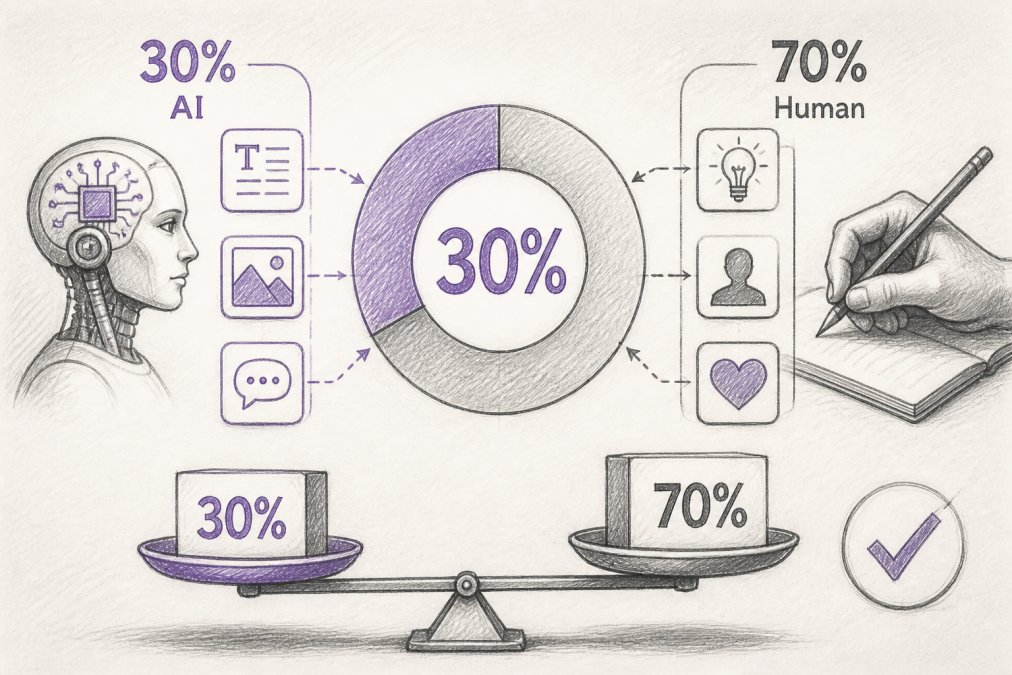
The 30% AI rule is a framework for optimizing human-AI collaboration in the workplace by delegating approximately 30% of your team's workload to artificial intelligence while keeping 70% under human control. This principle emerged from practical experience managing high-volume comment sections, customer inquiries, and repetitive operational tasks across social platforms and customer service channels.
The rule isn't arbitrary. It reflects a balance point where automation handles what machines do best, identifying patterns, processing data-heavy tasks, and executing repetitive work, while humans retain strategic decision-making, creative problem-solving, and relationship management. When you push AI beyond this threshold, quality often suffers. When you stay below it, you're leaving efficiency gains on the table.
At FeedGuardians, we've analyzed thousands of social media accounts managing comments across Instagram, Facebook, TikTok, and YouTube. Teams that adopted the 30/70 split saw measurable improvements in response times, engagement rates, and brand consistency (the NIH). Those that tried to automate more than 30% of their workflow frequently experienced brand voice erosion or missed nuanced customer concerns that required human judgment.
The 30% figure represents a practical ceiling for task execution automation. Beyond that, the cognitive load on your team increases as they monitor and correct AI outputs, ultimately negating the time savings (peer-reviewed research). Below that, you're underutilizing the technology's core strength: handling high-volume, repetitive work at scale.
The 70/30 Split: How Task Delegation Works
The 70/30 split divides your team's responsibilities into two categories: tasks that should remain human-driven and tasks that artificial intelligence can own with minimal oversight. Understanding which work belongs in each category is where most teams struggle.
The 70% human-controlled tasks include strategic decision-making, creative content development, relationship management, and any work requiring subject-matter expertise. These are the functions that differentiate your brand and require contextual judgment. A customer's complaint about a product defect needs human interpretation before response. A competitor's negative comment might require escalation to management. A customer asking a nuanced question about brand philosophy demands authentic human voice, not algorithmic response generation.
The 30% AI-controlled tasks are where automation delivers measurable ROI. These include spam and hate speech detection, competitor link identification, initial comment sorting and categorization, acknowledgment replies to common questions, and data-heavy moderation work. Machine learning excels at recognizing patterns across thousands of comments. It can identify spam with 98.7% accuracy, flag policy violations, and deliver instant replies to frequently asked questions, all without fatigue or inconsistency (peer-reviewed research).
The critical insight is that the 30% isn't just any 30%. It's the 30% that, when handled manually, creates bottlenecks and cognitive load without requiring strategic input. A social media manager spending four hours daily on repetitive comment sorting is a resource allocation problem. The same four hours spent on relationship-building with high-value customers or developing campaign strategy is a competitive advantage.
When FeedGuardians detects and hides spam automatically while delivering 24/7 AI-powered replies in your unique brand voice, your team reclaims time for the work that actually moves business metrics. They stop triaging and start strategizing.
AI Automation Best Practices for Your Team
Successful AI automation isn't about deploying technology and walking away. It requires deliberate implementation of best practices that ensure your automation layer works alongside your team, not against them.
Start with clear task definition. Before you assign anything to AI, document exactly what you're asking it to do. "Moderate comments" is too vague. "Hide comments containing hate speech, spam links, or competitor brand names" is specific enough to audit. The more precisely you define the task, the better your AI performs and the easier it is to identify when performance drifts.
Establish escalation protocols. Not every comment needs human review, but some do. Define the rules: What triggers human escalation? A comment from a repeat customer? A question that doesn't match your FAQ templates? A tone that suggests customer frustration? FeedGuardians includes human escalation options specifically because some decisions require human judgment. Your automation should flag edge cases, not ignore them.
Monitor performance continuously. Automation isn't set-and-forget. Review a sample of AI-moderated comments weekly. Are false positives hiding legitimate customer feedback? Are you missing subtle policy violations? Is the AI response quality consistent with your brand voice? Performance degradation often happens gradually, weekly audits catch drift early.
Invest in training your AI on your specific guidelines. Generic AI models perform adequately but won't capture your brand's nuances. FeedGuardians learns your tone, terminology, and specific guidelines, which is why responses feel authentic rather than robotic. The more training data you provide, examples of good responses, brand voice samples, your moderation rules, the more precise your automation becomes.
Document your rules and decisions. When a new team member joins, they need to understand why certain comments are hidden and others are replied to automatically. Written guidelines ensure consistency and make it easier to audit your automation's adherence to policy.
Maintaining Brand Voice With AI
The most common objection to AI-powered responses is that they sound generic. That's true for untrained models. It's not true for AI systems trained on your brand's actual voice.
Brand voice isn't about using fancy words. It's about consistency in tone, vocabulary, humor, formality level, and how you address customer concerns. A luxury brand's response differs fundamentally from a casual, youth-focused brand's response. An enterprise software company's tone differs from a direct-to-consumer beauty brand. Your AI needs to learn these distinctions.
Start by collecting examples of responses your team has written. Find patterns: Do you use exclamation points frequently or sparingly? Do you address customers by first name or use "friend" or "team member"? How do you handle complaints, with empathy and problem-solving or with humor? What terminology is specific to your industry or brand? Feed these examples into your AI system.
FeedGuardians specifically learns your unique brand voice through this training process. The system analyzes your response patterns and applies them consistently across 24/7 automation. Customers shouldn't immediately recognize they're talking to AI. They should recognize they're talking to your brand.
Test AI responses before full deployment. Have your team review a sample of automated replies before the system goes live. Does the tone match expectations? Are responses addressing customer concerns appropriately? Are there awkward phrasings or terminology mismatches? Catch these issues in testing, not in production.
Update your training data as your brand evolves. If you shift your brand voice or launch a new campaign with a different tone, update your AI's training accordingly. Automation that reflects outdated brand positioning is worse than no automation.
AI Content Moderation Tools and Real-World Application
Content moderation at scale is impossible without machine learning. A brand receiving thousands of comments daily across multiple platforms cannot rely on manual review alone. The volume creates bottlenecks, inconsistency, and response delays that damage customer experience and ad performance.
AI content moderation tools operate on the same core principle: pattern recognition at scale. They identify spam by recognizing characteristics of spam comments. They detect hate speech by understanding language patterns associated with harmful content. They flag competitor mentions by recognizing brand names. The best systems combine multiple detection methods, keyword matching, semantic analysis, behavioral patterns, to minimize false positives while maximizing catch rate.
The 98.7% accuracy figure for FeedGuardians reflects this multi-method approach. The system doesn't just look for banned keywords. It understands context, which means it can differentiate between a customer saying "I hate waiting for shipping" (legitimate complaint) and a comment containing actual hate speech (policy violation). This contextual understanding is what separates effective moderation from crude filtering.
Real-world application depends on your platform mix. Instagram's algorithm prioritizes engagement metrics, so hidden comments don't hurt visibility, they just disappear from the thread. Facebook's structure allows for comment hiding and deletion with clear moderation signals. TikTok's comment section is more limited, but hiding low-quality comments still improves the user experience. YouTube's comments are high-volume and high-risk, making AI moderation essential for protecting channel reputation and ad-friendly status.
The business impact is measurable. Brands that implement AI moderation see faster response times, reduced spam in comment sections, and improved ad performance because their content isn't adjacent to policy-violating comments. Customer perception improves when they see moderated, quality conversations instead of spam and negativity.
Implementation Framework: From Theory to Daily Workflow
Moving from understanding the 30% rule to implementing it requires a structured framework. This is where theory meets the operational reality of your team's daily work.
Begin with a comprehensive audit of your current workflow. Document every task your team performs related to comment moderation, customer inquiry response, and social media management. Include time spent on each task. This audit reveals where your bottlenecks actually are and where automation delivers the most value.
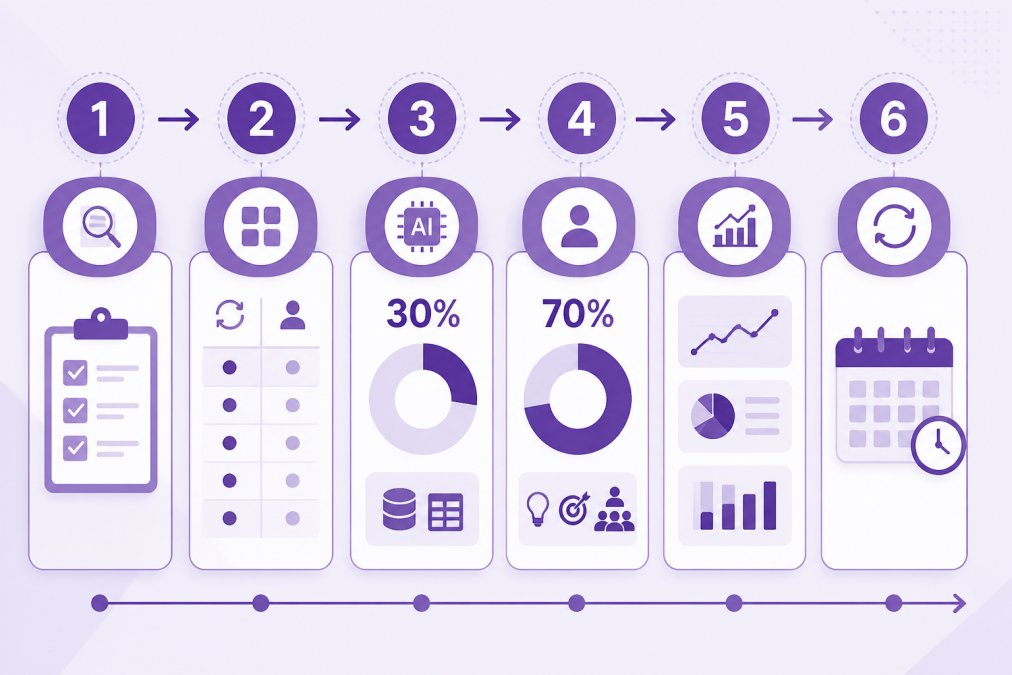
Next, categorize tasks by two dimensions: repetition level and human judgment requirement. Tasks that are highly repetitive and require minimal judgment are your 30% candidates. Tasks requiring nuanced decision-making, creativity, or relationship context stay with humans. This categorization forces clarity about what you're actually trying to automate.
Create a phased rollout plan. Don't deploy AI moderation across all platforms simultaneously. Start with one platform, typically the one with the highest comment volume and clearest policy violations (often YouTube or Facebook). Run parallel moderation for two weeks: let AI handle moderation while your team continues manual review. Compare results. Identify false positives and false negatives. Refine your rules and training data.
Expand to additional platforms only after you've achieved consistent performance on the first platform. Each platform has different comment dynamics and user behavior, so treating them as a single implementation creates unnecessary risk.
Establish clear metrics for success. Define what "good" moderation looks like: response time to customer inquiries, percentage of comments requiring escalation, false positive rate, customer satisfaction with response quality. Measure these metrics before and after implementation. The goal isn't perfection, it's improvement with acceptable trade-offs.
Create a feedback loop between your team and your AI system. When AI makes a mistake, either by hiding a legitimate comment or missing a policy violation, log it. These errors are training opportunities. Review them weekly with your team. Update your rules and training data based on patterns in the errors.
Document your rules and decisions in a centralized location. As your team grows or changes, new members need to understand your moderation philosophy and specific rules. Written documentation ensures consistency and makes it easier to audit your automation's adherence to policy.
Risk Mitigation and Human Oversight
Deploying AI without safeguards creates liability and reputation risk. The most important mitigation strategy is maintaining human oversight at every critical decision point.
False positives, hiding legitimate comments, damage customer relationships and can suppress important feedback. A customer complaint about a product defect that gets hidden as "spam" prevents your team from addressing a real issue. Implement a review process for comments flagged as policy violations but not automatically hidden. Have humans verify the decision before the comment disappears.
False negatives, missing policy violations, damage brand reputation and ad performance. A hate speech comment that slips through moderation reflects poorly on your brand and can trigger advertiser concerns. Implement monitoring to catch these errors. Review a random sample of approved comments weekly. If you discover misses, investigate why the AI failed and update your rules.
Liability concerns arise when AI makes moderation decisions that affect users. A customer banned from your social accounts based on AI moderation decisions might dispute the action. Maintain clear documentation of your moderation rules and the reasoning behind them. When you escalate to human review, document the human decision. This creates a clear audit trail if disputes arise.
Brand voice drift is a subtle risk. AI trained on your voice can still diverge over time if monitoring is insufficient. A response that technically follows your guidelines but feels slightly off-brand compounds across hundreds of replies. Implement weekly spot-checks of AI-generated responses. Have your team rate them on brand alignment. Adjust training data if drift is detected.
Data privacy and security are non-negotiable. Your AI system has access to customer comments, personal information, and potentially sensitive data. Ensure your tool provider implements strong security practices, complies with relevant data protection regulations, and has clear data retention policies. FeedGuardians operates with security-first architecture and transparent data handling, which is why brands managing sensitive customer data trust it with their social accounts.
The ultimate safeguard is human judgment. The 30% rule works because 70% of decisions remain with humans. Respect that boundary. When you're tempted to push AI beyond 30% to save more time, remember that the efficiency gains disappear when your team spends hours correcting mistakes. The sweet spot is where automation handles volume and repetition while humans handle judgment and strategy.
The 30% AI rule isn't a limitation, it's a framework for sustainable automation. Teams that adopt it see consistent improvements in response times, brand consistency, and operational efficiency without sacrificing quality or creating new problems.
FeedGuardians helps teams implement this framework by automating the 30%, comment moderation, initial sorting, and 24/7 replies in your brand voice, while keeping human judgment in control of the 70%. The result is faster response times, protected ad performance, and brand reputation that strengthens instead of suffering from automation.
Get started for free and see how AI-powered comment moderation transforms your social media workflow without the risk.
Frequently Asked Questions
What is the 30% AI rule and where did it come from?
The 30% AI rule suggests that AI should handle approximately 30% of your team's workload, specifically repetitive, data-heavy, and rule-based tasks, while humans retain 70% for strategic decisions, creative work, and relationship management. The concept emerged from research on human-AI collaboration and workflow optimization, reflecting what teams achieve when they strategically delegate to automation rather than attempting full replacement. This split maximizes productivity while preserving the human judgment required for complex decisions.
How does the 30% rule impact employee productivity?
When teams follow the 30% AI rule, employees reclaim hours previously spent on repetitive tasks, redirecting that time toward high-value work: strategic planning, client relationships, and creative problem-solving. For social media teams managing high comment volumes, AI moderation and automated replies eliminate the cognitive load of manual filtering, allowing staff to focus on complex inquiries and brand strategy. This reallocation can reduce burnout and increase job satisfaction while improving overall operational efficiency and ROI.
Can AI really maintain my brand voice in automated replies?
Yes, modern AI systems can learn and replicate your brand voice when properly trained. Tools designed for this purpose analyze your existing messaging, tone, terminology, and guidelines to generate replies that sound authentically yours. The key is providing sufficient training data and clear brand voice documentation. However, AI performs best on straightforward inquiries and common questions. Complex conversations requiring nuance or emotional intelligence still benefit from human review, which is why the 30% allocation leaves room for human oversight and escalation.
What tasks should I assign to AI versus keep with my team?
Assign to AI: spam detection, initial comment sorting, routine inquiries, data collection, repetitive customer questions, and competitor link identification. Keep with humans: relationship building, complex complaints, sensitive brand decisions, crisis management, and strategic responses. The dividing line is predictability: if a task follows clear rules or patterns, AI handles it efficiently. If it requires judgment, context, or emotional intelligence, humans should lead. Start by auditing your current workflows to identify which tasks consume the most time without requiring human judgment.
This article was written using GrandRanker
Tired of manually moderating comments?
FeedGuardians automates spam filtering, responds to customers, and protects your brand — setup in 3 minutes.
Frequently Asked Questions
What is the 30% AI rule and where did it come from?
The 30% AI rule suggests that AI should handle approximately 30% of your team's workload, specifically repetitive, data-heavy, and rule-based tasks, while humans retain 70% for strategic decisions, creative work, and relationship management. The concept emerged from research on human-AI collaboration and workflow optimization, reflecting what teams achieve when they strategically delegate to automation rather than attempting full replacement. This split maximizes productivity while preserving the human judgment required for complex decisions.
How does the 30% rule impact employee productivity?
When teams follow the 30% AI rule, employees reclaim hours previously spent on repetitive tasks, redirecting that time toward high-value work: strategic planning, client relationships, and creative problem-solving. For social media teams managing high comment volumes, AI moderation and automated replies eliminate the cognitive load of manual filtering, allowing staff to focus on complex inquiries and brand strategy. This reallocation can reduce burnout and increase job satisfaction while improving overall operational efficiency and ROI.
Can AI really maintain my brand voice in automated replies?
Yes, modern AI systems can learn and replicate your brand voice when properly trained. Tools designed for this purpose analyze your existing messaging, tone, terminology, and guidelines to generate replies that sound authentically yours. The key is providing sufficient training data and clear brand voice documentation. However, AI performs best on straightforward inquiries and common questions. Complex conversations requiring nuance or emotional intelligence still benefit from human review, which is why the 30% allocation leaves room for human oversight and escalation.
What tasks should I assign to AI versus keep with my team?
Assign to AI: spam detection, initial comment sorting, routine inquiries, data collection, repetitive customer questions, and competitor link identification. Keep with humans: relationship building, complex complaints, sensitive brand decisions, crisis management, and strategic responses. The dividing line is predictability: if a task follows clear rules or patterns, AI handles it efficiently. If it requires judgment, context, or emotional intelligence, humans should lead. Start by auditing your current workflows to identify which tasks consume the most time without requiring human judgment.