
Quick Summary
| Key Insight | What You Need to Know |
|---|---|
| It filters out the junk | AI instantly spots and hides spam, trolls, and nasty comments before they can poison your community. |
| It flags the money-makers | The system catches buying signals like "How much?" or "Do you ship to Canada?" and sends them straight to your team for a quick response. |
| It keeps your community safe | By curating a positive space, you encourage real customers to engage more deeply with your brand. |
So, what exactly is AI-powered social media management? Think of it as giving your social media team a brilliant assistant who handles all the grunt work. This allows your team to skip the tedious, repetitive tasks and focus on what they do best: strategy, creative thinking, and building real connections with your audience.
Why AI Powered Social Media Management Is No Longer Optional
Ever tried to listen to every single conversation in a packed stadium? That’s what managing social media for a growing e-commerce brand feels like. You're hit with a constant flood of comments, DMs, and mentions across a dozen different channels. It's overwhelming.
While it feels chaotic, that firehose of information is pure gold. Hidden inside are urgent customer service requests, hot sales leads, and toxic spam that could tank your brand's reputation. Trying to catch everything by hand isn't just inefficient—it's physically impossible to keep up.
Turning Chaos into a Growth Engine
This is exactly where AI-powered social media management steps in. We're not talking about replacing your team with robots. It’s about equipping them with a smart system that works 24/7 to sort through the noise and find the signal.
It's quickly becoming the new standard. In fact, 43% of marketers already consider AI a critical part of their social media strategy. This isn't a future trend; it's happening right now.
AI automates the most draining parts of the job, freeing up your team to handle the high-impact conversations that actually drive sales and build community. It turns your unpredictable social feed into a reliable engine for growth.
- It filters out the junk: AI instantly spots and hides spam, trolls, and nasty comments before they can poison your community.
- It flags the money-makers: The system catches buying signals like "How much?" or "Do you ship to Canada?" and sends them straight to your team for a quick response.
- It keeps your community safe: By curating a positive space, you encourage real customers to engage more deeply with your brand.
To see the difference, let’s compare the old way of doing things with the new, AI-driven approach.
Manual vs AI Powered Social Media Management
| Task | The Manual Approach | The AI Powered Approach |
|---|---|---|
| Comment Moderation | A community manager reads every comment, one by one. This is slow, prone to errors, and mentally draining. | AI automatically filters spam and toxic comments in real-time. Only important comments are flagged for human review. |
| Lead Identification | Your team has to scroll through hundreds of comments hoping to spot a potential customer. Many get missed. | AI instantly detects purchase intent and routes leads directly to the sales team, ensuring no opportunity is lost. |
| Customer Support | Support requests get buried under other notifications, leading to slow response times and unhappy customers. | Urgent issues are identified and escalated immediately, dramatically improving response times and customer satisfaction. |
The difference is clear. The manual way is reactive and limited by human capacity. The AI-powered approach is proactive, scalable, and frees your team to focus on what matters most.
The goal of AI isn't to remove the human element from social media. It's to handle the repetitive, low-value work so your team can dedicate their expertise to building relationships, creating great content, and converting leads.
This guide will walk you through how to put this technology to work, transforming your social channels from a chaotic mess into a powerful source of revenue and customer loyalty. Of course, effective management begins with knowing where you stand, and you can explore some of the best tools for social media analytics to get a clear view of your performance.
What AI Actually Does: A Look Under the Hood
So, how does an AI social media tool really work its magic? It’s not just a bunch of fancy algorithms. Think of it as a highly trained, always-on crew for your brand's social pages—a mix of a tough security guard, a sharp-witted analyst, and a super-efficient concierge, all rolled into one. They work together to turn the chaos of social media comments into a stream of valuable, actionable insights.
It all begins with the first line of defense, a digital bouncer that protects your brand’s reputation from the moment a comment goes live.
Spam and Harmful Comment Filtering
This is the most straightforward job for AI in social media, but it's a game-changer. It acts like a vigilant security guard, instantly spotting and removing junk comments before your real customers ever see them. We're talking about everything from obvious spam and bot posts to more subtle trolling and toxic language.
Imagine you're running a great ad for your e-commerce store. Without AI, your team would be stuck manually deleting hundreds of "crypto scam" or "free sunglasses" comments. The AI does it all for you, automatically. This keeps the conversation clean, lets legitimate customer comments shine, and stops you from wasting ad spend on attracting trolls.
Sentiment and Intent Detection
Beyond just kicking out the troublemakers, AI is also an expert at reading the room. Using Natural Language Processing (NLP), it analyzes the emotions and motivations behind what people write. Is a customer thrilled, frustrated, just curious, or ready to buy right now?
This is like having a team of mind readers on staff. The AI can tell the difference between a sarcastic "Great, my package is late again" and a genuinely happy "Great! My package just arrived!" This lets you jump on urgent customer service fires immediately while also engaging with your happy, loyal fans. Getting these nuances right is crucial, which is why digging into the top social media sentiment analysis tools can give you a real edge.
AI doesn't just read words; it deciphers the feeling and purpose behind them. It can spot the difference between someone just browsing and someone about to pull out their credit card.
This directly uncovers opportunities you'd otherwise miss in the noise. When the AI spots comments with clear purchase intent—like "Do you have this in blue?" or "How much is shipping?"—it can flag them as hot leads for your sales or support team to follow up on instantly.
Auto-Replies and Instant Engagement
Once the AI figures out what a comment means, it can step in as your 24/7 concierge. For all those common, repetitive questions, you can set up smart auto-replies. This isn’t about sending cold, robotic responses. It's about giving people helpful answers the second they ask, even if your team is asleep.
For instance, someone scrolling at 2 AM asks, "Do you ship to Australia?" The AI can immediately reply, "Yes, we do! You can find our international shipping rates here..." Not only does this make the customer happy, but it might just lock in a sale that would have been lost by morning.
Custom Automation Rules
Finally, automation rules are your playbook. This is where you get to tell the AI exactly how to act based on your specific business needs. You can create simple "if-this-then-that" triggers to manage your comment sections with incredible precision.
Here are a few ways an online store might use them:
- Hide Competitor Mentions: If a comment mentions a competitor, automatically hide it and flag it for your team to review.
- Prioritize Sales Leads: If a comment includes words like "price," "cost," or "discount," send it straight to the sales team's inbox.
- Handle Negative Feedback: If a comment has a strong negative sentiment, automatically alert your customer support manager for a personal follow-up.
These capabilities go beyond just text, too. Modern AI can help with creative tasks, and learning how to create videos with AI from scratch shows just how deep this technology goes, covering everything from scripts to visuals. It's becoming a standard part of the toolkit—in fact, 78% of social media marketers already use AI to brainstorm and generate post ideas. It’s clear this is no longer a futuristic concept but a present-day necessity.
Connecting AI Management to Business Growth
Features are great, but results are what really move the needle. For anyone in e-commerce or performance marketing, the big question is always, "What's the ROI?" So, let's get past the tech jargon and connect AI-powered social media management directly to real business outcomes and the KPIs that prove it's working.
This is about more than just tidying up your comments. It's about turning your social media channels into a reliable engine for revenue. Think about it: when an AI tool instantly flags a comment like, "Do you have this in a size medium?" that's not just moderation—that's a hot lead. Getting that question to your sales team immediately can turn a simple inquiry into a sale, directly boosting your bottom line.
From Clean Comments to Higher ROAS
A positive and clean comment section has a direct, measurable effect on your ad performance. When your paid campaigns are free from spam, scams, and trolls, the genuine engagement from actual customers shines through.
This social proof builds instant trust with new audiences. They see real people asking questions and loving your products, which makes them far more likely to click and convert. The result? A better Return on Ad Spend (ROAS).
This is how the core AI capabilities build on each other to deliver those business results.
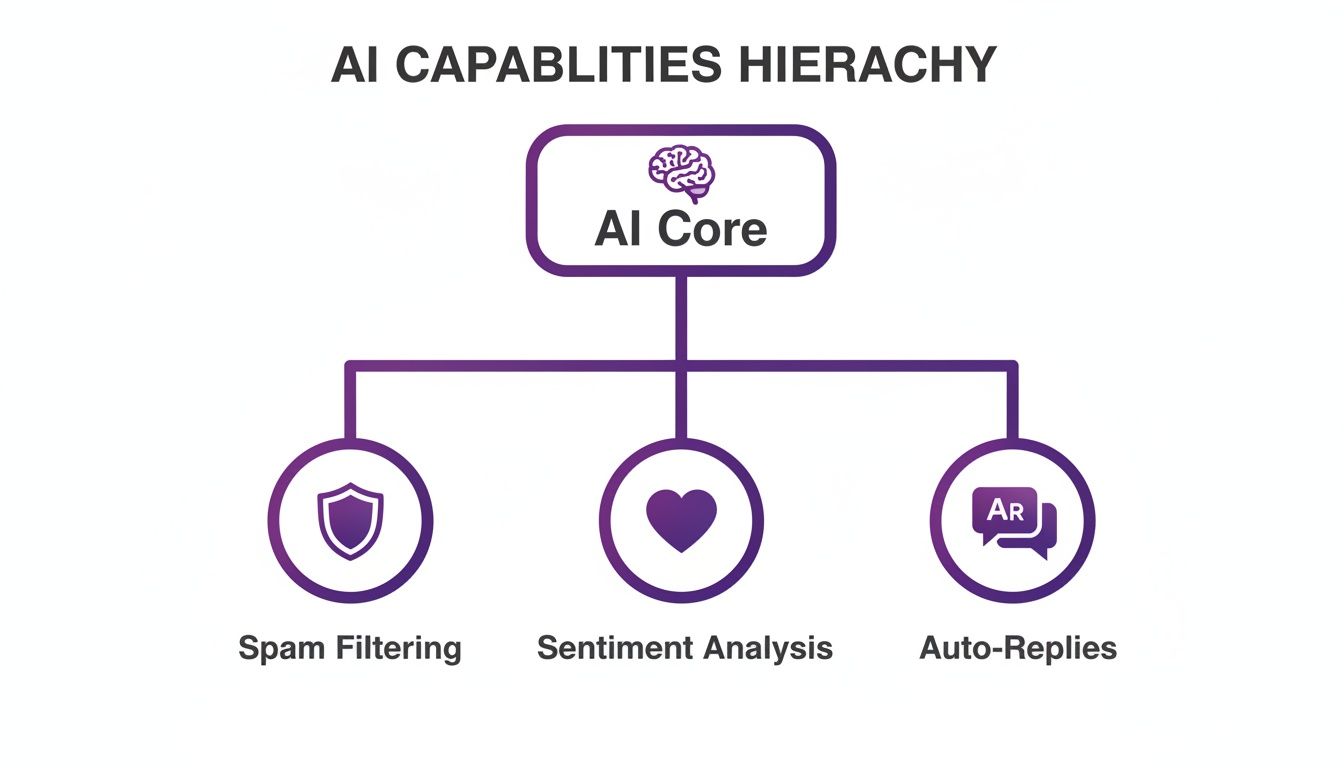
Each piece, from filtering out junk to understanding customer sentiment, works together. They create a healthier, more profitable environment for your brand to grow.
Mapping AI Actions to Measurable KPIs
To really grasp the impact of AI, you have to measure it. Vague goals like "improving engagement" just won't cut it. Instead, you can tie specific AI functions to hard numbers that matter to your business.
This table breaks down exactly how to track the ROI, connecting each AI capability to a business benefit and a specific KPI you can monitor.
Tracking Your ROI with AI Social Media Management
| AI Capability | Business Benefit | Key Performance Indicator (KPI) |
|---|---|---|
| Spam & Harmful Comment Filtering | Increased Ad Performance & Brand Safety | Return on Ad Spend (ROAS), Cost Per Acquisition (CPA) |
| Sentiment & Intent Analysis | Proactive Customer Service & Lead Gen | Customer Satisfaction (CSAT), Lead Conversion Rate |
| Automated Rules & Auto-Replies | Improved Team Efficiency & Response Time | First Response Time (FRT), Ticket Resolution Time |
| Purchase Intent Detection | Direct Revenue from Social Comments | Sales from Social, Average Order Value (AOV) |
This data-driven framework shifts the conversation from "Is this tool working?" to "How much revenue is this tool generating?" It gives you the concrete numbers to justify your strategy and investment. Turning this raw social data into strategy is where tools for conversation intelligence become invaluable.
Balancing Automation with Authenticity
Here's the thing: people have mixed feelings about AI. While nearly 60% of marketers are using AI every week, 52% of social media users get nervous about AI-generated content that isn't clearly labeled.
But that all changes when AI is used for customer support. A whopping 65% of consumers are totally fine with brands using AI if it means getting faster help on social media. The lesson is clear: customers love AI when it improves their experience, not when it fakes a human connection.
The sweet spot for AI in social media is using automation to create more opportunities for meaningful human interaction. It handles the noise so your team can focus on building relationships.
This mindset is at the heart of effective social listening—a practice that goes way beyond just tracking mentions. It’s about understanding the why behind the conversation so you can respond in a more helpful way. You can dive deeper into how this works on our guide here: https://feedguardians.com/blog/what-is-social-listening
Ultimately, the goal isn't to replace your team with bots. It's about giving them superpowers to do what they do best: connect with your customers.
Integrating AI into Your Social Media Workflow

So, you're ready to move from theory to practice? Great. Bringing AI powered social media management into your daily routine isn't like flipping a switch. It’s a thoughtful process of weaving smart tools into the way you already work to make things better, faster, and more efficient.
Think of it like hiring a new, incredibly fast assistant. You wouldn't just hand over the keys on day one with no instructions. You’d outline their role, set clear goals, and walk them through the process. The same exact logic applies here.
Your Step-by-Step Implementation Checklist
A successful rollout starts with a clear plan. Following a few simple steps ensures your new AI tool actually solves real problems and delivers results you can measure. This approach helps you avoid the common trap of buying a powerful tool only to let its best features gather dust.
Here's a practical, six-step roadmap to get you started.
Audit Your Current Workflow: Before you can automate anything, you have to know where your team's time is really going. Identify the biggest pain points. Are you manually deleting hundreds of spam comments every day? Or spending hours digging through notifications to find genuine customer questions? Pinpoint those time-sinks first.
Define Your Primary Goals: What, specifically, do you want this AI to accomplish? A good goal isn’t just "boost engagement." It’s something concrete, like "cut our average first-response time to customer questions by 80%" or "automatically find and flag 95% of all comments showing purchase intent."
Connect and Configure Basic Filters: Start with the low-hanging fruit. Connect your social accounts and turn on the tool’s pre-built filters for obvious spam, hate speech, and profanity. This is an instant win that cleans up your comment sections from day one.
Building Custom Rules for Your Brand
With the basics out of the way, you can start teaching the AI to think like your brand. This is where you move beyond generic filters and create custom automation rules that handle your specific audience and business needs.
For instance, an e-commerce brand could set up rules that automatically:
- Hide comments that mention specific competitors. No more letting your ad spend give free promotion to others.
- Flag comments with keywords like "broken" or "doesn't work" and instantly notify your support team.
- Spot questions about shipping or returns and reply with a helpful, pre-approved answer that links to your FAQ page.
The best AI integration feels like a natural extension of your brand’s voice, not a robot takeover. The goal is to automate the process, not the personality.
Fine-Tuning and Launching Your AI
The final steps are all about refinement. An AI tool is only as smart as you make it. You need to teach it your brand’s lingo, the slang your audience uses, and the nuances of how customers ask questions. This fine-tuning is what makes its actions and responses feel authentic and on-brand.
Before you go all-in, run a pilot test on a single social media account or ad campaign. This gives you a safe space to monitor the AI, catch any quirks, and make adjustments without risking your entire online presence.
Once you’re confident, you can roll it out everywhere. Don't forget to make sure it plays nicely with your other tools, like your CRM, to create a seamless flow of information. For a deeper dive into what's out there, our guide on the top AI comment moderation tools for 2025 is a great place to compare options.
Common Mistakes and How to Avoid Them
Bringing any new tech into your workflow has its share of bumps, and AI-powered social media management is no exception. These tools are incredibly powerful, but you can't just flip a switch and walk away. To really get the most out of them, you have to know the common traps that can trip you up and even hurt your brand's reputation.
The single biggest mistake? Thinking of AI as a replacement for human connection instead of a powerful assistant. It's so easy to fall in love with automation and forget that social media is, and always will be, about people. Sidestepping these blunders is how you reap all the benefits while keeping your community happy.
Over-Automating and Sounding Like a Robot
The most common trap is setting up the same generic, one-size-fits-all auto-reply for everything. When a customer sees the exact same canned response under ten different comments, it just screams "robot." That kills authenticity and can make your brand look lazy or detached, undoing all the hard work you put into building trust.
Instead, be surgical with your automation. A great use case is an auto-reply for a common question, like "do you ship to Canada?" But make sure it sounds like a real person wrote it. A little personality goes a long way. And always, always give people an easy way to talk to a human if they need more help.
The 'Set It and Forget It' Mindset
Another huge error is treating your AI tool like a crockpot—just set it and forget it. Kicking off your AI is the starting line, not the finish. Your audience's needs change, your products get updated, and the platforms themselves are always evolving. Your AI rules and responses need to keep up.
The fix is simple: schedule regular check-ups on your AI's performance. Take a look at the comments it's hiding, the DMs it's answering, and the leads it's flagging. Is it still making the right calls? Is the sentiment analysis still accurate? This consistent fine-tuning keeps your tool sharp and effective, not just an old script running on autopilot.
The smartest AI strategies always keep a 'human-in-the-loop.' This just means a real person on your team reviews the tricky, sensitive, or really negative stuff. Let automation handle the sheer volume, but let humans provide the empathy and nuance.
This approach ensures a genuinely frustrated customer gets a thoughtful, empathetic response, not just a boilerplate reply from a bot. You can dive deeper into striking this balance in our complete guide to customer service automation.
Ignoring the Goldmine of Customer Insights
Your AI tool isn't just a defensive shield; it’s a super-powered listening device. It sifts through thousands of comments, categorizing them and uncovering what your customers are really thinking. One of the biggest missed opportunities is letting all that rich data sit there, unexamined.
Don't let those insights go to waste. Dig into the data to find patterns:
- Common product complaints: Are a bunch of people saying the same thing about a recent update?
- Feature requests: What are your power users begging you to build next?
- Roadblocks to a sale: What's the one question that keeps popping up right before someone decides not to buy?
When you regularly analyze these trends, you turn comment moderation from a chore into a powerful feedback loop. It can directly inform your product roadmap, your marketing copy, and your entire business strategy. This is how you transform a simple management tool into an engine for real growth.
Real-World Examples of AI in Action
It’s one thing to talk about features, but it’s another to see how AI-powered social media management actually drives business results. Let’s look at how two different brands went from social media chaos to a reliable engine for growth.
These aren't just theoretical wins; they’re real stories of how this tech solves frustrating, expensive problems and opens up new doors for revenue. For each one, we'll look at the headache they were dealing with, the AI solution they put in place, and the bottom-line impact.
The Fashion Retailer Drowning in Spam
Imagine an online fashion retailer pouring money into a huge Instagram ad campaign. The ads were great, but the comments were a disaster—flooded with spam, scams, and just plain nasty remarks.
Their team was spending most of their day playing whack-a-mole, manually deleting hundreds of comments. This wasn't just a waste of time; it made the brand look bad and was actively driving away potential customers who saw the mess.
The fix was an AI moderation tool. They set up simple filters to automatically hide comments with sketchy links, profanity, and other spammy keywords.
The change was instant. In just the first week, their comment sections were clean, letting positive customer conversations take center stage. This built trust and led to a 15% lift in ad click-through rates. Best of all, the team could finally focus on engaging with real customers instead of fighting off bots.
The Tech Brand Capturing Lost Leads
Next up, a direct-to-consumer tech brand selling smart home gadgets. They knew that people were asking buying questions on their Facebook and Instagram posts, but these golden opportunities were getting lost in a sea of general feedback.
Questions like, "Is this compatible with my system?" or "What's the warranty?" would get buried for hours, and every missed question was a lost sale.
To fix this, they brought in an AI-powered social media management platform trained to spot purchase intent. They built rules to automatically flag comments with words like "buy," "price," or "shipping," and routed them directly to a sales support queue for a fast response.
This simple change completely transformed their process. Instead of digging for leads, high-intent questions came right to them. They started capturing dozens of qualified leads every week that used to slip away, directly boosting their social media sales by 10%.
Got Questions About AI Social Media Management?
Jumping into any new tech brings up questions. When it comes to AI-powered social media management, it's totally normal to wonder how it will really impact your brand's personality, your team's day-to-day, and, of course, your budget.
Let's walk through some of the most common questions we hear. My goal is to clear things up so you can feel confident about bringing AI into your social media strategy.
Will Using AI for Replies Make My Brand Sound Like a Robot?
That’s a huge concern for anyone who’s worked hard to build a specific brand voice. The short answer? No, not if you use it the right way.
Modern AI tools aren’t about blasting out generic, one-size-fits-all replies. You can actually teach them your brand’s unique voice, tone, and even your go-to phrases. The key is to be strategic.
Set up AI to automate answers for the simple, repetitive questions—things like "Do you ship to Canada?" or "What time do you close?" This instantly clears the clutter, freeing up your team to jump into the more complex or sensitive conversations that need a real human touch.
Think of AI as your team's first line of defense. It handles the easy stuff immediately, which buys your human experts more time to have meaningful, one-on-one conversations.
How Much Time Does This Actually Take to Set Up?
Getting started is probably faster than you think. These tools are built for marketers, not developers. The initial setup—connecting your social accounts and turning on the ready-made spam filters—can often be done in less than an hour.
The real magic happens when you start building your own custom rules, which might take a few more hours. But think of it as a one-time investment with a massive payoff. Those few hours of setup can easily save your team 10-15 hours every single week on manual comment sifting.
Is This Actually Affordable for a Small Business?
Yes, absolutely. The market for AI tools has exploded, so there are plenty of options designed specifically for small businesses and startups. Most platforms use a tiered pricing model based on how many accounts you have or your comment volume, so you’re not paying for more than you need.
When you weigh the cost against the hours you get back and the sales you capture from missed comments, the return on investment becomes a no-brainer. It's almost always more cost-effective than hiring another full-time person just to moderate comments.
So, Can I Just Replace My Social Media Manager with AI?
Nope. And you shouldn't want to. An AI tool is a seriously powerful assistant, but it's not a replacement for a smart human strategist.
AI can't brainstorm your next viral campaign, build genuine relationships with influencers, or spot a subtle shift in market trends. Its job is to crush the high-volume, repetitive work, letting your social media manager focus on the high-value strategy that actually grows your brand.
Ready to stop wasting time on spam and start capturing more leads? FeedGuardians uses AI to clean up your comments, engage customers instantly, and turn your social media into a revenue driver. See how it works at FeedGuardians.
Tired of manually moderating comments?
FeedGuardians automates spam filtering, responds to customers, and protects your brand — setup in 3 minutes.