
Quick Summary
| Key Insight | What You Need to Know |
|---|---|
| Bias enters hate speech | Bias enters hate speech detection through training data, labeling, and model blind spots, and compounds at every stage. |
| Report false positive and | Report false positive and false negative rates separately for each user group instead of relying on aggregate accuracy. |
| Route ambiguous and high-stakes | Route ambiguous and high-stakes moderation decisions to trained human reviewers, not back into the same model. |
| A defensible appeals process | A defensible appeals process includes notice, a plain-language reason, a route to a person, a stated response window, and a remedy. |
| Audit your moderation stack | Audit your moderation stack before launch and re-audit every quarter, because language drifts and models decay. |
| Why Automated Hate Speech | Why Automated Hate Speech Filtering Creates Ethical Risk |
Last Updated: October 30, 2026
Quick Summary
Automated hate speech filtering creates ethical risks because every threshold trades false positives against false negatives: a cautious filter silences legitimate speech, while a lenient one leaves abuse visible, and both errors fall hardest on minoritized users. Defensible hate speech filtering requires measuring error rates per user group, keeping humans in the appeals loop, and logging every automated decision.
- Bias enters hate speech detection through training data, labeling, and model blind spots, and compounds at every stage.
- Report false positive and false negative rates separately for each user group instead of relying on aggregate accuracy.
- Route ambiguous and high-stakes moderation decisions to trained human reviewers, not back into the same model.
- A defensible appeals process includes notice, a plain-language reason, a route to a person, a stated response window, and a remedy.
- Audit your moderation stack before launch and re-audit every quarter, because language drifts and models decay.
Table of Contents
- Why Automated Hate Speech Filtering Creates Ethical Risk
- Bias in Hate Speech Detection: Who Gets Silenced First
- False Positives, False Negatives, and the Cost of Both
- Context, Dialect, and Coded Language: Why Models Misread Intent
- Human Oversight in AI Moderation: Where Reviewers Fit
- AI Moderation Transparency and the Appeals Process
- Responsible Content Moderation Best Practices for Brands
- Auditing Your Moderation Stack Before You Deploy
- Frequently Asked Questions
Why Automated Hate Speech Filtering Creates Ethical Risk
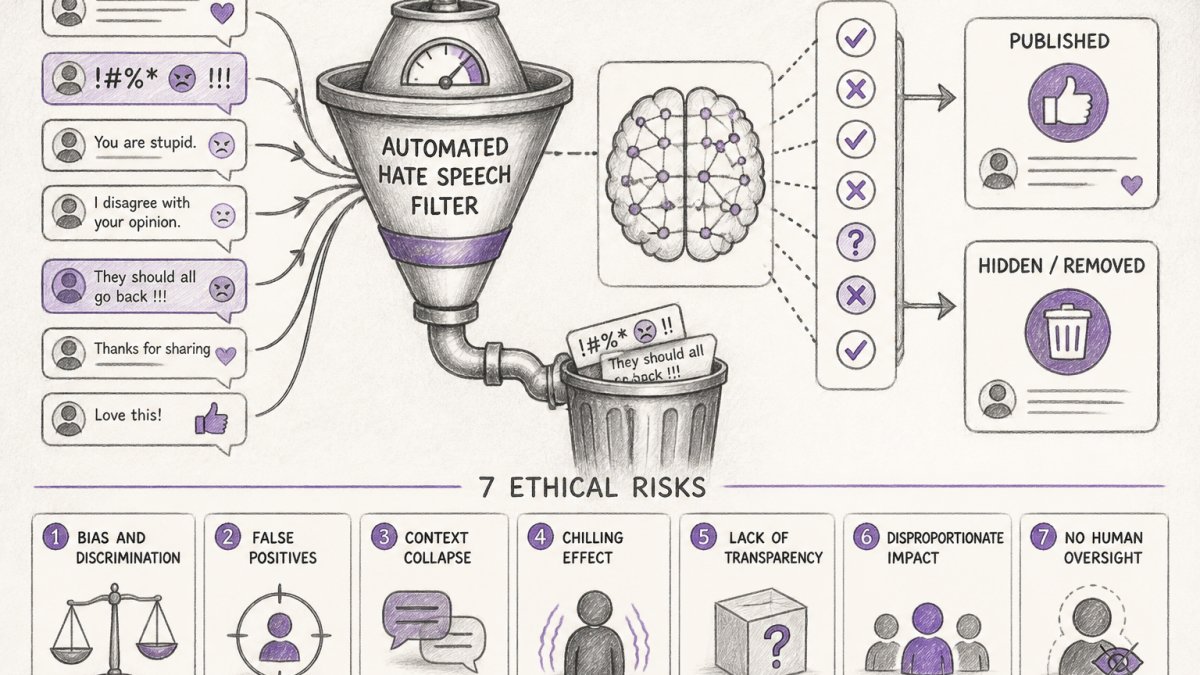
Automated hate speech filtering is the use of machine learning and natural language processing to detect and suppress abusive content on social platforms without human review of every decision. Brands deploying this technology should understand its ethical failure modes before doing so.
The stakes are higher than most marketing teams assume. Comment sections are now primary brand real estate, and the moderation decisions made there are public, permanent, and increasingly scrutinized.
Bias in Hate Speech Detection: Who Gets Silenced First
Bias in hate speech detection is the systematic tendency of a classification model to flag or miss content at different rates across user groups. It enters through the training data, the labeling process, and the model's blind spots, and it compounds at every stage. Most coverage stops at naming those sources. The useful question is how you measure the resulting disparity before it reaches your audience.
Where the Training Data Goes Wrong
Training data shapes what a model considers hateful. Annotated datasets are built by human labelers working from a written policy, and those labels carry the labelers' assumptions about what counts as abuse. If the annotators are not representative of the communities most targeted by hate speech, the model learns a skewed definition.
The pattern repeats in three predictable ways:
- Dialect penalty. African American English and regional dialects get flagged as aggressive more often because the training corpus associates those patterns with toxicity.
- Reclaimed language. Terms a community uses affectionately among itself get classified as slurs when the classifier reads them without context.
- Coverage gaps. Languages and code-switched posts are underrepresented in annotated datasets, so detection quality drops sharply outside the dominant language.
Disparate Impact on Minoritized Users
Disparate impact is the measurable difference in moderation outcomes between user groups that a neutral-sounding rule produces in practice. A model can hit its overall accuracy target while over-flagging posts from minoritized users and under-flagging abuse aimed at them.
Watch out: if your only quality metric is aggregate accuracy, this failure stays invisible. Accuracy hides who the errors land on.
How to Measure Disparate Impact, Not Just Describe It
Treat fairness as a measurement problem with a fixed procedure. The steps below are the ones most practitioners converge on; the exact numbers are yours to set and defend.
- Build a stratified test set. Pull a sample of real comments that includes known-benign posts and known-violating posts, then tag each with the user group or language context it represents where that information is available and lawful to record. Keep the set frozen so results are comparable across model versions.
- Compute error rates per group, not overall. For each group, calculate the false positive rate (benign posts wrongly hidden) and the false negative rate (violating posts left up). Report them side by side. A model that hides 2% of one group's benign comments and 0.5% of another's has a fourfold disparity even if total accuracy looks strong.
- Compare gaps, not just levels. Track the ratio between the highest and lowest group error rate. A widening ratio across releases is an early warning that a model update traded fairness for aggregate performance.
- Slice by context as well as identity. Run the same analysis on dialect-heavy posts, reclaimed-language posts, and each supported language. Context slices often reveal disparities that identity slices alone miss.
- Set a tolerance and a review trigger. Decide in advance how large a gap you will accept, and route any release that exceeds it to human review before deployment.
The Trade-off You Cannot Avoid
Reducing false positives for one group usually raises false negatives somewhere else, because the threshold is shared. The ethical move is not to claim a bias-free model; it is to document which errors you chose to accept, for whom, and why, and to revisit that choice when the data or the audience changes. That record is what lets you defend a moderation decision to a user, a journalist, or a regulator without contradicting yourself.
False Positives, False Negatives, and the Cost of Both
False positives and false negatives are the two error types every moderation system produces, and they carry opposite costs. A false positive hides legitimate speech. A false negative lets abuse stay visible.
For a brand, the asymmetry matters. The FTC's guidance on advertising and endorsement claims is a useful reminder that what appears in your comments can become your commercial problem.
There is no universally correct balance. To judge the tradeoffs, review the data comparing AI and human comment moderation.
Context, Dialect, and Coded Language: Why Models Misread Intent
Context is the variable that breaks most detection models.
Multilingual detection multiplies the problem. A model trained mostly on English loses precision on Spanish, Vietnamese, or Arabic comments, which means non-English-speaking users get both more false positives and more missed abuse.
The practical consequence: any moderation policy that ignores context will produce decisions your own community can see are wrong. That visibility is what turns a technical error into a trust problem.
Human Oversight in AI Moderation: Where Reviewers Fit
Human oversight in AI moderation is the practice of routing ambiguous or high-stakes decisions to a trained reviewer instead of letting the model act alone. It is not a backup feature.
A workable split looks like this:
- A model can handle volume, such as obvious spam and clear slurs.
- Reviewers handle edge cases: sarcasm, in-group language, political speech, anything involving a protected group.
- Escalation triggers fire on low-confidence classifications, appeals, and repeat offenders.
The honest answer is that the split depends on your risk tolerance and your volume, not on a single right answer. For a direct comparison, see automated comment hiding vs manual moderation.
AI Moderation Transparency and the Appeals Process
AI moderation transparency means users can find out that a decision was automated, why it was made, and how to challenge it. Without that, moderation becomes an invisible hand that users experience as arbitrary. Many approaches agree on the principle and stop there. The gap is the procedure: what notice says, who reviews, how long it takes, and what happens when the system was wrong.
What a Defensible Appeals Process Contains
A workable process has five parts, each with a concrete deliverable:
- Notice. When content is hidden or a user is restricted, tell the user in the product and, where appropriate, by email. The notice should state that an automated system made the decision, name the policy category that was triggered, and link to the full policy text.
- Plain-language reason. Give the specific rule and, where the model supports it, the passage or signal that triggered the flag. "Violated community guidelines" is not a reason; "matched the slur category under our hate speech policy" is.
- A route to a person. Provide a one-click appeal that routes to a trained human reviewer, not back into the same model. Preserve the content and the model's confidence score so the reviewer sees what the system saw.
Due Process as a Feedback Loop
Due process is not a legal nicety here; it is the mechanism that catches the model's mistakes before they become a pattern of silencing the same people repeatedly. Treat appeal outcomes as evaluation data. Track the share of appeals that succeed, broken out by policy category and user group. A high and rising overturn rate in one category is a signal that the model's threshold or training data is wrong there, and it should feed directly into the next bias audit described above.
Accountability Runs Both Ways
Brands should be able to explain their moderation policy to a regulator, a journalist, or an angry customer without contradicting themselves. That means keeping three records: the written policy, the decision log for each automated action, and the appeal outcome with the reviewer's rationale. If the policy exists only as model settings, it does not exist. If the appeal log does not exist, you cannot show that your process works, only that you have one on paper.
Responsible Content Moderation Best Practices for Brands
Responsible content moderation best practices start with a written policy that defines harm categories before any tool is configured. The policy drives the technology, not the reverse.
We recommend four commitments:
- Publish the rules. Tell users what gets hidden and why.
- Log every automated decision. You cannot audit what you did not record.
- Review by group, not just in aggregate. Track error rates across user segments.
- Keep a human in the loop for appeals. Automation handles volume; people handle judgment.
A deeper policy template can help structure the document section by section. The throughline across all four commitments is the same: make the system's reasoning visible enough that someone outside the team can check it.
Auditing Your Moderation Stack Before You Deploy
Auditing your moderation stack means testing it against your own policy, your own audience, and your own error tolerance before it touches live comments.
Run the audit on a sample of real comments, including ones you know should pass and ones you know should fail. If you are evaluating tools, see AI-powered Instagram comment moderation.
For the broader risk picture, brand safety in user-generated content covers what is at stake beyond the comment thread.
| Audit Step | What You Measure | Frequency |
|---|---|---|
| Define harm categories | Policy coverage vs. model labels | Before launch |
| Sample flagged and unflagged comments | Error distribution | Before launch |
| Measure error rates by user group | False positive and false negative gaps | Quarterly |
| Review dialect and coded cases | Contextual misreads | Quarterly |
| Set escalation thresholds | Human review triggers | Before launch |
| Re-audit | Drift and policy changes | Every quarter |
The hardest part of automated hate speech filtering is not building a model that catches abuse. It is building one you can defend when it gets a call wrong.
Frequently Asked Questions
What are the main ethical concerns with automated hate speech filtering?
The biggest concerns are bias in training data, false positives that silence legitimate speech, opacity in how decisions are made, and a lack of appeal routes for affected users. Automated hate speech filtering also raises free expression questions when models misread dialect, reclaimed language, or in-group humor as abuse. For brands, the practical risk is hiding or amplifying the wrong comments at scale, which damages trust with the audiences you are trying to protect.
Can AI hate speech detection be biased against certain groups?
Yes. Detection models learn from annotated datasets, and those datasets carry the assumptions of whoever labeled them. Research on algorithmic bias has shown that classifiers trained mostly on standard English can flag African American English and other dialects at higher rates than comparable posts written in mainstream phrasing. The result is disparate impact: minoritized users see their comments hidden more often, even when the content is not abusive. Auditing false positive rates by user group is the only reliable way to catch this.
How should users appeal an automated hate speech decision?
A workable appeals process needs three parts: a clear notice that a comment was actioned and why, a one-click route to request review, and a human reviewer who can reverse the decision. Set a response window, keep a record of the outcome, and publish how often appeals succeed. If your moderation tool hides comments silently, users cannot appeal what they do not know happened, which is why AI moderation transparency and visible escalation paths belong in the same conversation.
What role should human reviewers play in AI moderation?
Human oversight in AI moderation should focus on the cases models handle worst: sarcasm, reclaimed language, dialect, political speech, and anything near a ban threshold. Reviewers also own the appeals queue and the feedback loop that retrains the model. Treat automation as a first pass that handles volume, not a final judge. Brands running high comment volumes typically route only borderline and appealed cases to people, which keeps review costs manageable while preserving due process.

Tired of manually moderating comments?
FeedGuardians automates spam filtering, responds to customers, and protects your brand — setup in 3 minutes.
Frequently Asked Questions
What are the main ethical concerns with automated hate speech filtering?
The biggest concerns are bias in training data, false positives that silence legitimate speech, opacity in how decisions are made, and a lack of appeal routes for affected users. Automated hate speech filtering also raises free expression questions when models misread dialect, reclaimed language, or in-group humor as abuse. For brands, the practical risk is hiding or amplifying the wrong comments at scale, which damages trust with the audiences you are trying to protect.
Can AI hate speech detection be biased against certain groups?
Yes. Detection models learn from annotated datasets, and those datasets carry the assumptions of whoever labeled them. Research on algorithmic bias has shown that classifiers trained mostly on standard English can flag African American English and other dialects at higher rates than comparable posts written in mainstream phrasing. The result is disparate impact: minoritized users see their comments hidden more often, even when the content is not abusive. Auditing false positive rates by user group is the only reliable way to catch this.
How should users appeal an automated hate speech decision?
A workable appeals process needs three parts: a clear notice that a comment was actioned and why, a one-click route to request review, and a human reviewer who can reverse the decision. Set a response window, keep a record of the outcome, and publish how often appeals succeed. If your moderation tool hides comments silently, users cannot appeal what they do not know happened, which is why AI moderation transparency and visible escalation paths belong in the same conversation.
What role should human reviewers play in AI moderation?
Human oversight in AI moderation should focus on the cases models handle worst: sarcasm, reclaimed language, dialect, political speech, and anything near a ban threshold. Reviewers also own the appeals queue and the feedback loop that retrains the model. Treat automation as a first pass that handles volume, not a final judge. Brands running high comment volumes typically route only borderline and appealed cases to people, which keeps review costs manageable while preserving due process.