
Quick Summary
| Key Insight | What You Need to Know |
|---|---|
| Why Your Social Media Competitors Are a Goldmine of Data | Too many brands treat competitor analysis as a defensive chore—a box to check to make sure they aren't falling behind. That perspective completely m... |
| Identifying Your True Competitors Across Platforms | Before you can even think about benchmarking or content analysis, you have to nail down one critical question: who are you really up against on social... |
| Building Your Competitor Analysis Framework | Okay, you've got your list of social media competitors. Now the real work begins. It’s time to go beyond just knowing who they are and start breakin... |
| Got Questions About Competitor Analysis? We’ve Got Answers. | Even the sharpest social media pros run into questions when digging into the competition. It's a complex process. Let's walk through some of the most ... |
Your social media competitors are more than just rivals. Think of them as a free, real-time focus group, constantly feeding you market research data. Analyzing their moves reveals exactly what resonates with your shared audience, highlighting content opportunities and exposing performance gaps you can immediately exploit.
Why Your Social Media Competitors Are a Goldmine of Data
Too many brands treat competitor analysis as a defensive chore—a box to check to make sure they aren't falling behind. That perspective completely misses the point. If you shift your mindset from defense to offense, this task becomes a powerful engine for growth.
Instead of just mimicking what others do, you can strategically learn from their playbook to build a social presence that's stronger and more resilient.
Consider this: every post a competitor makes is a publicly available A/B test. They’re spending their time and money to figure out what works with the very audience you want to capture. Every high-engagement post, every successful ad campaign, and even every negative comment they receive is a valuable data point for you.
Uncovering Hidden Opportunities
A deep dive into your competitors' social media activity can illuminate pathways you might have overlooked. When you systematically track their content, you start seeing patterns that lead to real, actionable insights.
- Discovering New Audience Pockets: Is a competitor suddenly getting huge traction with a demographic you've ignored? This could be a clear signal of an untapped market just waiting for a brand like yours.
- Finding Gaps in the Content Matrix: If your rivals are all churning out short-form videos, maybe there’s a massive opening for high-quality, in-depth carousel posts or text-based threads that serve an unmet need for detail.
- Getting a Spark for New Campaigns: A competitor’s successful user-generated content (UGC) campaign could be the perfect inspiration for your own. You can see what worked and launch a similar initiative, but with your own unique brand voice.
For performance marketers and e-commerce brands, this process is all about precision. By watching a competitor's ad creative and messaging, you can pretty accurately infer their targeting strategy. That intelligence helps you refine your own ad spend for much better efficiency.
Learning from Their Wins and Fails
Your competitors provide a fantastic roadmap of what to do and, just as importantly, what not to do. Their failures are often more valuable than their successes.
Did they launch a new product that was met with crickets? Dive into the comments to understand why it fell flat. This intel helps you avoid making the same expensive mistakes.
On the flip side, when they hit a home run, you can reverse-engineer their success. This is where active observation, often supercharged with social listening techniques, becomes essential. By monitoring their wins, you get priceless data on messaging that converts and creative that grabs attention.
If you're new to the concept, our guide on what is social listening is a great place to start. In the end, analyzing your competitors isn't about copying them. It's about gathering intelligence to build a smarter, more effective strategy that drives real results.
Identifying Your True Competitors Across Platforms
Before you can even think about benchmarking or content analysis, you have to nail down one critical question: who are you really up against on social media? I can tell you from experience, the answer is almost always bigger and more complex than the handful of companies on your quarterly reports.
On social, you're not just competing for sales; you're in a bare-knuckle brawl for attention. That means your competitive landscape isn't a neat list—it's a chaotic mosaic of different players, all fighting for a sliver of your audience's incredibly limited screen time. If you only focus on brands selling the exact same thing, you're leaving yourself wide open to being outmaneuvered from completely unexpected directions.
A much smarter approach is to think in tiers. This framework helps you prioritize your efforts and, more importantly, figure out what you can learn from each type of rival.
Direct Competitors
Okay, these are the obvious ones. Direct competitors offer a similar product or service to a nearly identical audience. If you’re slinging sustainable running shoes, they are too.
Finding them is usually the easy part. Fire up Instagram, Pinterest, or TikTok and run some simple keyword searches. What brands pop up for terms like "eco-friendly running gear" or "vegan athletic shoes"? Those are the companies you’re going head-to-head with for market share every single day.
Indirect Competitors
Now we're getting into the interesting stuff. Indirect competitors solve the same core problem for your customer, just with a different solution. They aren't selling your product, but they are absolutely competing for the same budget and attention from your target demographic.
Let's stick with our running shoe brand. An indirect competitor could be:
- A high-performance sock company that runners rave about.
- A popular fitness app with dedicated running training plans.
- A brand selling recovery tools like foam rollers and massage guns.
These companies are all embedded in the "runner's lifestyle" ecosystem. Watching their social media feeds shows you how they talk to the running community, which content formats get the most love, and what kind of partnerships they’re landing. You can often unearth these players by lurking in niche Facebook Groups or Subreddits where runners hang out.
By widening your lens to include indirect competitors, you get a much richer picture of your audience's world—their other interests, their deeper pain points. This insight is pure gold for creating content that actually builds a community instead of just shouting about your product.
Aspirational and Audience Competitors
This last group is where the real next-level insights come from. These are brands that might not even be in your industry, but they have absolutely mastered the art of engaging your target audience.
An aspirational brand is a company you look up to for its incredible branding, community, or content strategy. Think about how a brand like Nike or Patagonia connects with people on an emotional level. You're not trying to copy them, but you can definitely learn from their playbook.
Audience competitors are even broader—they are any account that successfully grabs the attention of your ideal customer. For an e-commerce brand targeting Gen Z, this could be a hilarious meme account, a specific influencer, or a niche media outlet. They don't sell a competing product, but they are winning the attention battle. Studying them teaches you about the culture, the humor, and the trends that actually matter to your audience. This is especially vital on fast-moving platforms like TikTok, where using a reliable Tiktok Story Viewer can give you a real-time window into what's capturing attention right now.
To help pull all this together, it's useful to map out what you've found. A simple table can make sense of the chaos.
Finding Your Competitors on Social Media
Here’s a quick breakdown of the different competitor types and some practical ways to spot them in the wild.
| Competitor Type | What They Are | Platform Discovery Tactic |
|---|---|---|
| Direct | Sell a similar product to the same audience. | Use specific product keywords and hashtags on Instagram or Google Shopping to see who appears alongside you. |
| Indirect | Solve the same problem with a different product. | Monitor keyword discussions in relevant Facebook Groups, subreddits, or online forums to see what other solutions are mentioned. |
| Aspirational | Industry leaders with best-in-class branding. | Look at "best of" industry lists, award winners, and brands frequently cited for their marketing excellence. |
| Audience | Any account capturing your target audience's attention. | Analyze the "who to follow" suggestions on platforms and see what other accounts your followers actively engage with. |
Once you've mapped out this full spectrum of social media competitors, you finally have a comprehensive list to work from. This complete picture is the foundation for any meaningful analysis—and it’s how you’ll uncover the strategic opportunities your direct-only rivals will almost certainly miss.
If you're ready to start tracking these players more efficiently, our guide on the top social media monitoring tools is the perfect next step.
Building Your Competitor Analysis Framework
Okay, you've got your list of social media competitors. Now the real work begins. It’s time to go beyond just knowing who they are and start breaking down their social media playbook piece by piece. A systematic audit is the only way to turn those raw observations into a genuine strategic advantage, letting you benchmark your own performance against the rivals who really matter.
This means looking past the vanity metrics. Follower counts are nice, but we're digging deeper into the tactical elements that actually drive connection and, ultimately, business results. You’re essentially reverse-engineering their entire strategy to understand not just what they post, but why it works—or why it doesn't.
Before you dive in, it’s crucial to understand the different flavors of competitors you’ll be tracking. They aren't all created equal.
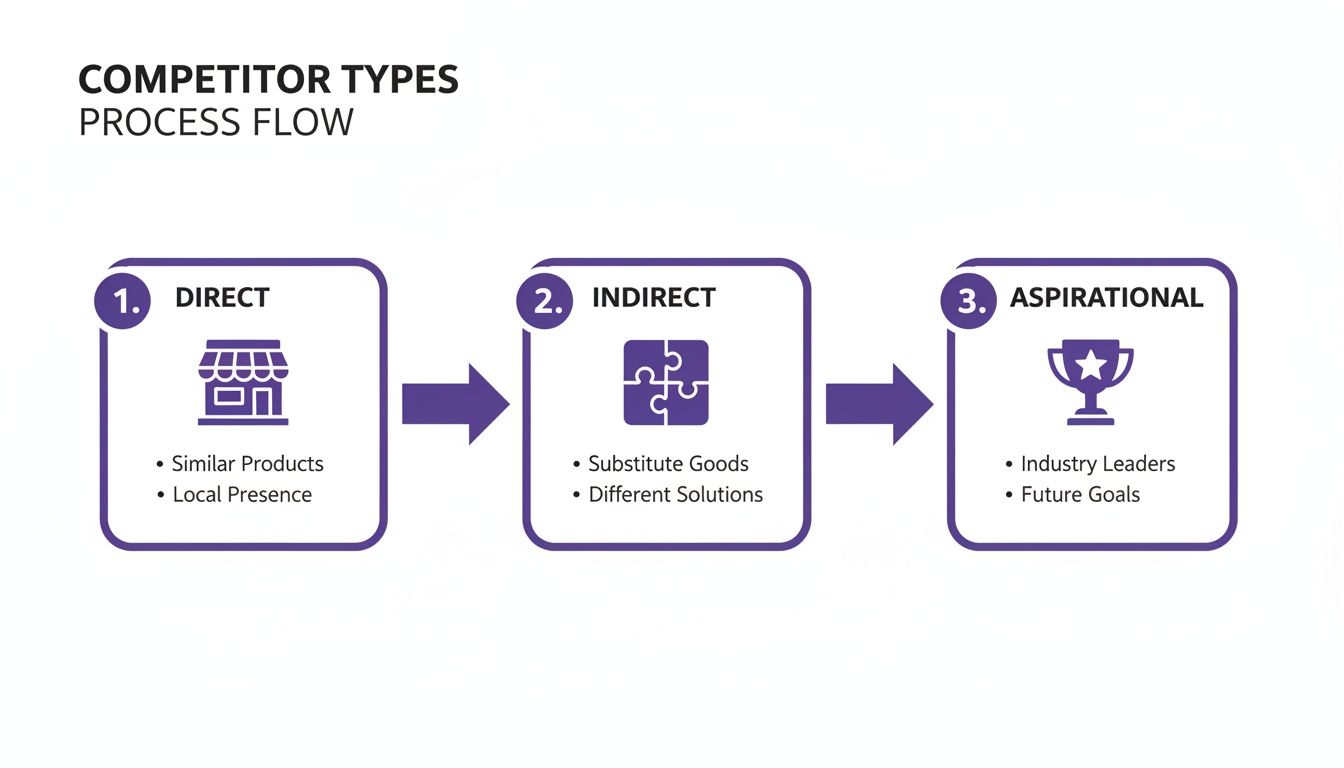
Mapping your competitors into these categories gives you a much richer, more complete picture of your market.
Benchmarking Content Strategy and Cadence
A solid analysis always starts with the content itself. The goal here is to spot the patterns in their publishing habits and map out the core themes that define their online personality. This isn't about copying what they do; it's about establishing a clear baseline for what’s standard in your niche.
Start by cataloging their content mix and how often they post.
- Post Formats: Are they all-in on Reels, or do detailed carousels seem to be their sweet spot? Make a note of the ratio of video, static images, and text-based updates.
- Content Pillars: What are the 2-4 recurring themes they keep coming back to? This could be anything from product tutorials and behind-the-scenes glimpses to customer stories or industry news.
- Publishing Frequency: How often are they posting on each platform? A direct competitor who posts three times a day on Instagram sets a very different tempo than one who shows up twice a week.
This initial audit gives you a snapshot of their operational rhythm and strategic priorities. You might find that the top performers actually post less frequently but with significantly higher production value—a critical insight for your own team's resource planning.
For a more structured approach, it's worth looking into frameworks for competitive content analysis. This can provide a methodical way to deconstruct what your rivals are doing and pinpoint strategic gaps you can fill.
Evaluating True Engagement and Audience Sentiment
Let’s be honest: high follower counts can be fool's gold. A far better indicator of a competitor's social health is their engagement rate, which tells you how much of their audience is actually interacting with their content. A competitor with 10,000 followers and 500 likes per post (5% engagement) is in a much stronger position than one with 100,000 followers and only 1,000 likes per post (1% engagement).
But don't stop at the numbers. You have to assess the quality of that engagement, too. This means rolling up your sleeves and getting into their comment sections. Are people asking genuine questions and leaving praise, or is it a wasteland of spam and emojis? This kind of sentiment analysis reveals the true health of their community.
To keep all this data organized, you'll need the right tools in your corner. Our guide to the best tools for social media analytics can help you find platforms that automate a lot of this heavy lifting.
Uncovering Paid Social Strategies
Organic content is only half the story. You can bet your most sophisticated competitors are running paid ad campaigns, and getting a handle on their approach is non-negotiable. Tools like the Meta Ad Library are fantastic for this, offering a transparent look at the ads any brand is currently running.
As you sift through their ads, keep an eye on a few key things:
- Messaging and Hooks: What specific pain points are they hitting in their ad copy?
- Offers and CTAs: Are they pushing discounts, free trials, or gated content like ebooks?
- Creative Formats: Do they lean on user-generated content, slick studio shots, or simple graphics?
This kind of intel is especially vital on the major platforms. Facebook, for instance, remains a juggernaut with 3.07 billion monthly active users and an ad reach of 2.28 billion people. Knowing that 40% of consumers use the platform to check out product reviews just underscores its importance for e-commerce brands trying to get an edge.
Here’s a practical example: Say you're an e-commerce brand and you notice a direct competitor's top-performing ads are all simple, unpolished videos from real customers. That's a massive signal that user-generated content (UGC) is what really connects with your shared audience. Armed with that knowledge, you could launch your own UGC campaign, encouraging customers to share their experiences and generating a ton of authentic, high-converting content for your own ad strategy. That’s how you turn simple analysis into powerful action.
Moving Beyond Manual Analysis with AI

Let's be honest, manual analysis has its limits. There's only so much data a person—or even a team—can realistically comb through before you hit a wall. This is where AI-powered tools come in, completely changing the game for analyzing your social media competitors. They take you from simply watching what your rivals do to predicting what their customers will do next.
These platforms handle the heavy lifting that’s just not feasible for a human, like sifting through thousands of comments across multiple competitor profiles in real-time. It’s not just about doing things faster; it’s about going deeper. AI can pick up on subtle nuances in language and tone that reveal what an audience truly feels and, more importantly, what they intend to do.
What Are People Really Saying in the Comments?
At a basic level, AI gives you large-scale sentiment analysis. It scans a competitor’s comment section and instantly sorts everything into positive, negative, or neutral buckets. This alone gives you a quick, high-level pulse check on their community's health.
But today's tools dig much deeper. They can pinpoint specific emotions and recurring topics within those comments. Imagine automatically discovering that 30% of a competitor’s negative feedback is tied to "slow shipping," or that their most glowing reviews consistently praise their "friendly customer service."
This kind of detail is a goldmine for your strategy. It lets you:
- Pinpoint Competitor Weaknesses: See a steady stream of complaints about a rival's product quality? You now have the perfect angle for your next marketing campaign.
- Double Down on Your Strengths: If their customers are raving about a feature that your product does even better, you've just found your next ad hook.
- Spot What's Coming Next: A sudden jump in comments about a specific feature or problem can signal a new customer need long before it becomes an industry-wide trend.
AI essentially turns a chaotic, noisy comment section into a structured, searchable database of customer feedback. You're getting the insights of a massive focus group without spending a dollar to recruit one.
The Big Difference: Sentiment vs. Purchase Intent
Sentiment tells you how people feel. Intent analysis tells you what they plan to do. For anyone in e-commerce or performance marketing, that distinction is everything. Modern AI models can be trained to recognize the specific language that signals a user is on the verge of making a purchase.
Just think about the difference between these two comments on a competitor’s post:
- "That looks cool!" (Positive sentiment, but low buying intent)
- "Where can I buy this? Do you have it in blue?" (Positive sentiment and a red-hot buying signal)
An AI-powered tool like FeedGuardians can automatically flag that second comment, identifying it as a high-value lead. This opens up some incredibly powerful, proactive workflows for any team looking to get an edge.
A Real-World Playbook for Performance Marketers
Let's say you run an e-commerce brand selling custom phone cases. Your marketing team's goal is to intercept customers who are actively shopping for a competitor's product.
Here’s a simple workflow using an AI tool:
- Set Up the Monitors: First, the team configures the tool to watch the Instagram and Facebook profiles of their top three competitors.
- Define the Triggers: Next, they create rules to flag comments that include phrases like "how much," "link to buy," "need this," or "is it in stock?"
- Get Real-Time Alerts: The moment a user leaves a comment showing clear purchase intent on a competitor's post, the AI sends an alert straight to the team's Slack channel.
- Launch a Targeted Play: The team can now engage directly with that user's profile to get on their radar. Even better, they can add this person to a custom audience for a hyper-targeted ad campaign that showcases their own phone cases, perhaps highlighting faster shipping or more unique designs.
This turns a competitor’s social media feed into your own lead generation engine. You’re no longer just a spectator; you're actively engaging high-intent buyers the moment they're ready to pull out their wallets. To learn more about the technology behind this, check out our guide on the best tools for social media sentiment analysis.
This strategy is especially powerful on platforms where social commerce is exploding. Take TikTok, for example. It's a massive force with its 1.59 billion monthly active users and an impressive 4.86% engagement rate. Its algorithm is a prime channel for reaching Gen Z and Millennials, and with 81% of consumers making impulse buys thanks to social media, spotting purchase intent on a rival’s TikTok is invaluable. For more on how social trends are driving sales, you can find additional social media marketing statistics on Dreamgrow.com.
By bringing AI into your workflow, you stop reacting to what your competitors did last week and start anticipating what their customers will want next.
All the data in the world is useless if it just sits there in a spreadsheet. The whole point of digging into your competitors’ social media is to find intelligence that fuels smarter, faster decisions. This is where the real work starts—translating what you’ve observed into a concrete plan that gives you an edge.
This isn't about creating some massive, overwhelming report nobody will read. It’s about building a simple, repeatable system for turning insights into action. We want to shift from just watching what others are doing to proactively shaping our own strategy, creating a feedback loop where we test, learn, and adapt based on what the market is telling us.
From Analysis to a Targeted SWOT
A classic SWOT analysis (Strengths, Weaknesses, Opportunities, Threats) is the perfect starting point, but with a twist—use your competitor data as the main ingredient.
- Strengths: Where are you clearly winning? Maybe your engagement rate is 1.5x higher, or your team is just plain faster and better at responding to comments. Pinpoint these and lean into them.
- Weaknesses: Time for some real honesty. Where are competitors eating your lunch? Perhaps their user-generated content feels more authentic and is sparking better conversations. Or maybe their video creative is just flat-out better than yours.
- Opportunities: This is where it gets interesting. A competitor's weakness is your roadmap. If a major rival's comment section is a dumpster fire of complaints about product quality, that’s a golden opportunity for you to hammer home your durability and satisfaction guarantees.
- Threats: What’s on the horizon? Look for things your competitors are doing that could disrupt your standing. This might be a new partnership with a huge influencer or a sudden push onto a platform where you have zero presence.
Going through this process forces you to connect every data point to a strategic "so what?" It’s the essential bridge between "they do this" and "so we should do that."
Refining Your Content and Brand Voice
Your competitive analysis is basically a cheat sheet for your content calendar. You now have a solid picture of which content pillars actually resonate with your shared audience, what formats get the most traction, and—just as important—what topics your competitors are completely ignoring.
Use their content gaps to your advantage. If a competitor’s feed is all polished, professional product shots, there’s probably a wide-open lane for you to win with authentic, behind-the-scenes content that puts a human face on your brand.
This is also the perfect time to sharpen your brand voice. By seeing how everyone else in your niche talks, you can carve out a unique position for yourself. If all your social media competitors sound like stuffy corporate bots, adopting a more conversational, witty, or even edgy tone can make you stand out immediately. Building that distinct personality is how you become a memorable brand, not just another company in the feed. To dive deeper, check out our guide on how to improve social media engagement by building a stronger brand presence.
Your competitor's weaknesses are not just problems for them; they are strategic opportunities for you. Every customer complaint they receive is a blueprint for your next winning ad campaign.
Sharpening Your Ad Targeting and Offers
For any performance marketing team, these competitive insights translate directly into better return on ad spend (ROAS). By looking at a competitor's ad creative, their messaging, and the offers they're pushing, you can make some very educated guesses about their targeting strategy and what’s hitting the mark.
For instance, if you see a competitor running a "buy one, get one" offer into the ground, it's a safe bet that type of deal works well with your target audience. You can then test a similar—or even better—offer. Likewise, if their top-performing ads are all built around customer testimonials, it's a clear signal to double down on social proof in your own creative.
Maintaining an Agile Strategy
The social media landscape is anything but static; it can change in a week, sometimes in a day. A one-and-done analysis will be stale before you know it. To truly stay ahead, you need a simple, repeatable process for keeping your insights fresh.
Quarterly Competitor Review Checklist:
- Re-evaluate Your Top 3 Competitors: Has a new player entered the game? Has a major rival stumbled?
- Benchmark Core KPIs: Run a quick check on their follower growth, average engagement rate, and posting frequency. How do you stack up?
- Analyze Their Top 5 Posts: What was their biggest hit this quarter? A viral video, a giveaway, a heartfelt customer story?
- Review Their Ad Library: Scope out any new campaigns, offers, or messaging angles they're putting money behind.
- Identify One Key Opportunity: Based on everything you just saw, what is the single most impactful thing you can do in the next quarter to gain ground?
This simple checklist turns competitive analysis from a one-off project into an ongoing strategic habit, ensuring you’re always learning and adapting.
Got Questions About Competitor Analysis? We’ve Got Answers.
Even the sharpest social media pros run into questions when digging into the competition. It's a complex process. Let's walk through some of the most common sticking points to help you dial in your own strategy.
How Often Should I Actually Do This?
This is probably the number one question I get. There’s no single right answer, but the best approach is to operate on two different timelines.
The Deep Dive (Quarterly): Think of this as your big, structured audit. This is when you pull all the data and benchmark everything—content performance, ad creative, community engagement, the works. A quarterly cadence keeps you on top of trends without drowning you in data.
The Quick Scan (Daily/Weekly): This is your ongoing, informal check-in. Just a quick scroll through your main competitors' feeds to spot anything new or interesting. A breakout post? A new campaign launch? A sudden shift in messaging? This keeps you from being blindsided.
This two-track system ensures you're catching both the major strategic shifts and the day-to-day tactics without making it a full-time job.
What Are the Best Tools if I’m on a Budget?
Another big one. You don't need a massive budget to get powerful insights. While the high-end paid platforms are great, you can get surprisingly far with free resources if you know where to look.
First off, don't overlook the built-in analytics on each social platform. They give you all the baseline metrics for your own accounts—follower growth, post engagement, reach—which is the foundation for any good comparison.
For anyone running ads, the Meta Ad Library is an absolute goldmine, and it’s completely free. It’s a searchable database of every single ad running on Facebook and Instagram. You can see your competitors' exact ad copy, their creative, and what they're pushing. It’s like having a direct window into their paid media playbook.
Is This… Unethical?
Let's clear this up: a proper competitor analysis is 100% ethical. You are simply looking at publicly available information. This isn't corporate espionage; it's smart market research. Every post, ad, and comment you're analyzing is data that brands have voluntarily put out into the world.
The goal here isn't to copy what your rivals are doing. It's to understand the playing field, identify what resonates with your shared audience, and then build your own, better strategy. Use their work for inspiration, not imitation.
Don’t fall into the vanity metric trap. A competitor with 200,000 followers but a 0.5% engagement rate is in a much worse spot than a brand with 20,000 followers and a 4% engagement rate. That smaller brand has a genuinely connected audience.
A high engagement rate is the true sign of a healthy, active community. It shows who is actually winning the war for attention and loyalty. Focus on the competitors who have cracked the engagement code—that's where the real lessons are.
Ready to stop guessing and start winning? FeedGuardians uses AI to monitor your competitors' comment sections, automatically identifying purchase intent signals and customer service issues in real time. Turn their social media into your lead generation machine. See how it works at https://feedguardians.com.
Tired of manually moderating comments?
FeedGuardians automates spam filtering, responds to customers, and protects your brand — setup in 3 minutes.