
Quick Summary
| Key Insight | What You Need to Know |
|---|---|
| Damaged Brand Credibility | A messy comment section makes you look like you don't care. |
| Reduced Customer Trust | People won't interact if your page feels neglected or unsafe. |
| Buried Legitimate Interactions | Real questions from real customers get lost in the sea of junk. |
| Skewed Performance Metrics | Fake engagement ruins your data, making it hard to measure what matters. |
We’ve all seen them: those weird, out-of-place comments on Instagram posts. These are spam accounts—profiles built for one reason: to flood feeds with unwanted, repetitive, or irrelevant junk. They're often pushing scams or sketchy products.
Think of them as digital party crashers. They show up uninvited, make a lot of noise, and completely ruin the vibe you're trying to create with your community.
Why Instagram Spam Is More Than Just an Annoyance
Imagine your brand’s comment section as a cozy coffee shop where customers chat, ask questions, and connect with you. Now, picture a bunch of robots bursting in, shouting nonsense and shoving flyers in everyone's faces. That’s what dealing with spam accounts on Instagram feels like, and the problem goes way deeper than just being annoying.
This digital mess directly attacks your brand's credibility and the trust you've built with your customers. When a potential buyer lands on your page and is greeted by a wall of spam, it screams that the space is unmanaged, unprofessional, and maybe even a little unsafe.
The Real Business Cost of Spam
Spam doesn't just look bad; it actively gets in the way of business. A constant stream of "DM for a collab" or crypto scams buries real customer questions and feedback. That means missed sales and frustrated people who feel like you're ignoring them. It's a direct hit to your bottom line.
The scale of this problem is huge. Fake influencers in the US alone reportedly spend $1.3 billion a year on fake followers. These ghost followers provide zero engagement and zero sales, showing just how easy it is for brands to be misled by empty numbers.
Spam dilutes your brand's voice and authority. Every fake comment pushes a real customer's voice further down, making it harder for you to build a genuine community and measure what truly resonates with your audience.
How Spam Erodes Trust and Skews Metrics
Beyond the obvious clutter, spam works like a slow poison. It wears away the trust that's essential for building a loyal customer base. If your account looks like a spam free-for-all, new visitors will think twice before engaging or buying anything.
This is where a solid reputation management strategy becomes critical. You can learn more about this in our comprehensive online reputation management guide for 2025.
On top of that, all this noise messes with your analytics. Spam comments and likes inflate your engagement numbers with garbage interactions, making it impossible to know what content is actually working. You could end up making bad marketing decisions based on completely bogus data.
Ignoring spam creates a domino effect of problems:
- Damaged Brand Credibility: A messy comment section makes you look like you don't care.
- Reduced Customer Trust: People won't interact if your page feels neglected or unsafe.
- Buried Legitimate Interactions: Real questions from real customers get lost in the sea of junk.
- Skewed Performance Metrics: Fake engagement ruins your data, making it hard to measure what matters.
Dealing with spam accounts on Instagram isn't just about spring cleaning. It's about protecting your reputation, nurturing your community, and making sure your marketing is built on real, authentic connections.
Knowing the Different Types of Instagram Spammers
To win the fight against spam on Instagram, you first need to know who you’re up against. Spam isn’t a one-size-fits-all problem; different accounts use different tactics for different reasons. Think of yourself as a detective learning to spot the specific clues that give away a spammer's real identity and what they're after.
This is about more than just spotting an annoying comment. It's about recognizing the patterns that help you classify the threat. Once you know what you’re dealing with, you can pick the right strategy to protect your brand and keep your community safe.
The Bot Commenters and Promo Pushers
This is probably the most common spam you see every day. These accounts are built to blitz comment sections with generic, often nonsensical messages. It's a numbers game for them—they're hoping that by plastering their pitch everywhere, they'll get a few clicks or convince someone to pay for a worthless service.
These spammers love comments like "DM for a promo" or "Send me this post." It’s a simple bait-and-switch. If you actually reply, you’ll get a price list for "exposure" on their page, which is almost always full of fake, bought followers and delivers zero real value. To get a deeper dive into these accounts, check out our guide on what a spam account is.
You can spot them by looking for a few things:
- Repetitive Comments: They’ll post the exact same phrase on hundreds of different accounts.
- Vague Calls to Action: Messages like "Promote it on..." with no specific details are a huge red flag.
- Weird Misspellings: They might type "prom0te" or "se_nd" to sneak past Instagram's basic spam filters.
To help you quickly identify what you're up against, here's a quick breakdown of the usual suspects.
Common Types of Instagram Spam Accounts and Their Goals
| Spam Account Type | Key Characteristics | Primary Goal |
|---|---|---|
| Promo Bots | Generic comments ("DM to collab," "Promote it on..."), random emojis, often no profile picture. | Drive traffic to their own (usually scammy) services or pages. Trick users into paying for fake promotions. |
| Phishing Scammers | Urgent messages ("Your account is at risk!"), fake giveaway wins, links to fake login pages. | Steal login credentials, personal information, or financial details. |
| Impersonators | Copied profile picture, bio, and a nearly identical username (e.g., brand_name_ vs. brand_name). | Deceive your followers, run fake giveaways, and damage your brand's reputation. |
| Fake Followers | Empty or stolen profiles, no posts, follows thousands of accounts but has few followers. | Inflate follower counts for other accounts, making them appear more popular than they are. |
Each of these spammers requires a slightly different approach, but recognizing them is always the first step.
The Phishing Scammers
This group is far more dangerous than the promo pushers. Phishing scammers aren't just an annoyance; they are actively trying to steal your information. Their comments or DMs often contain malicious links dressed up as special offers, giveaways, or security warnings about your account.
For instance, a classic tactic is a comment that says, "Congrats! You've won our weekly giveaway. Click the link in our bio to claim!" That link, of course, goes to a phony login page built to snatch your Instagram username and password.
Phishing accounts prey on excitement and fear. They create a sense of urgency to make you act before you think, putting your account security and personal data at immediate risk.
These scammers can be crafty, using profile pictures and usernames that look official at first glance. Always be skeptical of links you didn't ask for, especially ones promising free stuff or claiming there's a problem with your account. Instagram will never ask for your password in a comment or a DM.
The Impersonator Accounts
Impersonators might be the most damaging of all because they directly attack your brand's reputation by pretending to be you. They'll steal your profile picture, copy your bio, and create a username that's just a tiny bit different (like adding an extra letter or an underscore).
Their main goal is to fool your followers. They might run fake giveaways, DM your customers asking for personal information, or send them to scam websites. This doesn't just confuse your audience; it can cause real financial and reputational harm if one of your customers falls for the trap.
To spot these fake accounts, it's helpful to know how they operate behind the scenes. Many of these spammers use tools like Instagram bots that automate likes and follows to make their fake profiles look more real before they start causing trouble. Recognizing these different types—from the simple bot to the malicious impersonator—is the first critical step in building a strong defense and keeping your community clean and trustworthy.
Why Your Growing Brand Is a Magnet for Spam
If you've noticed more junk comments showing up as your follower count climbs, you're not imagining things. In fact, it's a sign of success. On Instagram, a growing, active brand is like a beacon for spammers because you’ve already done the hard work of building an audience for them.
Think of your brand's visibility like a spotlight. The brighter that light shines, the more it attracts—both genuine fans and pests. Every viral post, every trending hashtag, and every successful ad campaign tells spammers that your page is fertile ground for their schemes. They don't see your engaged followers as a community; they see them as a list of potential targets.
Your Success Is Their Opportunity
Spammers play a numbers game, using automated bots to scan Instagram for promising accounts. They’re looking for specific signs that an account has an active and trusting audience, which means your own marketing efforts essentially create a roadmap for them.
These signals include:
- High Follower Counts: A large audience is an immediate high-value target. It promises a much bigger reach for their scams.
- Strong Engagement Rates: Lots of likes, shares, and real comments signal that your followers are paying attention. This makes them more likely to see and interact with a spam comment.
- Use of Popular Hashtags: When you use trending hashtags to get more eyes on your content, you're also popping up on the radar of bots that are constantly scraping those tags for new victims.
In short, the very things you do to grow your brand are what make you a prime target for spam accounts on Instagram. It’s an unfortunate side effect of building influence on the platform.
The Ecosystem of Digital Deception
Instagram's sheer size is a double-edged sword. With over 2 billion monthly active users, it’s a phenomenal place for brands to connect with customers. But it's also an irresistible playground for scammers who exploit the platform's lax identity verification to create fake accounts with ease. For e-commerce brands, this often means comment sections get flooded, drowning out real customer conversations and potentially damaging your reputation.
Spammers have a whole playbook of tactics designed to take advantage of your audience, from phishing for sensitive data to straight-up impersonating your brand.
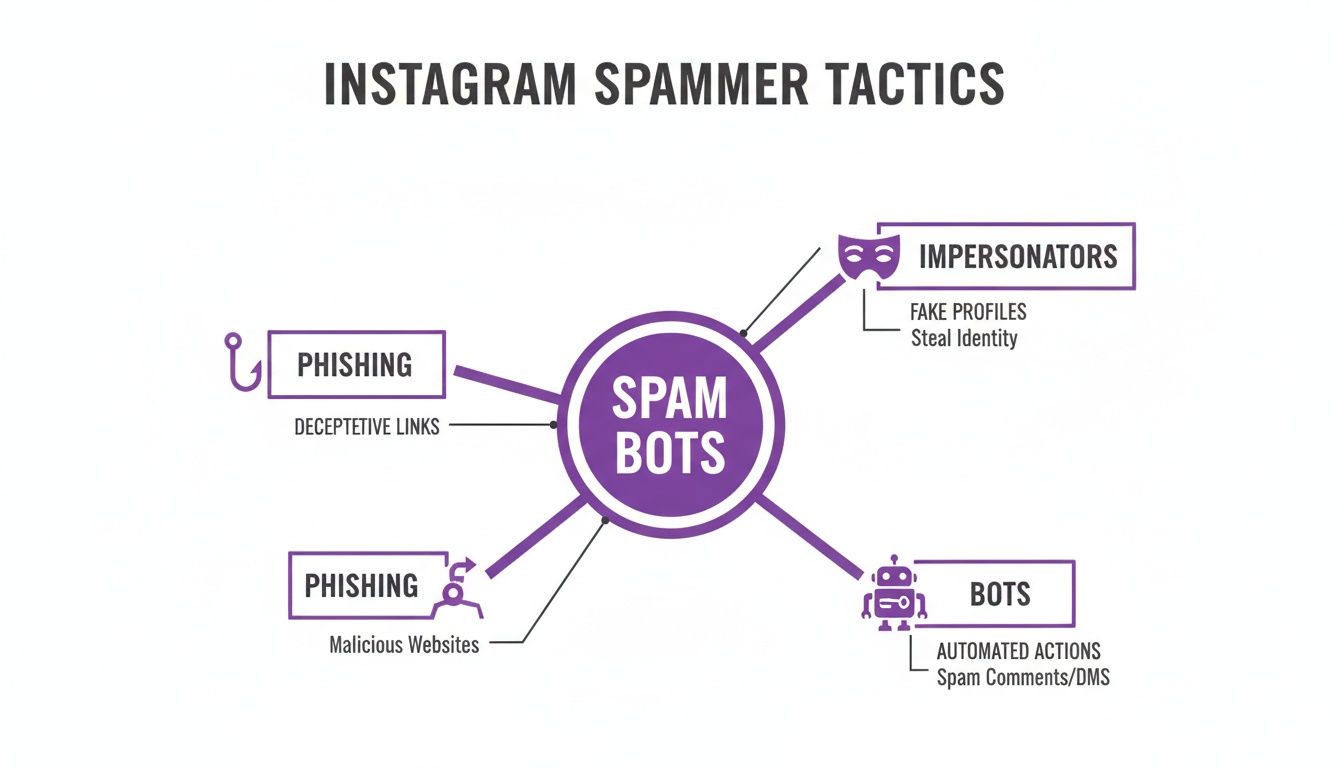
This visual breaks down the most common methods spammers use. It shows how bots often power phishing attempts and impersonation scams, highlighting how a single bot network can launch multiple types of attacks at once. This makes fighting them off manually feel like a losing battle.
Spammers don’t see your brand; they see a distribution channel. Your comment section is their free advertising space, and your followers are their leads.
This is why it’s so critical to understand how they operate. Once you recognize the patterns, you can see spam not as random noise, but as a calculated attack. This is where practices like social listening come in handy, allowing you to monitor conversations and spot unusual activity before it gets out of hand.
Ultimately, a growing spam problem is a backhanded compliment—it means you're getting noticed. But if you let it run wild, it can quickly poison the community you've worked so hard to build. Protecting your corner of Instagram is a non-negotiable part of sustaining your growth.
Manual Moderation Versus Automated Protection
Knowing how to spot spam accounts on Instagram is one thing, but actually stopping them is a whole different ball game. When it comes to protecting your comment section, you really have two main playbooks: the hands-on manual approach or a smarter, automated defense.
Each strategy has its moments, but figuring out the difference is crucial for building a spam management plan that can actually grow with your brand. Let's break down these two options to see which makes the most sense.
The Grind of Manual Moderation
When you’re just starting out, manual moderation feels like the natural choice. It means your team is in the trenches, managing comments directly with the tools Instagram gives you. This gives you total control, which can be comforting at first.
So, what does this look like in practice? It's a constant cycle of a few key tasks:
- Deleting and Hiding Comments: Spotting spam and getting rid of it before too many people see it.
- Reporting Spam Accounts: Flagging sketchy profiles and hoping Instagram takes action.
- Blocking Troublesome Users: Kicking specific accounts out of your space for good.
- Using Keyword Filters: Creating a blocklist of words (like "DM for promo") to automatically hide certain comments.
These tools are helpful, no doubt. But relying on them alone is like trying to bail out a sinking boat with a teacup. The sheer amount of spam makes it an exhausting, never-ending job. For social media managers, that means less time creating great content or engaging with real customers and more time doing tedious cleanup.
The real problem shows up when you start to grow. A post goes viral, and suddenly the spam multiplies, completely overwhelming your team.
Manual moderation is fundamentally reactive. You're always playing catch-up, cleaning up the mess after it’s already been made. Your audience still sees the spam before you can get to it.
The Power of Automated Protection
Automation offers a modern, proactive solution. Instead of waiting for spam to show up, smart tools use AI to catch and hide spam comments the second they're posted—often before a single follower sees them. Think of it as a 24/7 security guard for your comments section.
This approach is just far more efficient and scalable. While you're offline or busy with other work, the system is constantly monitoring your posts, analyzing comments for red flags, and taking care of business. This frees up your team to focus on what actually moves the needle: building a community.
You can check out our detailed look at the top AI comment moderation tools for 2025 to see how this technology works. These systems are powerful because they analyze multiple signals at once—from shady links and spammy phrases to an account's past behavior—making them much sharper than a human trying to keep up.
Comparing Your Options
Choosing between manual and automated methods really comes down to balancing your resources, scale, and how seriously you want to protect your brand’s reputation.
To make it crystal clear, we’ve put together a table comparing the two approaches. It helps highlight the trade-offs you make with each one.
Comparing Spam Management Methods
| Feature | Manual Moderation (Instagram Tools) | Automated Moderation (e.g., FeedGuardians) |
|---|---|---|
| Speed | Slow and reactive; action happens after the spam appears. | Instant and proactive; spam is hidden in real-time. |
| Scalability | Poor; becomes unmanageable as your account grows. | Excellent; handles any volume of comments without extra effort. |
| Efficiency | Low; drains your team's time and energy. | High; works 24/7 with minimal human input. |
| Accuracy | Prone to human error; can miss clever spam. | Highly accurate; uses AI to spot new and evolving spam tactics. |
| Cost | High hidden costs in employee time and lost opportunities. | A cost-effective subscription that saves countless hours. |
Ultimately, the choice becomes obvious as your brand gains traction. Manual work just doesn't scale, and the time your team wastes on cleanup is time they could have spent growing the business.
And this isn't a small problem. Spam on Meta's platforms is a huge headache for brands. After a short dip in 2023, spam on Facebook and Instagram shot right back up to its 2022 peaks, making them the most spammed social networks out there.
If you’re still set on the manual route, you might look to hire an Instagram Virtual Assistant to take on the task. But even with help, you're still just treating the symptoms. For any brand that's serious about growth and protecting its community, automation is the clear path forward.
Proactive Steps for a Cleaner Instagram Presence
Putting out spam fires is one thing, but preventing them in the first place is the real game-changer. The best way to deal with spam accounts on Instagram is to make your profile an unattractive place for them to hang out. Getting ahead of the problem saves you time and helps you build a much healthier, more authentic community.
Think of it like building a fence around your yard. Instead of constantly chasing spammers out after they’ve trampled your garden, you’re putting up a barrier that makes them skip your property altogether. It signals to everyone—real followers and bots alike—that your space is well-maintained and protected.
A clean, professional page doesn't just keep spam away; it builds serious trust with your actual customers.
Fortify Your Comment Section with Filters
One of the most effective tools you have is right inside the Instagram app: the comment filtering system. This lets you automatically hide comments that contain specific words, phrases, or even emojis you know are spammy. It’s your front line.
To get the most out of it, you need to think like a spammer. Start by creating a custom blocklist filled with the junk you see all the time.
- Promotional Spam: Think "DM for promo," "collab," and "send pic."
- Scam Language: Add common phishing bait like "crypto," "giveaway," and "winner."
- Bot-Speak: Don't forget to include variations like "pr0mote" or "c0llab" to catch bots that try to sidestep simple filters.
Keep this list updated. Spammers are always trying new things, so your defenses need to adapt.
Your goal is to create a filter so effective that most spam never sees the light of day. This instantly improves the experience for your real audience and reduces your manual cleanup workload.
Establish and Enforce Community Guidelines
Set the rules of the road for your page. Putting together a simple set of community guidelines and making them easy to find—in a Story Highlight or linked in your bio—tells people what you expect.
This isn’t just for looks. When you have to remove a comment or block an account for breaking the rules, you can point to your public policy. It shows you’re serious about keeping the conversation positive and on-topic.
Conduct Regular Follower Audits
Spam doesn’t just live in your comments. A lot of spam accounts on Instagram will follow you, hoping for a follow-back or just to look more legitimate. That’s why you need to clean out your follower list from time to time.
Keep an eye out for the classic red flags:
- A missing profile picture or a generic stock photo.
- A username that's just a jumble of random letters and numbers.
- An empty bio with zero posts.
- A massive "following" number but hardly any followers of their own.
Clearing these accounts out does more than just tidy up your follower count. It removes inactive users, which can improve your engagement metrics and make your brand look far more credible. By actively managing who's in your community, you create a space where real conversations can happen, turning your page into a genuine asset.
Turning a Clean Comment Section Into More Conversions
Dealing with spam accounts on Instagram is way more than just a cleanup chore. When you get rid of the junk, you’re actually turning your comment section from a messy, untrustworthy space into a place where you can actually grow your business. Every spam comment you delete clears the way for a real customer to speak up—and that's where the magic happens.
Think of your comments like the checkout line at a store. A customer is ready to buy, but they have one last question. If that question gets a quick, helpful answer and is surrounded by other positive comments, it builds a ton of trust. A clean, well-managed page shows you actually care about your customers.
From Social Proof to Sales
A healthy comment section is pure gold for social proof. When new people visit your page and see real questions, glowing reviews, and thoughtful replies from your team, it confirms they’re in the right place. It’s a huge confidence booster for anyone who was on the fence.
On the flip side, a page full of "DM for a promo" bots or shady links is a major turn-off. It screams that the brand isn't paying attention, which makes people wonder about the quality of your products and your business as a whole.
A spam-free environment lets real customer feedback and questions shine. This creates a powerful cycle of trust. Answering one person's question doesn't just help them; it acts like a public FAQ for anyone else with the same thought.
Turning Conversations Into Revenue
When you automate spam removal, you free up your team from the soul-crushing task of manually deleting comments. This means they can spend their time on what really matters: talking to real customers and driving sales. Instead of playing whack-a-mole with bots, they can answer product questions and help guide people to make a purchase.
This simple shift makes a huge difference:
- Faster Response Times: Real customer questions don't get buried in a mountain of spam, so your team can reply much faster.
- Increased Engagement: When people see you’re actively part of the conversation, they’re more likely to join in. If you want to dive deeper, check out our guide on how to improve social media engagement.
- Actionable Insights: With all the noise gone, you get clear, unfiltered feedback on your products and marketing, helping you make smarter decisions.
At the end of the day, protecting your Instagram from spam is a fundamental part of your sales strategy. It’s not just about being tidy; it's about building a safe, trustworthy space where customers feel comfortable connecting with you and, ultimately, buying from you. It’s an investment that nurtures real interaction and lets you focus on the conversations that actually bring in revenue.
Common Questions About Instagram Spam
When you're trying to keep your brand's Instagram clean, a lot of questions pop up. It's totally normal to wonder what actually works and what doesn't when it comes to fake accounts, follower quality, and even influencer partnerships. Let's clear up some of the most common questions social media managers and e-commerce brands ask about spam accounts on Instagram.
Does Blocking Spam Accounts Actually Stop Them?
Blocking a single spam account might feel like a win, but it’s really just a temporary fix. It’s like swatting one mosquito in a swamp—another one is always right there to take its place. Spammers don't just have one account; they run huge networks of bots, so when you block one, thousands more are waiting in the wings.
Playing this manual game of whack-a-mole is exhausting and, frankly, impossible to win. A much smarter strategy is to use tools that automatically spot and hide spam based on what it says and how it acts. This way, you’re putting up a defense against the entire spam network, not just one account at a time.
Will Buying Followers Hurt My Real Engagement?
Yes, without a doubt. Buying followers is one of the worst things you can do for your Instagram account's health. The "followers" you get are just bots or dead accounts that will never like your content, leave a meaningful comment, or buy your products. This immediately destroys your engagement rate—the key metric that compares your likes and comments to your follower count.
When your engagement rate plummets, you're sending a clear signal to the Instagram algorithm that your content isn't very interesting. In response, the algorithm will stop showing your posts to your real followers, torpedoing your organic reach and making all your hard work pointless.
How Can I Spot an Influencer with Fake Followers?
Before you partner with an influencer, you have to do some detective work. The follower count on their profile can be misleading, so it's crucial to dig deeper and check the actual quality of their audience for any red flags.
Here are a few things to look for:
- Engagement Ratio: If an account has 100k followers but their posts only get a few likes and generic comments like "Nice pic!", something is wrong. Real engagement grows as the follower count does.
- Follower List Quality: Spend a few minutes scrolling through their list of followers. Are you seeing a lot of profiles with no photo, a jumble of random letters for a username, and zero posts? Those are classic signs of bot accounts.
- Comment Authenticity: Read the comments on their posts. Are people having actual conversations, or is it just a wall of single emojis and one-word replies? A lack of real discussion is a huge warning sign.
- Sudden Growth Spikes: You can use third-party tools to look at their follower growth history. If you see huge, unnatural jumps in their follower count overnight, they likely just bought a batch of fakes.
Protecting your brand from spam is about more than just cleaning up comments. It's about protecting your reputation and making sure your real customers can actually talk to you. FeedGuardians uses AI to automatically hide spam, flag customer questions, and keep your comments section pristine 24/7. Stop wasting hours on manual clean-up and start focusing on the conversations that actually grow your business. Learn more about how FeedGuardians can protect your brand.
Tired of manually moderating comments?
FeedGuardians automates spam filtering, responds to customers, and protects your brand — setup in 3 minutes.