
Quick Summary
| Key Insight | What You Need to Know |
|---|---|
| 5 Ways to Handle Hate Speech on Social Media | A Practical Framework Why Your Response Matters |
| Why Your Response Matters | Why Your Response Matters |
| Way 1 | Report and Block, Using Platform Reporting and Blocking Mechanisms Step-by-Step Reporting Process When to Block vs. Report |
| Step-by-Step Reporting Process | Step-by-Step Reporting Process |
| When to Block vs | When to Block vs. Report |
| Way 2 | Respond With Counter-Speech Examples and Factual Rebuttals Crafting Calm, Factual Responses When Not to Engage |
Table of Contents
- 5 Ways to Handle Hate Speech on Social Media: A Practical Framework
- Way 1: Report and Block, Using Platform Reporting and Blocking Mechanisms
- Way 2: Respond With Counter-Speech Examples and Factual Rebuttals
- Way 3: Understand Social Media Platforms' Hate Speech Policies and Community Guidelines
- Way 4: Use Hate Speech Reporting Tools and AI-Assisted Moderation
- Way 5: Set Boundaries, Document Evidence, and Prioritize Psychological Recovery
- Showing Solidarity and Building Safer Online Discourse
- Common Mistakes When Handling Hate Speech Online
5 Ways to Handle Hate Speech on Social Media
Last Updated: July 22, 2026
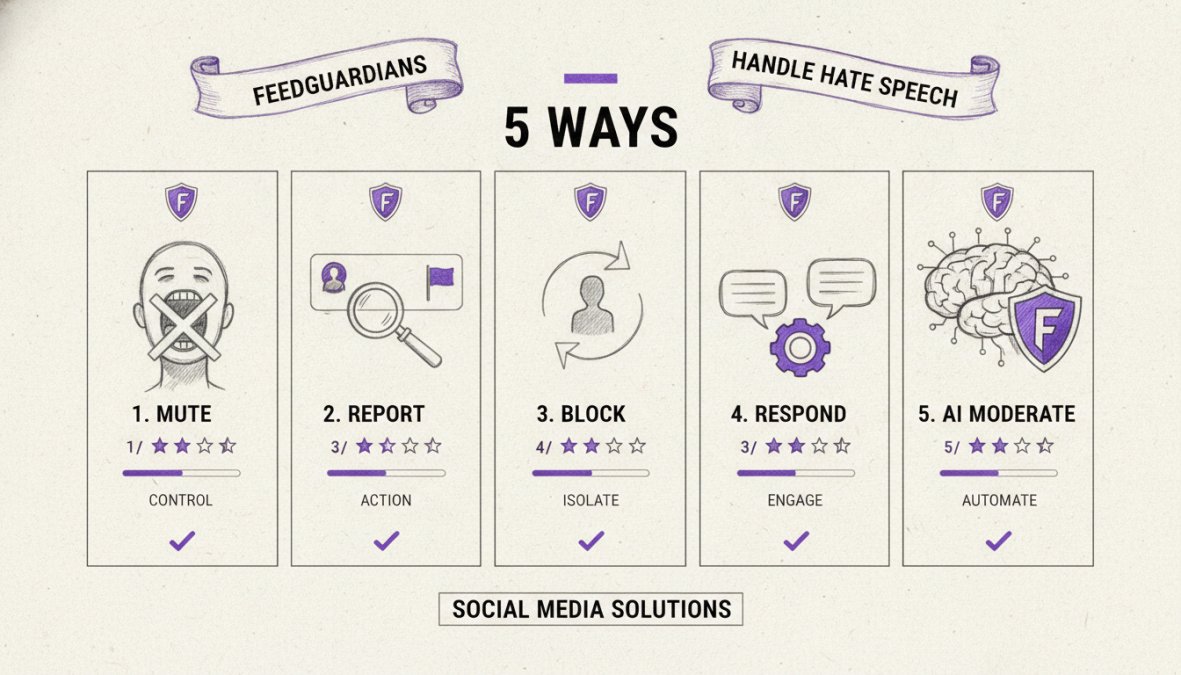
Hate speech online has become a persistent challenge for individuals and brands alike. This guide from FeedGuardians covers 5 practical strategies that combine platform tools, personal boundaries, and community responsibility to help you maintain a safer online presence.
Responding to hate speech effectively requires understanding platform policies, recognizing when engagement helps versus when it escalates, and protecting your own mental health. Below, we'll show you exactly how to implement each strategy, from reporting mechanisms to counter-speech tactics.
Why Your Response Matters
How you respond to hate speech shapes both your safety and the broader health of online discourse. When you report harmful content, you provide platforms with data they use to improve moderation systems. When you document incidents, you create a record that can support legal action if needed. When you set boundaries, you protect your mental wellbeing.
Research from Pew Research Center's study on online harassment found that targeted harassment campaigns can escalate from comments to coordinated attacks. Understanding how to respond early prevents situations from spiraling into sustained abuse.
Way 1: Report and Block, Using Platform Reporting and Blocking Mechanisms
The first line of defense against hate speech is using built-in platform tools. Every major platform, Instagram, Facebook, TikTok, YouTube, has dedicated reporting and blocking features designed for this purpose. These tools feed directly into platform moderation teams, creating a documented record of violations.
Step-by-Step Reporting Process
On Instagram and Facebook:
- Locate the comment or post containing hate speech
- Tap the three dots (more options) in the top right corner
- Select "Report" and choose the violation category: "Hate speech or symbols," "Harassment," or "Threats"
- Submit the report
On TikTok:
- Open the video or comment containing hate speech
- Tap the three dots next to the content
- Select "Report" and choose "Hate speech or violent extremism"
- Submit
On YouTube:
- Click the three dots under the comment or video
- Select "Report comment" or "Report video"
- Choose the appropriate violation category and submit
When reporting, include specific details about why the content violates community guidelines. Note the specific slur, threat, or dehumanizing language involved to help moderators make faster decisions.
When to Block vs. Report
Report when:
- The content violates platform community guidelines
- The account is coordinating harassment
- You want the platform to take action against the account itself
Block when:
- You want to prevent an account from seeing your content or contacting you
- You're experiencing persistent low-level harassment
- You want immediate relief without waiting for platform moderation
Many users do both: report the content to the platform, then block the account to prevent future interactions.
Way 2: Respond With Counter-Speech, Examples and Factual Rebuttals
Counter-speech, responding to hate speech with factual, calm rebuttals, can be effective under specific conditions. The goal isn't to convince the original poster but to provide accurate information for the broader audience reading the thread.
Research from Anti-Defamation League's counter-speech guidelines suggests that well-crafted responses can reduce the persuasiveness of hateful narratives. However, this only works when your response is calm, fact-based, and brief.
Crafting Calm, Factual Responses
A strong counter-speech response follows this structure:
- Acknowledge the claim directly (without repeating slurs)
- Provide a specific fact or statistic that contradicts the claim
- Keep it short (2-3 sentences maximum)
- Avoid emotional language or personal attacks
Example:
- Hate speech: "People from [group] commit more crimes because they're naturally violent"
- Counter-speech: "Crime rates correlate with socioeconomic factors and policing patterns, not ethnicity. Studies controlling for income show no difference in crime rates across groups."
The critical difference between effective counter-speech and ineffective engagement is emotional regulation. When you respond with anger or sarcasm, you're engaging in conflict rather than speaking to the broader audience.
When Not to Engage
Do NOT engage when:
- The person is clearly seeking attention or a reaction (trolling)
- You're emotionally activated and can't respond calmly
- The thread is already full of responses
- The account appears to be coordinating harassment
- Your safety is at stake
- You lack the specific knowledge to fact-check the claim
Way 3: Understand Social Media Platforms' Hate Speech Policies and Community Guidelines
Each platform defines hate speech differently, and understanding those definitions helps you recognize violations and report them effectively.
How Platform Policies Differ
Instagram and Facebook define hate speech as content attacking individuals based on protected characteristics including race, ethnicity, national origin, sexual orientation, sex, gender identity, and serious disease/disability. They prohibit slurs, calls for violence, and conspiracy theories targeting groups.
TikTok prohibits hate speech targeting individuals or groups based on protected characteristics and removes content promoting discrimination or violence.
YouTube removes content promoting violence or discrimination based on protected characteristics. They allow educational and news content that discusses hate speech in context.
| Platform | Slurs Allowed? | Conspiracy Theories | Calls for Violence | Dehumanizing Language |
|---|---|---|---|---|
| Instagram/Facebook | No | No | No | No |
| TikTok | No | No | No | No |
| YouTube | No (in hateful context) | Case-by-case | No | No |
What gets removed on Instagram might stay on YouTube if framed as educational content. This inconsistency means your own reporting and documentation matter significantly.
Recognizing Hate Speech vs. Free Speech
Hate speech typically includes:
- Slurs or dehumanizing language targeting a protected group
- Conspiracy theories blaming specific groups for societal problems
- Calls for violence or discrimination against a group
- Stereotypes presented as biological truths
Offensive speech that may NOT be hate speech:
- Criticism of a government, religion, or ideology
- Disagreement with a group's political positions
- Personal insults that don't target group identity
Way 4: Use Hate Speech Reporting Tools and AI-Assisted Moderation
Specialized moderation solutions can help you manage comments and protect your account from hate speech. Tools like FeedGuardians provide AI-powered comment moderation that automatically detects and hides hate speech, spam, and harmful content with 98.7% accuracy.
Automated Detection and Real-Time Moderation
AI moderation tools analyze comment text for patterns associated with hate speech, including slurs, dehumanizing language, conspiracy theories, and coordinated harassment. Unlike human moderators, AI systems process thousands of comments simultaneously and flag violations in real-time.
FeedGuardians automatically detects and hides spam, scams, hate speech, and competitor links across Instagram, Facebook, TikTok, and YouTube. The system learns your community guidelines and brand voice, distinguishing between acceptable edge cases and clear violations.
The advantage is speed and consistency. A comment containing hate speech is hidden within seconds, before it gains visibility or attracts pile-ons.
Managing Your Digital Wellbeing Settings
Platforms offer digital wellbeing features that give you control over what you see and who can interact with you.
Instagram and Facebook:
- Filter offensive words and phrases in comments
- Restrict accounts without hiding them
- Limit who can comment on your posts
- Hide likes and view counts
TikTok:
- Filter comments by keywords
- Restrict who can comment (friends only, no one)
- Limit duets and stitches to approved users
YouTube:
- Hold comments for review before publication
- Filter and block specific words or phrases
- Restrict who can comment (subscribers only)
These settings prevent hate speech from reaching you directly and are genuinely protective for people experiencing targeted harassment.
Way 5: Set Boundaries, Document Evidence, and Prioritize Psychological Recovery
Handling hate speech isn't just about technical response, it's about protecting yourself. This is where many guides fall short by ignoring the emotional toll of online harassment.
Incident Documentation for Legal Implications
If you're experiencing sustained harassment or threats, documentation becomes important for potential legal action. For each incident, record:
- Date and time of the post/comment
- Platform and account name
- Full text of the content (screenshot if possible)
- URL or link to the content
- Whether you reported it and the platform's response
- Any escalation (multiple accounts, coordinated timing, offline threats)
Store this information in a dated document or spreadsheet. If the harassment involves threats of violence, document those specifically. According to Internet Society's guidance on online harassment and legal remedies, many jurisdictions recognize cyberstalking and online harassment as crimes. Documentation is your strongest tool for proving pattern and intent.
Healing After Online Harassment
Online harassment has real psychological effects. Studies show that targeted harassment can lead to anxiety, depression, and reduced online participation.
Strategies for recovery:
Take a break from the platform. Stepping away for 3-7 days can reset your nervous system. You don't have to quit permanently, but giving yourself time to recover prevents harassment from becoming your primary association with that platform.
Talk to someone about it. Many people minimize online harassment and don't process it. Talking to a friend, family member, or therapist helps you realize your reaction is normal and valid.
Reframe the harassment as information about the harasser, not you. People who send hate speech are responding to their own fears and ideological commitments, not to anything true about you.
Reconnect with supportive communities. After harassment, many people withdraw entirely. Instead, spend more time with supportive accounts and communities to counterbalance the negative experience.
Set ongoing boundaries. Implement digital wellbeing settings to filter comments or restrict who can interact with you. You're protecting your mental health.
Showing Solidarity and Building Safer Online Discourse
Individual responses matter, but systemic change requires collective action. When you see hate speech targeting a group you're not part of, your response signals whether the online space is safe for that group.
Showing solidarity means:
- Reporting hate speech even when it's not directed at you
- Amplifying voices from affected communities
- Calling out hate speech among your own networks
- Supporting platforms and policies that prioritize safety
Online spaces are healthier when people across different groups actively resist dehumanization. When someone from a marginalized group sees bystanders reporting hate speech and speaking up, it signals they're not alone.
Handling hate speech on social media combines technical platform knowledge, emotional regulation, and community responsibility. The strategies covered here, reporting, counter-speech, policy understanding, AI-assisted moderation, and boundary-setting, give you concrete tools to protect yourself and contribute to safer online spaces.
FeedGuardians helps brands and individuals automate this process. The platform detects and hides hate speech with 98.7% accuracy, delivers 24/7 AI-powered responses in your brand voice, and protects your account reputation in real-time. Get started with FeedGuardians and turn your social media comments into safer, more valuable conversations.
Frequently Asked Questions
What's the difference between reporting hate speech and blocking a user?
Reporting escalates content to platform moderators for review and potential removal, addressing the broader community. Blocking prevents a specific user from contacting you directly but doesn't remove their content from the platform. Use reporting for content violating community guidelines and blocking for persistent harassment. Both actions protect your digital wellbeing, but reporting helps maintain safer online discourse for everyone.
How do I know if something qualifies as hate speech under social media platforms' policies?
Most platforms define hate speech as content targeting individuals or groups based on protected characteristics like race, ethnicity, religion, gender, sexual orientation, or disability. Hate speech typically includes dehumanization, demonization, or calls for violence. However, platforms differ in enforcement. Review each platform's specific community guidelines. When in doubt, look for language that demeans or incites harm. If you're unsure, reporting it allows platform moderators to make the determination.
What should I include when documenting hate speech incidents for legal purposes?
Document the date, time, platform, username of the person posting, exact text or screenshot of the content, URL/link to the post, and your initial report submission confirmation. Save screenshots with full context, including replies and any escalation. Keep records of platform responses and actions taken. This documentation supports potential legal implications if harassment continues or escalates. Store files securely and maintain chronological records for any future legal proceedings or restraining order applications.
Can counter-speech actually reduce online hate, or does it make things worse?
Counter-speech can be effective when factual, calm, and brief. Research shows respectful factual rebuttals help audiences recognize misinformation without amplifying hateful narratives. However, lengthy arguments or emotional responses often escalate conflict and amplify toxic content. Counter-speech works best when directed at undecided observers rather than the original poster. If engagement becomes hostile, disengage and use reporting instead. The goal is protecting community discourse, not changing the harasser's mind.
How can AI-assisted moderation tools like FeedGuardians help protect against hate speech?
AI moderation tools automatically detect and hide hate speech, spam, and toxic content in real-time across platforms like Instagram, Facebook, TikTok, and YouTube. They learn your brand's tone and guidelines, flagging violations with high accuracy before they spread. These tools reduce manual moderation burden, allowing teams to focus on complex cases requiring human judgment. Combined with human escalation options, AI-assisted moderation provides 24/7 protection while maintaining platform accountability and digital safety standards.
This article was written using GrandRanker
Tired of manually moderating comments?
FeedGuardians automates spam filtering, responds to customers, and protects your brand — setup in 3 minutes.
Frequently Asked Questions
What's the difference between reporting hate speech and blocking a user?
Reporting escalates content to platform moderators for review and potential removal, addressing the broader community. Blocking prevents a specific user from contacting you directly but doesn't remove their content from the platform. Use reporting for content violating community guidelines and blocking for persistent harassment. Both actions protect your digital wellbeing, but reporting helps maintain safer online discourse for everyone.
How do I know if something qualifies as hate speech under social media platforms' policies?
Most platforms define hate speech as content targeting individuals or groups based on protected characteristics like race, ethnicity, religion, gender, sexual orientation, or disability. Hate speech typically includes dehumanization, demonization, or calls for violence. However, platforms differ in enforcement. Review each platform's specific community guidelines. When in doubt, look for language that demeans or incites harm. If you're unsure, reporting it allows platform moderators to make the determination.
What should I include when documenting hate speech incidents for legal purposes?
Document the date, time, platform, username of the person posting, exact text or screenshot of the content, URL/link to the post, and your initial report submission confirmation. Save screenshots with full context—including replies and any escalation. Keep records of platform responses and actions taken. This documentation supports potential legal implications if harassment continues or escalates. Store files securely and maintain chronological records for any future legal proceedings or restraining order applications.
Can counter-speech actually reduce online hate, or does it make things worse?
Counter-speech can be effective when factual, calm, and brief. Research shows respectful factual rebuttals help audiences recognize misinformation without amplifying hateful narratives. However, lengthy arguments or emotional responses often escalate conflict and amplify toxic content. Counter-speech works best when directed at undecided observers rather than the original poster. If engagement becomes hostile, disengage and use reporting instead. The goal is protecting community discourse, not changing the harasser's mind.
How can AI-assisted moderation tools like FeedGuardians help protect against hate speech?
AI moderation tools automatically detect and hide hate speech, spam, and toxic content in real-time across platforms like Instagram, Facebook, TikTok, and YouTube. They learn your brand's tone and guidelines, flagging violations with high accuracy before they spread. These tools reduce manual moderation burden, allowing teams to focus on complex cases requiring human judgment. Combined with human escalation options, AI-assisted moderation provides 24/7 protection while maintaining platform accountability and digital safety standards.