
Quick Summary
| Key Insight | What You Need to Know |
|---|---|
| 1. Build a Comprehensive | 1. Build a Comprehensive Social Media Strategy and Content Plan Define Your Audience and Create Buyer Personas Map Your Content Strategy Across Platforms |
| Define Your Audience and | Define Your Audience and Create Buyer Personas |
| Map Your Content Strategy | Map Your Content Strategy Across Platforms |
| 2. Leverage Social Commerce | 2. Leverage Social Commerce Strategies to Drive Direct Sales Optimize Product Pages and Descriptions Streamline Your Checkout Process |
| Optimize Product Pages and | Optimize Product Pages and Descriptions |
| Streamline Your Checkout Process | Streamline Your Checkout Process |
Table of Contents
- 1. Build a Comprehensive Social Media Strategy and Content Plan
- 2. Leverage Social Commerce Strategies to Drive Direct Sales
- 3. Create Engaging Video Content and User-Generated Content
- 4. Run Live Shopping Events to Boost Real-Time Engagement
- 5. Partner with Influencers Through Strategic Collaborations
- 6. Deploy Targeted Social Media Ads and Paid Promotions
- 7. Implement Social Media Selling Tools for Seamless Operations
- Advanced Analytics and ROI Measurement for Social Commerce
Last Updated: July 26, 2026
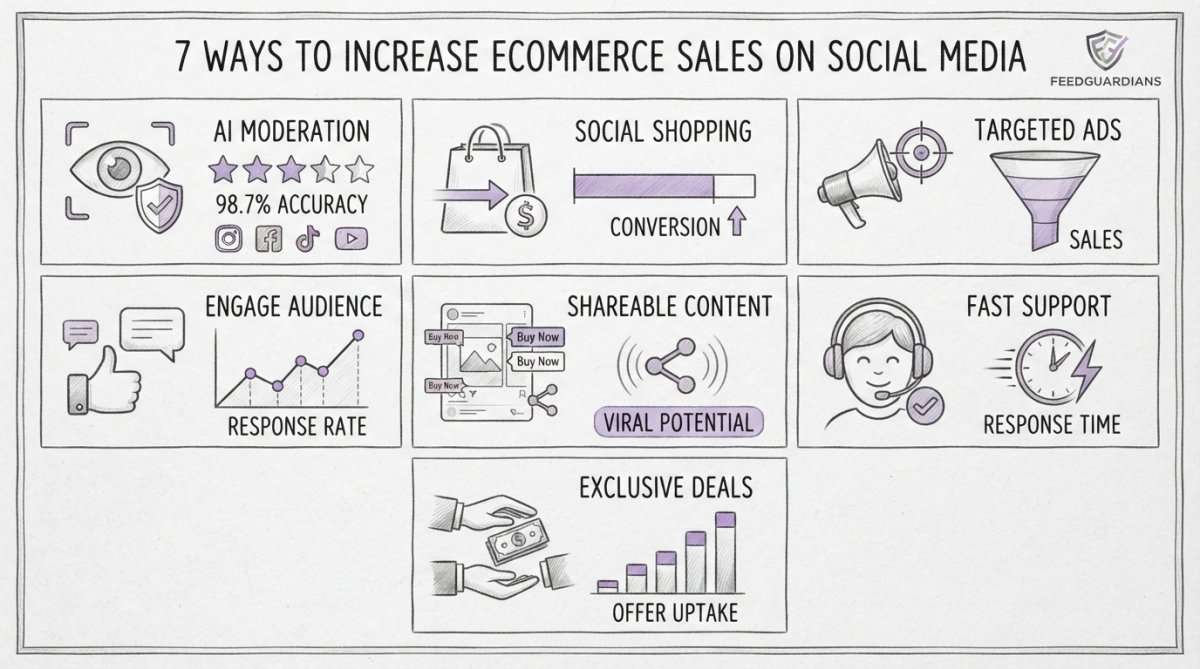
When it comes to driving revenue through social channels, most ecommerce brands focus on the wrong metrics. The real path to growth involves understanding 7 ways to increase ecommerce sales on social media that actually convert browsers into buyers. At FeedGuardians, we've analyzed hundreds of successful social commerce strategies, and the pattern is clear: winning brands build systems that turn engagement into transactions.
1. Build a Comprehensive Social Media Strategy and Content Plan
Your social media strategy is a business system. The difference between brands that generate consistent sales and those that treat social as a side project comes down to mapping who they're reaching, what content converts, and where their audience spends time.
Define Your Audience and Create Buyer Personas
Start by identifying customer segments most likely to buy. Pull transaction records from the last 12 months and identify patterns in age, location, interests, and purchase frequency. Layer in behavioral signals: which audiences engage most with your content, click through to your website, and actually convert?
Map Your Content Strategy Across Platforms
Each platform has different content rhythms. Instagram rewards polished, visually consistent feeds. TikTok thrives on raw, authentic, fast-paced content. Facebook prioritizes engagement and watch time. YouTube demands longer-form storytelling.
Map your content strategy by platform: decide what percentage of posts will be educational, entertaining, promotional, and community-focused. A common distribution is 40% educational, 30% entertaining, 20% community/user-generated, and 10% promotional. Document a 90-day content calendar specifying posting frequency, content types, and themes for each platform.
2. Use Social Commerce Strategies to Drive Direct Sales
Winning at social commerce means removing friction from discovery to checkout. Every click away from the platform, every form field, every second of loading time is a potential drop-off.
Optimize Product Pages and Descriptions
Write product descriptions that answer questions your audience actually asks. Include specific dimensions, weight, materials, and care instructions. Add 3-5 high-quality product images from different angles and at least one lifestyle image showing the product in use.
Customer reviews dramatically increase conversion rates. Encourage satisfied customers to leave reviews within 48 hours of purchase. Offer a small incentive (10% off next order, giveaway entry) for reviews. Display highest-rated and most helpful reviews prominently.
Simplify Your Checkout Process
Use native checkout features whenever possible: Instagram Checkout, Facebook Pay, TikTok Shop's integrated payment system. These keep customers on the platform and reduce friction. If directing to your website, ensure mobile optimization (90%+ of social commerce is mobile), sub-3-second load times, and checkout completion in 3 clicks.
Offer multiple payment options: credit card, PayPal, Apple Pay, Google Pay, and buy-now-pay-later services like Afterpay or Klarna.
3. Create Engaging Video Content and User-Generated Content
Video content drives 80% of social media engagement. Videos that convert stop the scroll, hold attention, and create urgency or desire for your product.
Produce Platform-Specific Video Content
TikTok videos should be 15-60 seconds, shot vertically, with fast cuts and trending audio. Instagram Reels should be 15-90 seconds with high production quality and clear CTAs. YouTube videos can be 5-20 minutes for deeper storytelling. Facebook videos should be 15-30 seconds with captions (most users watch without sound).
Follow this pattern: hook in the first 3 seconds, demonstrate value in the middle, include a clear next step at the end. Product demo videos outperform lifestyle videos by 2-3x in conversion.
Encourage and Amplify User-Generated Content
Customer testimonials and unboxing videos are 5-10x more persuasive than brand-created content. Create a branded hashtag and ask customers to post unboxing videos, styling photos, or reviews using it. Offer a monthly giveaway for the best submission (free product or $50-100 store credit). Repost the best content to your main feed, tagging the customer.
4. Run Live Shopping Events to Boost Real-Time Engagement
Live shopping events create urgency and allow real-time interaction. A well-executed live stream can generate 5-10x the engagement of a static post and drive meaningful sales in a single hour.
Plan and Promote Your Live Shopping Event
Choose a specific date and time, then promote across all channels at least 5 days in advance. Create reminder posts on Instagram, pinned posts on Facebook, TikTok announcements, and email alerts. Select 5-10 products to feature and prepare a 2-3 minute segment for each: demo the product, answer common questions, show it being used, announce the live-only discount.
Recruit a co-host if possible, a team member, influencer, or customer. Live streams with multiple speakers are significantly more engaging than solo presentations.
Maximize Conversions During the Live Stream
Go live 2-3 minutes early to build anticipation. During the stream, read comments aloud and respond to questions. Use visual aids: product close-ups, demo videos, before-and-after photos, customer testimonials. Change visuals every 30-45 seconds to maintain attention.
Announce the discount or limited quantity early and repeat every 5-10 minutes. Include a clear CTA: "Tap the link in my bio" (Instagram), "Shop now in comments" (Facebook), or "Link in bio" (TikTok).
5. Partner with Influencers Through Strategic Collaborations
Influencer partnerships work because they transfer trust. An influencer's audience trusts their opinion more than brand messaging.
Identify and Vet the Right Influencers
Don't chase follower counts. A micro-influencer with 10K highly engaged followers in your niche outperforms a macro-influencer with 500K disengaged followers. Look for influencers whose audience matches your buyer persona and whose content aligns with your brand values.
Use tools like HypeAudience or Influee to search by niche, follower count, engagement rate, and audience demographics. Filter for engagement rate above 3% and audience overlap with your target market. Reach out with a personalized pitch referencing a specific post you liked. Offer a flat fee, commission on sales, or free product plus commission.
Measure Influencer Campaign Performance
Provide each influencer with a unique discount code or affiliate link to track exactly how many sales they drive. Calculate ROI: if you paid $500 and they drove $2,000 in sales, that's a 4x return. Build ongoing relationships with top performers rather than one-off campaigns.
6. Deploy Targeted Social Media Ads and Paid Promotions
Organic reach on social platforms has declined significantly. To reach customers at scale, you need paid advertising.
Use Advanced Audience Targeting and Retargeting
Start with detailed audience targeting. On Meta Ads Manager, target by age, location, interests, behaviors, and lookalike audiences. Create a lookalike audience based on your best customers, those with the highest lifetime value and lowest return rates. This audience typically converts at 2-3x the rate of cold audiences.
Retargeting is where the real ROI lives. Create a pixel on your website that tracks visitors, then retarget them with ads showing products they viewed. A customer who viewed a product but didn't buy is 10-100x more likely to convert when retargeted with that specific product.
Optimize Ad Creative and Landing Pages
Test multiple versions of ad creative: different images, copy, and CTAs. Run 3-5 variations simultaneously and pause underperformers after 3-5 days of data. Video ads outperform static image ads by 2-3x.
Create short (15-30 second) video ads showing your product in action, highlighting a specific benefit, and including a clear CTA. Send traffic from ads to a dedicated landing page optimized for conversion, not your homepage. The landing page should match the ad's messaging, show the product prominently, include social proof (reviews, ratings, testimonials), and have a single, clear CTA.
7. Implement Social Media Selling Tools for Seamless Operations
As you scale social commerce, manual processes break down. You need tools that automate product syncing, manage inventory across platforms, handle customer service at scale, and protect your brand reputation.
Choose the Right Platform and Tools for Your Needs
Your ecommerce platform (Shopify, WooCommerce, BigCommerce) determines which social selling tools are available. Shopify integrates deeply with Meta Commerce Manager for real-time inventory sync and centralized campaign management.
For comment management and customer service at scale, FeedGuardians automatically detects and hides spam, hate speech, and competitor links with 98.7% accuracy while delivering 24/7 AI-powered replies in your brand voice. This is critical during high-engagement periods when manual responses become impossible. FeedGuardians learns your tone and terminology, so replies feel authentic and on-brand.
Use Hootsuite or Sprout Social for content scheduling and cross-platform posting. These tools let you plan content weeks in advance and track performance metrics.
| Tool Category | Best Option | Key Benefit |
|---|---|---|
| Comment Moderation & AI Replies | FeedGuardians | 98.7% accuracy, 24/7 responses |
| Content Scheduling | Hootsuite | Multi-platform posting |
| Influencer Management | Influencer Hero | Campaign tracking, affiliate payouts |
| Social Analytics | Sprout Social | Deep engagement insights |
Protect Your Brand Reputation While Scaling Sales
As your social presence grows, set up a comment moderation workflow: all comments are reviewed, spam and hate speech are hidden automatically, and negative comments are escalated to your team for response. Monitor brand mentions across platforms using a social listening tool. Customers who receive quick responses are 3-5x more likely to become loyal.
Protect your ad accounts and social accounts with strong passwords, two-factor authentication, and limited team access.
Advanced Analytics and ROI Measurement for Social Commerce
Measuring true ROI requires tracking the full customer journey, not just last-click attribution. Set up UTM parameters on all social links using consistent naming: utm_source (instagram, facebook, tiktok, youtube), utm_medium (social, paid, organic), utm_campaign (product_launch, summer_sale, influencer_collab).
Track these core metrics for each platform: reach, engagement, click-through rate, conversion rate, cost per acquisition, and return on ad spend (ROAS). Calculate the lifetime value of customers acquired from each platform and shift more budget to platforms with higher-value customers.
The path to sustainable social commerce sales isn't about chasing the latest platform or trend. It's about building systems: a clear strategy, optimized product pages, engaging content, influencer partnerships, targeted ads, and tools that automate repetitive work.
The challenge most brands face isn't knowing what to do, it's managing operational complexity as volume scales. FeedGuardians solves the customer engagement piece by automatically moderating harmful comments, detecting spam with 98.7% accuracy, and delivering 24/7 AI-powered responses in your unique brand voice. This keeps your team focused on strategy and creative work while the tool handles volume, protecting your brand reputation and boosting ad performance instantly.
Frequently Asked Questions
What are the best social media platforms for ecommerce sales?
The top platforms for ecommerce sales on social media vary by audience. Facebook Shops, Instagram Shopping, TikTok Shop, and Pinterest Product Pins each serve different demographics and buying behaviors. Facebook and Instagram are ideal for broad consumer audiences, TikTok for younger demographics, and Pinterest for visual discovery-driven purchases. Your choice depends on where your target audience spends time and what type of products you sell. Test multiple platforms to see which drives the highest conversion rates and return on ad spend (ROAS) for your business.
How can I increase ecommerce sales on social media without a huge advertising budget?
Focus on organic strategies first: create engaging video content, encourage user-generated content, optimize your product descriptions, and build genuine customer engagement. Leverage influencer collaborations with micro-influencers who have lower rates but engaged audiences. Use free social media selling tools to streamline operations, and implement customer reviews and testimonials to build trust. Prioritize content strategy and audience targeting over raw ad spend, a well-planned $500 campaign often outperforms a poorly targeted $5,000 campaign.
What role does live shopping play in social commerce strategies?
Live shopping events create real-time engagement opportunities that drive urgency and conversions. During live streams, you can showcase products, answer customer questions instantly, and offer exclusive discounts or promotions. Live shopping combines the personal touch of in-store shopping with the convenience of ecommerce, leading to higher average order values and customer loyalty. Platforms like Facebook Live, Instagram Live, and TikTok Live support this format. Schedule regular live events, promote them in advance, and use them to build community while directly selling products.
How do I measure ROI from my social media ecommerce efforts?
Track key performance indicators (KPIs) including conversion rates, average order value, customer acquisition cost (CAC), return on ad spend (ROAS), and customer lifetime value. Use platform analytics (Meta Ads Manager, TikTok Analytics) and third-party tools to attribute sales back to specific posts, campaigns, or influencers. Monitor abandoned cart rates, email follow-ups, and repeat purchase rates. Set baseline metrics before launching campaigns, then compare performance monthly. Advanced analytics reveal which content types, audience segments, and selling tools generate the best returns.
What should I do if negative feedback or complaints appear on my social media posts?
Respond promptly and professionally to all feedback, both positive and negative. Address complaints publicly and offer to move the conversation to direct messages for sensitive issues. Use this as an opportunity to show your customer service commitment. For spam, hate speech, or competitor attacks, use moderation tools to hide or remove inappropriate comments. Tools like FeedGuardians can automatically detect and manage harmful content while ensuring legitimate customer concerns are escalated to your team. Transparency and quick resolution build trust and protect your brand reputation.
This article was written using GrandRanker
Tired of manually moderating comments?
FeedGuardians automates spam filtering, responds to customers, and protects your brand — setup in 3 minutes.
Frequently Asked Questions
What are the best social media platforms for ecommerce sales?
The top platforms for ecommerce sales on social media vary by audience. Facebook Shops, Instagram Shopping, TikTok Shop, and Pinterest Product Pins each serve different demographics and buying behaviors. Facebook and Instagram are ideal for broad consumer audiences, TikTok for younger demographics, and Pinterest for visual discovery-driven purchases. Your choice depends on where your target audience spends time and what type of products you sell. Test multiple platforms to see which drives the highest conversion rates and return on ad spend (ROAS) for your business.
How can I increase ecommerce sales on social media without a huge advertising budget?
Focus on organic strategies first: create engaging video content, encourage user-generated content, optimize your product descriptions, and build genuine customer engagement. Leverage influencer collaborations with micro-influencers who have lower rates but engaged audiences. Use free social media selling tools to streamline operations, and implement customer reviews and testimonials to build trust. Prioritize content strategy and audience targeting over raw ad spend—a well-planned $500 campaign often outperforms a poorly targeted $5,000 campaign.
What role does live shopping play in social commerce strategies?
Live shopping events create real-time engagement opportunities that drive urgency and conversions. During live streams, you can showcase products, answer customer questions instantly, and offer exclusive discounts or promotions. Live shopping combines the personal touch of in-store shopping with the convenience of ecommerce, leading to higher average order values and customer loyalty. Platforms like Facebook Live, Instagram Live, and TikTok Live support this format. Schedule regular live events, promote them in advance, and use them to build community while directly selling products.
How do I measure ROI from my social media ecommerce efforts?
Track key performance indicators (KPIs) including conversion rates, average order value, customer acquisition cost (CAC), return on ad spend (ROAS), and customer lifetime value. Use platform analytics (Meta Ads Manager, TikTok Analytics) and third-party tools to attribute sales back to specific posts, campaigns, or influencers. Monitor abandoned cart rates, email follow-ups, and repeat purchase rates. Set baseline metrics before launching campaigns, then compare performance monthly. Advanced analytics reveal which content types, audience segments, and selling tools generate the best returns.
What should I do if negative feedback or complaints appear on my social media posts?
Respond promptly and professionally to all feedback—both positive and negative. Address complaints publicly and offer to move the conversation to direct messages for sensitive issues. Use this as an opportunity to show your customer service commitment. For spam, hate speech, or competitor attacks, use moderation tools to hide or remove inappropriate comments. Tools like FeedGuardians can automatically detect and manage harmful content while ensuring legitimate customer concerns are escalated to your team. Transparency and quick resolution build trust and protect your brand reputation.