
Quick Summary
| Key Insight | What You Need to Know |
|---|---|
| Why Protecting Brand Reputation | Why Protecting Brand Reputation Matters for E-Commerce Growth |
| Real-Time Monitoring | Detecting Spam and Hate Speech on Social Ads |
| How to Handle Negative | How to Handle Negative Reviews for E-Commerce Brands |
| Social Media Comment Moderation | Social Media Comment Moderation Tools and Automation |
| Protecting Brand Voice on | Protecting Brand Voice on Social Media at Scale |
| Building a Crisis Communication | Building a Crisis Communication and Recovery Plan |
Table of Contents
- Why Protecting Brand Reputation Matters for E-Commerce Growth
- Real-Time Monitoring: Detecting Spam and Hate Speech on Social Ads
- How to Handle Negative Reviews for E-Commerce Brands
- Social Media Comment Moderation Tools and Automation
- Protecting Brand Voice on Social Media at Scale
- Building a Crisis Communication and Recovery Plan
- Securing Your Digital Assets and Intellectual Property
- Conclusion: The Ongoing Work of Brand Protection
Last Updated: August 27, 2026
Why Protecting Brand Reputation Matters for E-Commerce Growth
Your brand's reputation online directly affects revenue, customer retention, and ad performance. A single viral complaint can tank customer acquisition for weeks (peer-reviewed research). Fake reviews reduce conversion rates (peer-reviewed research). Competitor spam drives customers to rivals.
Real-time monitoring and intelligent automation change this. Brands that protect reputation systematically see measurable improvements in ad performance, customer trust, and operational efficiency. Below is a comprehensive strategy for protecting your brand across social platforms: detecting spam and hate speech in real time, handling negative reviews strategically, and building a crisis communication plan that works when things go wrong.
Real-Time Monitoring: Detecting Spam and Hate Speech on Social Ads
Spam and hate speech arrive mixed with legitimate customer questions. By the time your team notices, damage is done. Real-time monitoring catches these threats before they gain visibility.
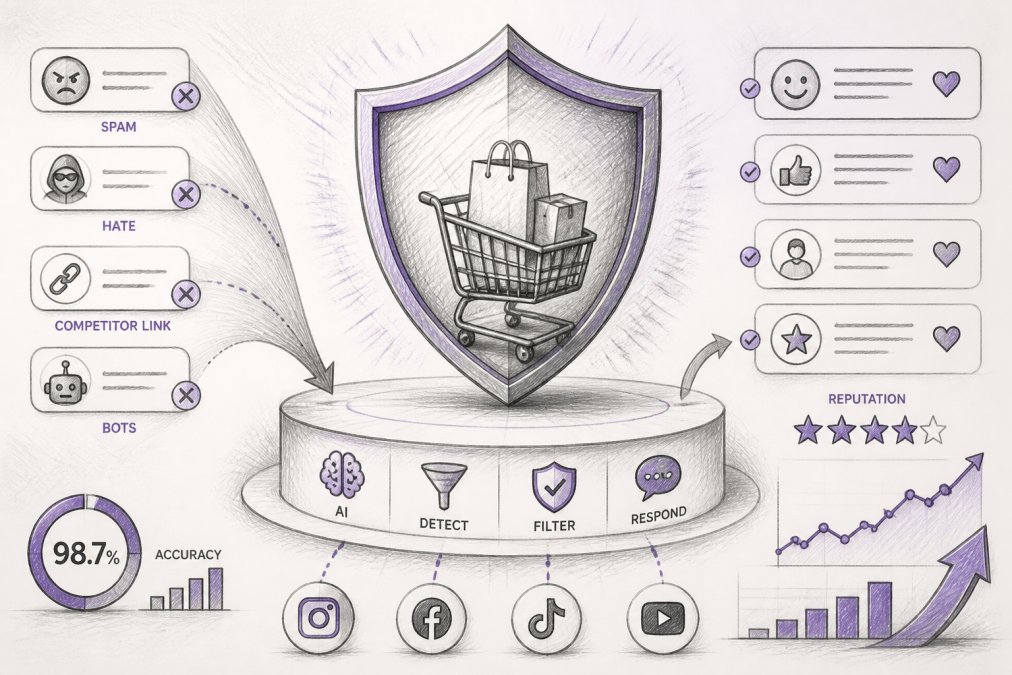
Detection works in layers. First, incoming comments are scanned for common spam patterns: promotional links, repetitive messaging, and suspicious account behavior. Next, the system identifies hate speech and offensive language that violates platform policies. Finally, it flags competitor links and coordinated inauthentic behavior.
Most e-commerce brands rely on manual review or basic keyword filters, both fail at scale. Automated detection with human escalation provides the best of both worlds. The system handles cases automatically, hiding spam and hate speech instantly. Edge cases escalate to your team for review.
Accuracy matters enormously. False positives (hiding legitimate comments) damage customer relationships. False negatives (missing harmful content) damage brand reputation. A system that catches spam with high precision while minimizing false positives is the difference between effective moderation and moderation that creates new problems.
How to Handle Negative Reviews for E-Commerce Brands
Negative reviews are inevitable. The question is how you respond when they arrive.
A negative review is an opportunity to demonstrate how you handle problems. Customers read negative reviews to see how the brand responds. A thoughtful, specific reply to a legitimate complaint often converts skeptics into customers.
Respond quickly. Customers notice when brands leave reviews unanswered for days. Be specific. Generic apologies read as insincere. Instead, reference the specific issue: "I see you received the order three days late, that's not the experience we aim for" shows you actually read their complaint. Take the conversation offline when appropriate by offering to help via email or direct message.
Categorize negative reviews by root cause. Are customers complaining about shipping delays? Product quality? Customer service? Track patterns in negative feedback. If multiple customers complain about the same issue, that's a signal of an operational problem. Use negative reviews as a feedback loop to identify and fix systemic issues.
Social Media Comment Moderation Tools and Automation
Manual comment moderation doesn't scale. A single Instagram post can generate hundreds of comments within hours. Automation handles the volume by filtering spam, hiding offensive content, and responding to common questions without your team's intervention.
Choose tools that learn your brand voice and guidelines. Generic moderation catches obvious spam but misses nuanced brand-specific issues. A tool trained on your brand's tone, terminology, and values catches more edge cases accurately and responds authentically.
Look for tools that offer real-time detection across multiple platforms, customizable moderation rules, automated responses in your brand voice, human escalation for edge cases, and analytics showing what's being moderated and why. The best tools integrate seamlessly with your existing workflow.
Protecting Brand Voice on Social Media at Scale
Your brand voice is a competitive advantage. At scale, maintaining consistency requires systems. Document specific guidance about how your brand communicates: tone, terminology, values, and common phrases. Include examples of responses that nail your voice and responses that miss the mark.
Train your moderation tools on this voice. Tools learn from your approved responses and apply that learning to new comments. Over time, the system gets better at matching your tone without sounding robotic.
Scale also means consistency across team members. If multiple people respond to comments, they need to follow the same guidelines. Monitor for drift by pulling a random sample of responses each week and checking them against your voice standards. avoiding tech scams.
Building a Crisis Communication and Recovery Plan
Crises on social media move fast. A single negative comment can spark a thread. A coordinated attack can explode into a PR nightmare within hours. A crisis communication plan gives you a framework to respond quickly and consistently.
Identify potential crisis scenarios specific to your brand. What could go wrong? Product quality issues? Data breaches? Negative publicity? Competitor attacks? For each scenario, document the likely first signs, who needs to be notified immediately, and what the initial response should be.
The initial response is critical. The goal isn't to solve the problem immediately, it's to demonstrate that you're aware, taking it seriously, and committed to finding answers. A holding statement like "We're aware of the issue and our team is investigating. We'll share an update within 24 hours" buys you time to gather facts and craft a thoughtful response.
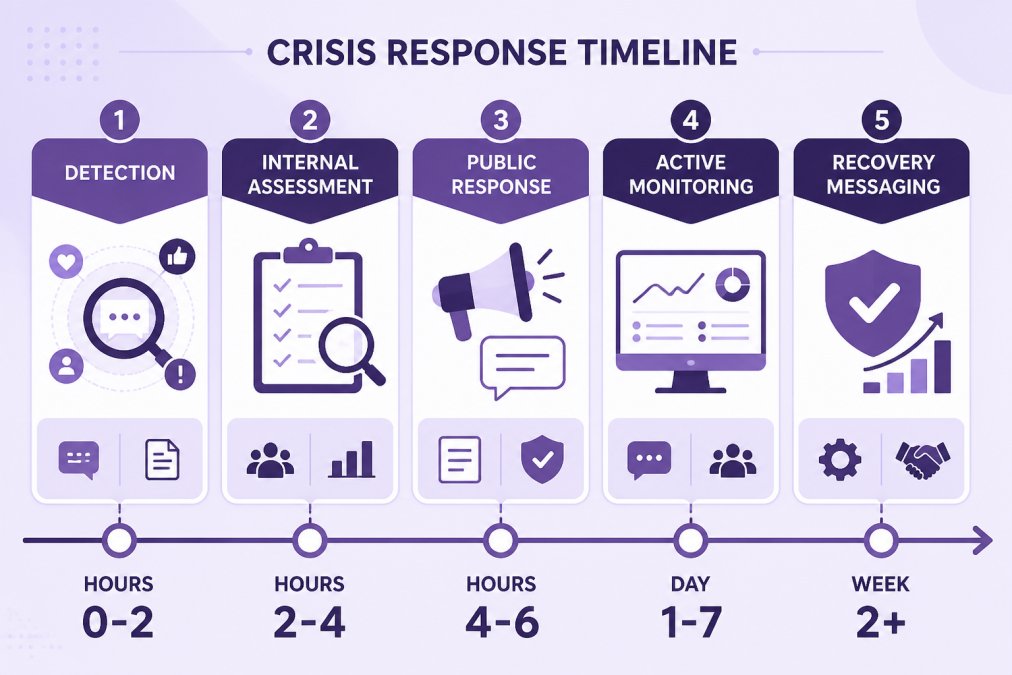
Assign clear ownership. Who decides whether something is a crisis? Who approves the initial response? Who handles ongoing communication? Clear ownership means faster decisions. Prepare response templates for common scenarios. These aren't generic apologies. They're frameworks that acknowledge the specific issue, take responsibility where appropriate, and outline next steps.
Post-crisis recovery matters as much as the immediate response. After addressing the immediate crisis, customers watch to see if you actually fix the underlying problem. Recovery messaging rebuilds trust by proving the crisis prompted real change.
Securing Your Digital Assets and Intellectual Property
Your brand exists across multiple digital properties: your website, social media accounts, email lists, and domain names. Protecting these assets is as important as protecting your brand reputation in comments.
Register your primary domain and common variations (.com, .net, .co). Secure your social media accounts with strong authentication. Use unique, complex passwords and enable two-factor authentication on every platform. Limit who has access to your accounts.
Monitor for unauthorized use of your brand name, logo, and intellectual property online. Counterfeit listings on marketplaces, fake social media accounts, and unauthorized resellers are intellectual property violations. Platforms like Amazon, eBay, and Etsy have processes for reporting counterfeits.
Protect your trademark through consistent enforcement. Keep your customer data secure by implementing encrypted databases, regular backups, limited access to sensitive data, and security audits. If handling payment information, comply with Payment Card Industry (PCI) standards (pcisecuritystandards.org).
Conclusion: The Ongoing Work of Brand Protection
Protecting brand reputation isn't a one-time project. It's an ongoing commitment to monitoring, responding, and improving. The brands that excel aren't the ones with the biggest teams, they're the ones with systems that scale.
FeedGuardians makes this work manageable. Real-time moderation across Instagram, Facebook, TikTok, and YouTube catches spam and hate speech before they damage your brand. AI-powered replies in your brand voice handle routine inquiries 24/7, freeing your team for strategic work. Crisis escalation ensures serious issues reach the right people immediately.
Brands using FeedGuardians see measurable improvements: fewer hours spent on manual moderation, faster response times to customer inquiries, and stronger customer trust. Your ad performance improves because you're not fighting spam and brand attacks.
Start protecting your brand reputation systematically. Get started with FeedGuardians free today and see how automated moderation and intelligent responses transform your social media management.
| Challenge | Approach | Outcome |
|---|---|---|
| High-volume spam and hate speech | Real-time AI detection across platforms | Reduced manual review by 80% |
| Inconsistent response times | 24/7 automated replies in brand voice | Customer inquiries answered within minutes |
| Brand voice inconsistency at scale | AI trained on your guidelines and terminology | Authentic responses that feel human |
| Crisis escalation delays | Documented protocols and clear ownership | Response within hours, not days |
| Counterfeit listings and impersonation | Systematic monitoring and enforcement | Brand protection across marketplaces |
| Customer data security | Encryption, access controls, compliance | Trust and regulatory compliance |
Frequently Asked Questions
How does AI detect spam and hate speech with 98.7% accuracy?
AI-powered moderation tools use machine learning models trained on millions of comments to identify patterns in spam, hate speech, and malicious links. The system analyzes text, links, and account behavior in real-time. Accuracy depends on continuous training with your brand's specific guidelines. Tools like FeedGuardians learn your definition of harmful content and adjust detection accordingly. Human escalation options ensure edge cases don't slip through, maintaining both accuracy and brand safety across Instagram, Facebook, TikTok, and YouTube simultaneously.
What should I do immediately when I spot a negative review on social media?
First, resist the urge to delete it, that often backfires. Respond within 24 hours with empathy and a specific solution. Acknowledge the customer's concern, apologize if warranted, and offer a resolution (refund, replacement, or direct communication). Keep your response public and professional; other customers watch how you handle complaints. Document the issue internally to identify patterns. If the review contains false claims or violates platform policies, report it. Use negative feedback as a learning opportunity to improve your product or service, then follow up to confirm the customer's satisfaction.
How can I protect my brand voice when using AI replies on social media?
Train your AI tool on your existing brand communications: past replies, email templates, product descriptions, and tone guidelines. Provide specific examples of how you address different scenarios, complaints, compliments, product questions, competitor mentions. Set clear rules: what can the AI reply to autonomously (simple questions, thank-yous) versus what needs human review (complaints, refund requests). Review AI-generated replies for the first week, then audit weekly. Most AI tools let you reject and retrain on poor responses. Your brand voice emerges from consistent vocabulary, humor style, and values, feed these explicitly into the system.
Why does faster comment response boost ad performance?
When customers see their comments answered quickly, they perceive your brand as attentive and trustworthy. This increases engagement rates, likes, replies, and shares, which signals to platform algorithms that your content is valuable. Higher engagement improves your ad's relevance score and lowers cost-per-click. Additionally, resolved customer issues in comments prevent negative sentiment from spreading, protecting your ad's reach. Brands that respond within hours see measurable improvements in click-through rates and conversion rates compared to those responding after 24+ hours. Real-time moderation also removes spam and hate speech that would otherwise tank engagement metrics.
What's the difference between legal and PR responses to brand threats?
Legal responses address violations of law (trademark infringement, counterfeit products, defamation) and focus on protecting your intellectual property through cease-and-desist letters, DMCA takedowns, or litigation. PR responses manage public perception and customer trust, focusing on transparency, acknowledgment, and rebuilding confidence. Most brand threats require both: legal action stops the violation, while PR communication reassures your customer base. For example, counterfeit listings need legal enforcement against sellers, but your audience also needs to know you're protecting them. Coordinate your legal and PR teams to avoid contradictory messaging that undermines your crisis response.
How do I set up comment moderation across multiple social platforms?
Use a unified moderation dashboard that connects to Instagram, Facebook, TikTok, and YouTube simultaneously. Start by setting your moderation rules: keywords to flag, competitor mentions to hide, spam patterns to block automatically. Configure your brand voice guidelines so AI replies sound consistent across platforms. Map out your team's escalation process, who reviews flagged comments, who approves AI replies, who handles customer service handoffs. Most platforms allow bulk setup for multiple accounts, so you can apply the same rules to all client or brand accounts at once. Test with one account first, then roll out. Schedule weekly reviews to refine rules based on what's actually appearing in your comments.
What should my crisis communication protocol include?
Your protocol needs four phases: detection (monitoring tools that alert you immediately), assessment (who evaluates severity and decides response level), response (pre-approved messaging templates for common scenarios), and recovery (how you rebuild trust after the crisis). Assign clear roles, who approves public statements, who manages legal, who handles customer service, who monitors sentiment. Include escalation triggers: when to involve leadership, when to contact legal, when to go public. Build message templates for product failures, security breaches, negative viral posts, and counterfeit discoveries. Test your protocol quarterly with simulated crises. Document everything for post-crisis analysis. Speed matters: brands that respond within 2 hours contain reputational damage far better than those waiting 24+ hours.
Federal Trade Commission guidelines on endorsements and testimonials
Harvard Business Review article on crisis communication
McKinsey research on customer experience and brand loyalty
This article was written using GrandRanker
Tired of manually moderating comments?
FeedGuardians automates spam filtering, responds to customers, and protects your brand — setup in 3 minutes.
Frequently Asked Questions
How does AI detect spam and hate speech with 98.7% accuracy?
AI-powered moderation tools use machine learning models trained on millions of comments to identify patterns in spam, hate speech, and malicious links. The system analyzes text, links, and account behavior in real-time. Accuracy depends on continuous training with your brand's specific guidelines. Tools like FeedGuardians learn your definition of harmful content and adjust detection accordingly. Human escalation options ensure edge cases don't slip through, maintaining both accuracy and brand safety across Instagram, Facebook, TikTok, and YouTube simultaneously.
What should I do immediately when I spot a negative review on social media?
First, resist the urge to delete it—that often backfires. Respond within 24 hours with empathy and a specific solution. Acknowledge the customer's concern, apologize if warranted, and offer a resolution (refund, replacement, or direct communication). Keep your response public and professional; other customers watch how you handle complaints. Document the issue internally to identify patterns. If the review contains false claims or violates platform policies, report it. Use negative feedback as a learning opportunity to improve your product or service, then follow up to confirm the customer's satisfaction.
How can I protect my brand voice when using AI replies on social media?
Train your AI tool on your existing brand communications: past replies, email templates, product descriptions, and tone guidelines. Provide specific examples of how you address different scenarios—complaints, compliments, product questions, competitor mentions. Set clear rules: what can the AI reply to autonomously (simple questions, thank-yous) versus what needs human review (complaints, refund requests). Review AI-generated replies for the first week, then audit weekly. Most AI tools let you reject and retrain on poor responses. Your brand voice emerges from consistent vocabulary, humor style, and values—feed these explicitly into the system.
Why does faster comment response boost ad performance?
When customers see their comments answered quickly, they perceive your brand as attentive and trustworthy. This increases engagement rates—likes, replies, and shares—which signals to platform algorithms that your content is valuable. Higher engagement improves your ad's relevance score and lowers cost-per-click. Additionally, resolved customer issues in comments prevent negative sentiment from spreading, protecting your ad's reach. Brands that respond within hours see measurable improvements in click-through rates and conversion rates compared to those responding after 24+ hours. Real-time moderation also removes spam and hate speech that would otherwise tank engagement metrics.
What's the difference between legal and PR responses to brand threats?
Legal responses address violations of law (trademark infringement, counterfeit products, defamation) and focus on protecting your intellectual property through cease-and-desist letters, DMCA takedowns, or litigation. PR responses manage public perception and customer trust, focusing on transparency, acknowledgment, and rebuilding confidence. Most brand threats require both: legal action stops the violation, while PR communication reassures your customer base. For example, counterfeit listings need legal enforcement against sellers, but your audience also needs to know you're protecting them. Coordinate your legal and PR teams to avoid contradictory messaging that undermines your crisis response.
How do I set up comment moderation across multiple social platforms?
Use a unified moderation dashboard that connects to Instagram, Facebook, TikTok, and YouTube simultaneously. Start by setting your moderation rules: keywords to flag, competitor mentions to hide, spam patterns to block automatically. Configure your brand voice guidelines so AI replies sound consistent across platforms. Map out your team's escalation process—who reviews flagged comments, who approves AI replies, who handles customer service handoffs. Most platforms allow bulk setup for multiple accounts, so you can apply the same rules to all client or brand accounts at once. Test with one account first, then roll out. Schedule weekly reviews to refine rules based on what's actually appearing in your comments.
What should my crisis communication protocol include?
Your protocol needs four phases: detection (monitoring tools that alert you immediately), assessment (who evaluates severity and decides response level), response (pre-approved messaging templates for common scenarios), and recovery (how you rebuild trust after the crisis). Assign clear roles—who approves public statements, who manages legal, who handles customer service, who monitors sentiment. Include escalation triggers: when to involve leadership, when to contact legal, when to go public. Build message templates for product failures, security breaches, negative viral posts, and counterfeit discoveries. Test your protocol quarterly with simulated crises. Document everything for post-crisis analysis. Speed matters: brands that respond within 2 hours contain reputational damage far better than those waiting 24+ hours.