Quick Summary
| Key Insight | What You Need to Know |
|---|---|
| Why Businesses Switch From | Why Businesses Switch From Yuma AI |
| 1. FeedGuardians | AI-Powered Comment Moderation and Response |
| 2. Gorgias | E-Commerce Focused Support Automation |
| 3. Zendesk | Omnichannel Support with AI Copilot |
| 4. Intercom | Live Chat with Fin AI Agent |
| 5. Freshdesk | Cost-Effective Omnichannel Solution |
Table of Contents
- Why Businesses Switch From Yuma AI
- Top Yuma AI Alternatives for Customer Support
- 1. FeedGuardians: AI-Powered Comment Moderation and Response
- 2. Gorgias: E-Commerce Focused Support Automation
- 3. Zendesk: Omnichannel Support with AI Copilot
- 4. Intercom: Live Chat with Fin AI Agent
- 5. Freshdesk: Cost-Effective Omnichannel Solution
- 6. Salesforce Service Cloud: Enterprise-Grade Support
- Comparison Table: Feature Breakdown
- AI Customer Service Software for Ecommerce: What to Evaluate
- Customer Support Automation Best Practices
- How to Choose the Right Alternative
- Conclusion
Last Updated: August 13, 2026
Why Businesses Switch From Yuma AI
Companies seeking a yuma ai alternative for customer support typically encounter the same limitations: restricted omnichannel reach, inflexible automation workflows, or pricing that doesn't scale. Yuma AI focuses narrowly on ticket resolution, leaving gaps in customer engagement, brand voice consistency, and social media integration.
The core issue is that customer support has fragmented across email, chat, social media, SMS, and in-app messaging. A ticket-focused tool misses conversations happening elsewhere. Teams discover this after implementation, still manually managing Instagram comments and TikTok inquiries while Yuma handles their help desk.
Switching happens for three reasons: businesses need AI that matches their brand voice, integration depth across customer platforms, and transparency about escalation paths when automation fails.
This guide covers the top yuma ai alternatives for customer support, breaking down features, pricing, and use cases to match the right tool to your operation.
Top Yuma AI Alternatives for Customer Support
1. FeedGuardians: AI-Powered Comment Moderation and Response
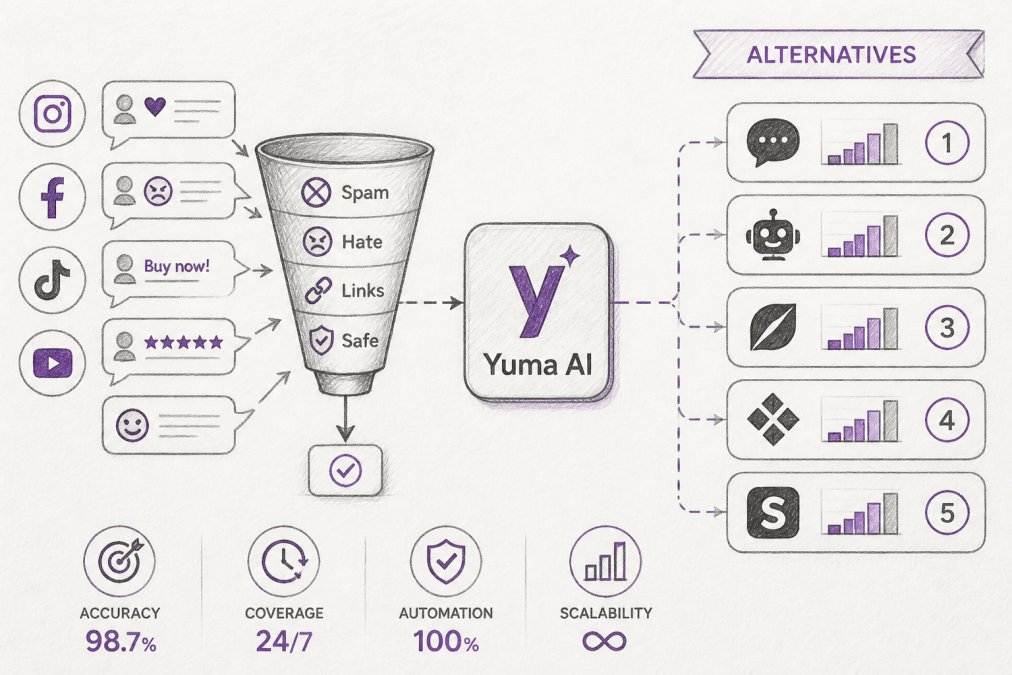
FeedGuardians automates responses and moderation across Instagram, Facebook, TikTok, and YouTube, the platforms where e-commerce brands lose revenue to unanswered inquiries and spam.
The core strength is real-time moderation with 98.7% accuracy for detecting spam, hate speech, scams, and competitor links. The AI learns your brand voice and terminology, generating contextually appropriate replies 24/7. You're not getting templated responses; you're getting personalized interactions that sound like your team wrote them.
For e-commerce, this shifts economics. A single missed comment on a viral post can cost hundreds in lost sales. FeedGuardians catches those moments automatically, responds in your tone, and escalates complex inquiries to your team.
Best for: E-commerce brands, content creators, and agencies managing high comment volumes. If your revenue depends on social media engagement, this is the yuma ai alternative for customer support that protects it in real time.
Pros:
- AI learns your unique brand voice and terminology
- 98.7% accuracy on harmful content detection
- Real-time moderation across four major platforms
- 24/7 automated replies in your voice
- Human escalation option for complex inquiries
- Free plan available
Cons:
- Focused on social media comments, not traditional help desk ticketing
- Requires brand voice training period for optimal accuracy

2. Gorgias: E-Commerce Focused Support Automation
Gorgias is built for Shopify stores and e-commerce platforms, understanding inventory, order history, and customer lifecycle. The AI Agent resolves common inquiries automatically, order status, returns, shipping, by pulling real data from your store.
Gorgias wins against Yuma through omnichannel depth: email, chat, SMS, and social media flow through a unified inbox. The AI learns what kind of inquiry typically comes from which channel, routing and responding accordingly. Pricing is ticket-based, which can spike unpredictably, but unlimited agent seats work well for growing teams.
Best for: Shopify stores and e-commerce businesses where support inquiries are transactional and data-driven.
Pros:
- Deep e-commerce platform integration (Shopify, BigCommerce, Magento)
- AI Agent handles transactional queries automatically
- Unlimited agent seats on paid plans
- Omnichannel support in one inbox
- Strong automation rules engine
Cons:
- Ticket-based pricing can lead to unpredictable costs
- AI Agent and voice/SMS channels are add-ons with separate fees
3. Zendesk: Omnichannel Support with AI Copilot
Zendesk is the enterprise standard for customer service. Its strength is architectural: email, chat, phone, social media, and self-service portals flow through a single ticketing system. The AI Copilot suggests answers and drafts responses that your team reviews before sending.
This approach appeals to larger teams and regulated industries requiring audit trails and explicit human approval. Reporting and analytics are sophisticated, showing bottlenecks, agent performance, and satisfaction trends across all channels.
The trade-off is complexity and cost. Advanced AI and omnichannel routing typically require higher-tier plans.
Best for: Enterprises and mid-market companies with dedicated support teams, complex routing requirements, and budget for comprehensive licensing.
Pros:
- Highly customizable and scalable
- Extensive app marketplace for integrations
- Strong reporting and analytics
- Enterprise-grade security and compliance
- Omnichannel support across all major channels
Cons:
- Pricing becomes expensive with add-ons and higher-tier plans
- Advanced AI features are add-ons, increasing total cost
- Steeper learning curve for smaller teams
4. Intercom: Live Chat with Fin AI Agent
Intercom positions itself as a customer messaging platform emphasizing proactive engagement and personalized experience. The Fin AI Agent handles common questions, routes complex issues to humans, and maintains conversation context across sessions. Setup is faster than most competitors.
Pricing scales with seats and messaging channels. A team of five using Intercom across email, chat, and SMS pays significantly more than the same team using a ticket-based system.
Best for: Growing e-commerce and SaaS companies wanting proactive customer engagement across multiple channels.
Pros:
- Intuitive interface and fast setup
- Strong focus on proactive customer engagement
- Fin AI Agent resolves significant query volume
- Shared inbox for team collaboration
- Help center and knowledge base included
Cons:
- Pricing increases significantly with additional seats and channels
- Total cost can be higher than advertised
- Less suitable for high-volume, transactional support
5. Freshdesk: Cost-Effective Omnichannel Solution
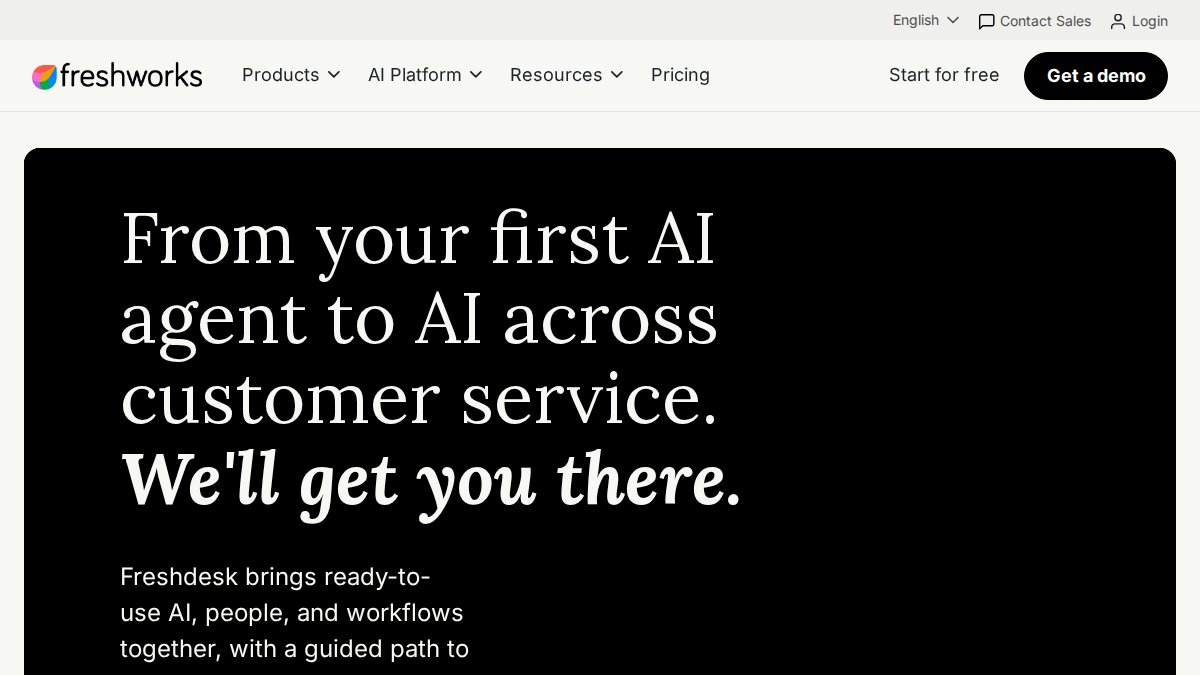
Freshdesk competes on value with omnichannel support (email, chat, phone, social media), a free plan for small teams, and predictable per-agent pricing. The Freddy AI Copilot assists agents; the Freddy AI Agent handles customer-facing automation.
Freshdesk stands out through transparency: you know exactly what you're paying per agent per month with no surprise add-on billing. For budget-conscious teams, this is valuable.
Best for: Small to mid-sized businesses looking for omnichannel support without enterprise pricing.
Pros:
- Free plan available for small teams
- Predictable per-agent pricing
- Omnichannel support across major channels
- AI Agent with metered sessions
- Good value compared to competitors
Cons:
- Omnichannel features and advanced AI often require higher-tier plans
- AI Agent sessions expire monthly with no rollover
- Less customization than enterprise alternatives
6. Salesforce Service Cloud: Enterprise-Grade Support
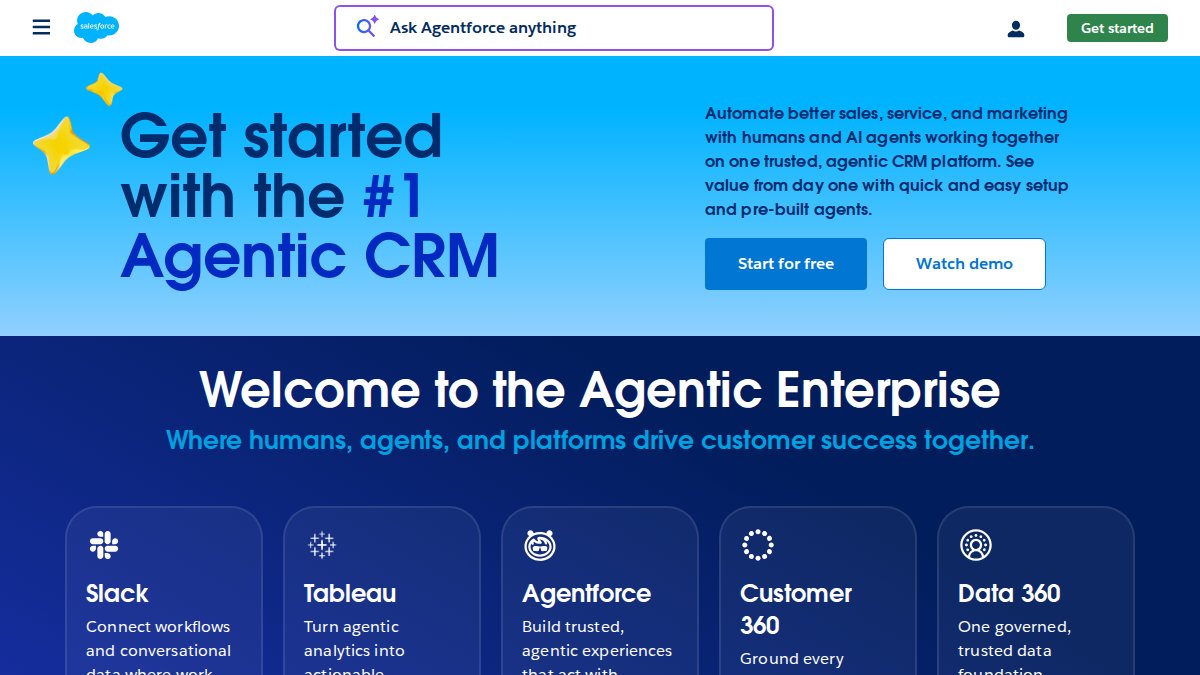
Salesforce Service Cloud is for organizations already in the Salesforce ecosystem needing support infrastructure that integrates with their CRM, sales pipeline, and business intelligence. The platform handles case management, omnichannel routing, and AI-powered agent assist through Einstein Bots.
The advantage is unified data: your support team sees the customer's full history, past purchases, open opportunities, and interactions in one view. This context matters for complex B2B support scenarios.
The disadvantage is cost and implementation complexity requiring specialized expertise.
Best for: Enterprises already committed to Salesforce with complex support requirements and implementation budget.
Pros:
- Seamless integration with broader Salesforce ecosystem
- Highly scalable and customizable for complex operations
- Advanced AI capabilities with Einstein Bots
- Unified customer data across sales and support
- Enterprise-grade security and compliance
Cons:
- Significantly more expensive than other solutions
- Complex setup and implementation requiring specialized expertise
- Steep learning curve for teams new to Salesforce
Comparison Table: Feature Breakdown
| Platform | Omnichannel Support | AI Automation | Pricing Model | Free Tier | Best For |
|---|---|---|---|---|---|
| FeedGuardians | Social media focused | Brand voice replies | See pricing page | Yes | E-commerce, content creators |
| Gorgias | Email, chat, SMS, social | Transactional AI Agent | Ticket-based | No | Shopify stores |
| Zendesk | Email, chat, phone, social | AI Copilot (agent assist) | Per-agent subscription | No | Enterprise teams |
| Intercom | Email, chat, SMS, in-app | Fin AI Agent | Per-seat + channels | No | Growing SaaS, e-commerce |
| Freshdesk | Email, chat, phone, social | Freddy AI Agent | Per-agent subscription | Yes | Small to mid-market |
| Salesforce Service Cloud | Email, chat, phone, social, case mgmt | Einstein Bots | Per-user subscription | No | Enterprises on Salesforce |
AI Customer Service Software for Ecommerce: What to Evaluate
When evaluating a yuma ai alternative for customer support, focus on these criteria rather than feature lists alone.
Automation depth. Can the AI resolve inquiries, or does it just draft responses for human review? Full automation saves time; partial automation maintains quality control. Know which model your team needs.
Platform coverage. Match the tool's strengths to where your customers actually contact you. If they're mostly on Instagram and TikTok, a traditional helpdesk alone isn't enough.
Data integration. The best AI tools pull context from your business systems. Gorgias integrates with Shopify and checks inventory. Zendesk integrates with CRMs. FeedGuardians learns your brand voice. Understand what data each tool accesses and whether that improves response quality.
Cost transparency. Ticket-based pricing (Gorgias) scales with volume but is unpredictable. Per-agent pricing (Zendesk, Freshdesk) is predictable but may overshoot during seasonal peaks. Calculate your actual cost under expected volume, not advertised starting price.
Escalation clarity. What happens when the AI can't handle an inquiry? Is there a clear human handoff? Can your team see why it escalated? These workflows matter more than automation alone.
Response time impact. Measure whether the tool actually reduces response time in your channels. Run a pilot if possible.
Customer Support Automation Best Practices
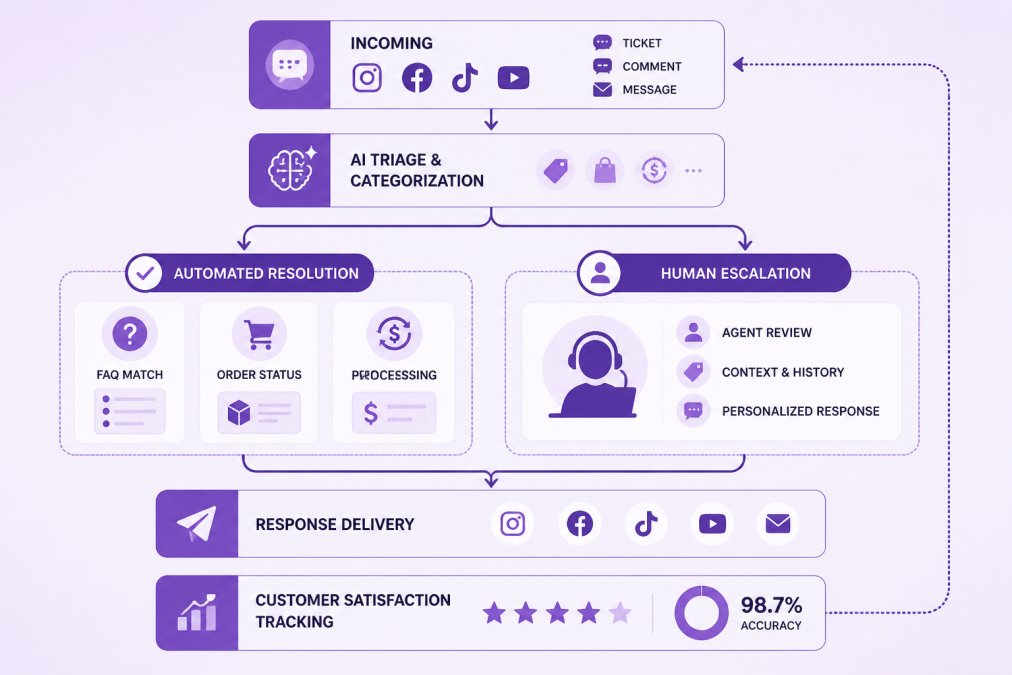
Start with high-volume, low-complexity inquiries. Automate questions that come in repeatedly with clear, data-driven answers: order status, shipping tracking, FAQ items, refund policies. Keep complex complaints and feature requests with your team initially.
Maintain a human escalation path that works. Automation fails. Your team needs to see escalations immediately, understand why they occurred, and override the AI's decision if needed. If escalations pile up in a queue, you've added latency, not saved time.
Train the AI on your actual customer interactions, not templates. FeedGuardians learns your brand voice by analyzing past comments. Gorgias learns order handling by watching your team process refunds. The best automation adapts to your specific operation.
Monitor response quality alongside response time. Track customer satisfaction scores, not just ticket resolution rates. A 10-second automated response that doesn't solve the problem is worse than a 2-hour human response that does.
Segment your automation strategy by channel. Social media comments (FeedGuardians) can handle higher automation rates because stakes are lower. Help desk tickets might need more human review due to account access or sensitive information. Live chat sits in the middle.
Set clear boundaries on what the AI can do without approval. Define these before implementation: Can it reply to comments? Process refunds? Delete comments? Access payment information? These boundaries protect customer trust.
How to Choose the Right Alternative
Map your current support operation: where do inquiries come from, how many daily, what percentage are repetitive, response time, team size. Match this baseline to a tool's actual capabilities.
Test before committing. Most platforms offer free trials or freemium plans. FeedGuardians and Freshdesk have free tiers. Run a real scenario with actual customer inquiries and see what happens.
Evaluate implementation timeline and training required. FeedGuardians and Intercom are fast (days). Zendesk and Salesforce Service Cloud are slow (weeks to months). Gorgias and Freshdesk are in the middle. If your team is stretched thin, choose speed.
Consider the yuma ai alternative for customer support matching your growth trajectory. Small e-commerce brands can start with Freshdesk or FeedGuardians and scale to mid-market. Enterprise-bound organizations should consider Zendesk or Salesforce Service Cloud.
Talk to existing customers about what surprised them, what they'd change, and whether AI automation delivered promised time savings.
Choosing the right yuma ai alternative for customer support depends on matching the tool's architecture to your actual operation. FeedGuardians excels at protecting brand reputation and revenue through real-time social media automation. For traditional help desk automation, Gorgias wins on e-commerce integration, Zendesk on enterprise scale, and Freshdesk on cost-effectiveness. Start with your current pain point, test before committing, and scale your automation strategy as your team grows. Get started with FeedGuardians and protect your social media engagement with AI-powered moderation and replies in your unique brand voice.
Frequently Asked Questions
What makes Yuma AI alternatives different from Yuma AI itself?
Yuma AI alternatives vary in their core strengths. FeedGuardians specializes in social media comment moderation and brand voice replies across Instagram, Facebook, TikTok, and YouTube with 98.7% accuracy in detecting spam and hate speech. Gorgias and Zendesk focus on omnichannel helpdesk automation for email, chat, and support tickets. Intercom emphasizes live chat and proactive messaging. The best choice depends on whether you need social media automation, traditional customer support, or both. Each platform handles ticket resolution, response time optimization, and customer satisfaction differently based on your primary support channel.
Which AI customer service software for ecommerce is best for Shopify stores?
Gorgias is purpose-built for Shopify with deep native integrations, allowing you to pull customer data, order history, and product information directly into your support workflow. This reduces manual data entry and speeds up ticket resolution. Zendesk and Intercom also support Shopify but require additional setup. FeedGuardians works best for ecommerce brands managing high comment volumes across social platforms, which directly impacts ad performance and customer retention. For pure helpdesk automation, Gorgias offers the fastest setup on Shopify. For social media-driven sales, FeedGuardians protects your ad spend and turns comments into conversions.
How do I implement customer support automation best practices with these tools?
Start with automated triage: route incoming inquiries by type (order status, returns, product questions) so AI handles routine questions while complex issues escalate to humans. Set up FAQ automation and knowledge base integration so the AI can pull answers from your help center. Enable real-time support by training the AI on your brand voice and common customer interactions. Monitor response times and resolution rates weekly. Use sentiment analysis to flag frustrated customers for priority human handling. Test your automation on low-risk inquiries first, then expand. Human-in-the-loop workflows are critical, always allow agents to review and override AI responses before they reach customers. Track customer satisfaction scores after each interaction to measure impact.
How much do Yuma AI alternatives cost compared to Yuma AI?
Pricing varies significantly. Gorgias starts at $10/month (ticket-based), Zendesk at $19/agent/month, Intercom at $29/seat/month, Freshdesk at $19/agent/month with a free plan, and Salesforce Service Cloud at $25/user/month. FeedGuardians offers a free plan with paid tiers based on volume and features. Costs scale with number of agents, monthly conversations, or billable tickets depending on the platform's model. Enterprise solutions like Salesforce and LivePerson require custom quotes. For pricing details and to compare against your current support volume, visit each platform's pricing page directly.
Can these alternatives integrate with my existing help desk software?
Yes, most offer API connectivity and integrations with popular helpdesk platforms. Zendesk, Freshdesk, and Salesforce have extensive app marketplaces. Gorgias integrates natively with Shopify and connects to most email and ticketing systems. Intercom works with CRM and marketing automation tools. FeedGuardians integrates with social platforms (Instagram, Facebook, TikTok, YouTube) and can escalate complex inquiries to your existing support team. Before switching, verify that your current tools are supported. Most platforms offer migration assistance and can import historical ticket data, so technical debt from switching is typically manageable with 1-2 weeks of setup time.
This article was written using GrandRanker
Tired of manually moderating comments?
FeedGuardians automates spam filtering, responds to customers, and protects your brand — setup in 3 minutes.
Frequently Asked Questions
What makes Yuma AI alternatives different from Yuma AI itself?
Yuma AI alternatives vary in their core strengths. FeedGuardians specializes in social media comment moderation and brand voice replies across Instagram, Facebook, TikTok, and YouTube with 98.7% accuracy in detecting spam and hate speech. Gorgias and Zendesk focus on omnichannel helpdesk automation for email, chat, and support tickets. Intercom emphasizes live chat and proactive messaging. The best choice depends on whether you need social media automation, traditional customer support, or both. Each platform handles ticket resolution, response time optimization, and customer satisfaction differently based on your primary support channel.
Which AI customer service software for ecommerce is best for Shopify stores?
Gorgias is purpose-built for Shopify with deep native integrations, allowing you to pull customer data, order history, and product information directly into your support workflow. This reduces manual data entry and speeds up ticket resolution. Zendesk and Intercom also support Shopify but require additional setup. FeedGuardians works best for ecommerce brands managing high comment volumes across social platforms, which directly impacts ad performance and customer retention. For pure helpdesk automation, Gorgias offers the fastest setup on Shopify. For social media-driven sales, FeedGuardians protects your ad spend and turns comments into conversions.
How do I implement customer support automation best practices with these tools?
Start with automated triage: route incoming inquiries by type (order status, returns, product questions) so AI handles routine questions while complex issues escalate to humans. Set up FAQ automation and knowledge base integration so the AI can pull answers from your help center. Enable real-time support by training the AI on your brand voice and common customer interactions. Monitor response times and resolution rates weekly. Use sentiment analysis to flag frustrated customers for priority human handling. Test your automation on low-risk inquiries first, then expand. Human-in-the-loop workflows are critical—always allow agents to review and override AI responses before they reach customers. Track customer satisfaction scores after each interaction to measure impact.
How much do Yuma AI alternatives cost compared to Yuma AI?
Pricing varies significantly. Gorgias starts at $10/month (ticket-based), Zendesk at $19/agent/month, Intercom at $29/seat/month, Freshdesk at $19/agent/month with a free plan, and Salesforce Service Cloud at $25/user/month. FeedGuardians offers a free plan with paid tiers based on volume and features. Costs scale with number of agents, monthly conversations, or billable tickets depending on the platform's model. Enterprise solutions like Salesforce and LivePerson require custom quotes. For pricing details and to compare against your current support volume, visit each platform's pricing page directly.
Can these alternatives integrate with my existing help desk software?
Yes, most offer API connectivity and integrations with popular helpdesk platforms. Zendesk, Freshdesk, and Salesforce have extensive app marketplaces. Gorgias integrates natively with Shopify and connects to most email and ticketing systems. Intercom works with CRM and marketing automation tools. FeedGuardians integrates with social platforms (Instagram, Facebook, TikTok, YouTube) and can escalate complex inquiries to your existing support team. Before switching, verify that your current tools are supported. Most platforms offer migration assistance and can import historical ticket data, so technical debt from switching is typically manageable with 1-2 weeks of setup time.