
Quick Summary
| Key Insight | What You Need to Know |
|---|---|
| Self-hosting requires GPU capacity | Self-hosting requires GPU capacity sized to peak throughput, not average comment volume. |
| Commercial per-request pricing scales | Commercial per-request pricing scales linearly with traffic, while self-hosted costs are step functions. |
| Build a labeled evaluation | Build a labeled evaluation set from your own comment data and score candidates per policy category. |
| Track false-positive and false-negative | Track false-positive and false-negative rates separately and compare them against human-review volume. |
| Start with a managed | Start with a managed service and move to self-hosting only if economics and control justify it. |
| Open Source vs Commercial Moderation APIs | The Core Trade-OffQuick Comparison Table |
Last Updated: November 2, 2026
Quick Summary
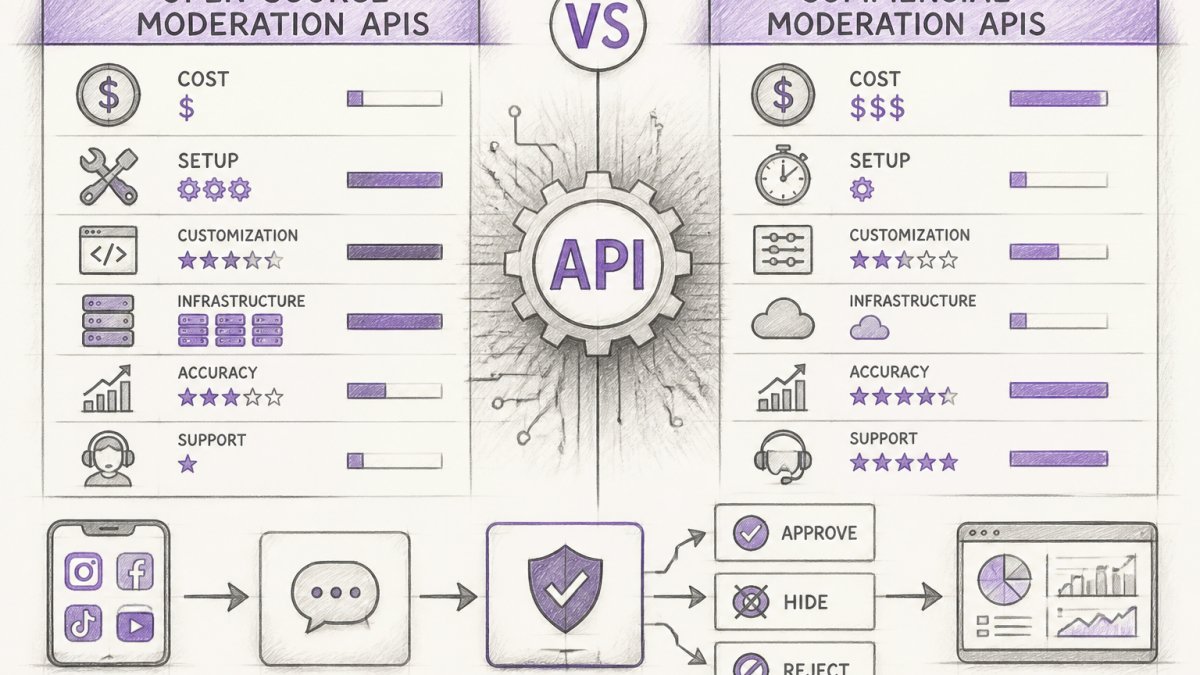
Choosing between open source and commercial moderation APIs comes down to control versus operational burden. Open-source moderation APIs give you full ownership of model weights and data, but you own the infrastructure, GPU capacity, and maintenance, while commercial APIs are managed services charged per request.
- Self-hosting requires GPU capacity sized to peak throughput, not average comment volume.
- Commercial per-request pricing scales linearly with traffic, while self-hosted costs are step functions.
- Build a labeled evaluation set from your own comment data and score candidates per policy category.
- Track false-positive and false-negative rates separately and compare them against human-review volume.
- Start with a managed service and move to self-hosting only if economics and control justify it.
Table of Contents
- Open Source vs Commercial Moderation APIs: The Core Trade-Off
- Open-Source Content Moderation Tools: Control at a Cost
- Content Moderation API Pricing: Total Cost of Ownership
- Content Moderation Accuracy: Benchmarks and the Quality Gap
- Social Media Comment Moderation Tools for E-commerce Teams
- Privacy, Retention, and Regulatory Requirements for Moderation Data
- Choosing Your Moderation Stack: Start with FeedGuardians
- Frequently Asked Questions
Open Source vs Commercial Moderation APIs: The Core Trade-Off
The choice between open source and commercial moderation APIs comes down to one trade-off: control versus operational burden. Open-source content moderation tools give you full ownership of model weights and data, but you own the infrastructure, GPU capacity, and maintenance. Commercial APIs hand you a managed service and charge per request. This comparison explains where each approach wins.
Moderation APIs are programmatic endpoints that classify user-generated text or images against a safety policy and return a decision, such as allow, flag, or hide. The distribution model, not the model itself, usually decides the outcome.
Quick Comparison Table
| Factor | Open Source | Commercial API |
|---|---|---|
| Control and customization | Full, including model weights | Limited to exposed settings |
| Upfront setup | High; infrastructure and tuning | Low; API key and SDK |
| Cost shape | Fixed infrastructure plus labor | Usage-based per request |
| Data location | Stays in your environment | Sent to vendor servers |
| Scaling | You provision capacity | Vendor absorbs spikes |
| Maintenance | Your team owns updates | Vendor handles it |
Open-Source Content Moderation Tools: Control at a Cost
Open-source content moderation tools are self-hosted systems where you run the model, tune the policy, and keep every record inside your own environment. That control is real. So is the operational overhead.
Take LocalMod, a self-hosted API built for offline execution. It runs entirely inside your perimeter, which matters when comment data cannot leave your network. Extending this logic to multimedia streams requires a careful evaluation of the trade-offs inherent in local versus cloud processing.
The catch is people. Someone has to patch the stack, monitor drift, and retrain when your policy changes.
Self-Hosting Requirements and GPU Management
Self-hosting means you own the inference layer. A text moderation model needs GPU capacity sized to your peak throughput, not your average, because comment volume spikes during ad pushes and product launches. Underprovision and latency climbs; overprovision and you pay for idle hardware.
Plan for four ongoing jobs:
- Capacity planning tied to peak comment volume
- Model updates and regression testing after each change
- Monitoring for accuracy drift and false-positive spikes
- On-call coverage when the endpoint goes down
That is model operations work, and it does not shrink with volume. It scales with complexity.
Content Moderation API Pricing: Total Cost of Ownership
Content moderation API pricing is rarely the line item that decides the budget. Total cost of ownership is. A commercial API bills per request, which is easy to forecast at low volume and easy to underestimate at scale.
The crossover point sits wherever your per-request fees exceed the fully loaded cost of the infrastructure and labor you would need to replace them. Below that line, commercial wins on cost and speed.
Most comparisons stop at the per-request fee. That is the smallest part of the picture. Build the model from five cost buckets, and price each one at your real peak volume rather than your monthly average:
- Inference and API fees. Commercial moderation APIs commonly charge per request, and pricing depends on volume and the terms you negotiate. Self-hosted inference costs are GPU hours, whether you rent cloud instances or amortize owned hardware.
- Infrastructure. Self-hosting adds load balancers, queues, object storage for review artifacts, logging, and monitoring. Commercial APIs push most of this onto the vendor, but you still pay for your own logging and review tooling.
- Engineering labor. Model updates, regression testing after each change, drift monitoring, and on-call coverage are recurring costs. A common pattern is one part-time engineer at low volume and a dedicated owner once you cross into high-throughput, multi-language moderation.
- Human review. Every system produces flags that need a person. Reviewer queues, appeals handling, and escalation staffing scale with your false-positive rate, not with your request count, so a noisy model can quietly double review labor.
- Compliance and audit. Retention controls, audit logs, data residency, and vendor security reviews carry real staff time. Self-hosting can reduce vendor review effort but increases your own controls burden.
Operational Economics at Different Moderation Volumes
At low volume, a commercial API is almost always cheaper. You pay for what you use and nothing else. As volume climbs, the math shifts, but only if your team can absorb the operational work without adding headcount. If self-hosting forces you to hire a dedicated engineer, that salary usually erases the savings. Run the numbers with your real peak volume, not your monthly average.
The mechanics matter more than the headline rate. Commercial per-request pricing scales linearly with traffic, so a viral post or a paid campaign spike raises the bill in the same week.
A practical way to model it is to price three scenarios at your own numbers: your median monthly volume, your 95th-percentile day, and a launch-week peak. For each, total the five buckets above. The scenario where the commercial total stays flat while the self-hosted total stays fixed is usually the one that decides the architecture. Watch out: comparing a commercial per-request rate against raw GPU hourly rates alone understates self-hosting by the labor and review costs, which are often the largest buckets at moderate volume.
Content Moderation Accuracy: Benchmarks and the Quality Gap
Content moderation accuracy is where the open-versus-commercial debate gets honest. The quality gap between top open-weight models and proprietary models has narrowed, but it has not closed. The remaining difference shows up in edge cases: sarcasm, coded language, and context-dependent threats.
Generic model benchmarks do not answer the question that matters.
A reproducible evaluation framework is the missing piece in most comparisons. Build a labeled set from your own comment data and score every candidate, open source or commercial, on the same categories:
- Hate speech and harassment, including coded language, dog whistles, and reclaimed terms used in-group versus as an attack.
- Sexual content and nudity, where context and intent change the correct decision.
- Self-harm and violence, where recall matters more than precision and a miss is costly.
- Spam, scams, and competitor links, which are often adversarial and change weekly.
- Policy-specific categories unique to your brand, such as medical claims or regulated-product promotion.
Score each category with precision and recall rather than a single accuracy number, and include multilingual samples, slang, adversarial inputs, and context-sensitive cases. A model that performs well on English text can miss slang in other languages or misread brand-specific context.
False Positives, False Negatives, and Human Review
Every moderation system makes two kinds of mistakes. A false positive hides a legitimate comment, which frustrates a real customer. A false negative lets harmful content through, which damages the brand.
The asymmetry is operational, not philosophical. A false positive on a paying customer's comment can trigger a support ticket, a public complaint, or a lost sale, and the cost lands immediately.
Human review is the release valve. Build an escalation path so flagged comments reach a person before they reach the public.
Moderation-specific evaluation criteria should include error rates per category, not just an overall accuracy figure.
Social Media Comment Moderation Tools for E-commerce Teams
Social media comment moderation tools solve a different problem than raw text classification. E-commerce teams are not moderating a forum; they are defending ad spend and conversion rates on Instagram, Facebook, TikTok, and YouTube. A spam comment under a paid creative can tank return on ad spend within hours.
FeedGuardians is an AI-powered comment moderation and response solution for brands across Instagram, Facebook, TikTok, and YouTube. It detects and hides spam, scams, hate speech, and competitor links, and replies in your brand voice around the clock. If comment volume under your ads is the pain point, see how to stop negative comments from killing your ads.
Privacy, Retention, and Regulatory Requirements for Moderation Data
Privacy is the strongest argument for self-hosting, and the strongest reason to choose a vendor carefully. When comment data leaves your environment for a commercial API, you need to know where it is stored, how long it is retained, and whether it is used for training. Get that in writing.
Regulatory obligations tighten the stakes. The Federal Trade Commission's guidance on data privacy and security sets expectations for how businesses handle consumer data, and state privacy laws add retention limits. For teams working through platform compliance, our guide to DSA comment moderation compliance covers the reporting side, and readers in the UK should review the Online Safety Act and your comment section.
Watch out: choosing a vendor without a documented retention policy can leave you unable to answer a regulator's questions about where comment data went.
Choosing Your Moderation Stack: Start with FeedGuardians
Most teams do not need to pick a side in the abstract. Start with a managed service, measure your real volume and error rates, and only move to self-hosting if the economics and the control requirements justify the operational cost. For most e-commerce and agency teams, they do not.
FeedGuardians is built for that starting point. The platform learns your tone and guidelines and offers a human escalation option. If you are weighing options, compare the leading comment moderation tools first, then read our guide to AI comment moderation for small businesses before you commit.
Frequently Asked Questions
What is the difference between an open-source moderation model and a commercial moderation API?
An open-source moderation model ships with downloadable weights you run on your own infrastructure, so you control data and customization but handle deployment, GPUs, and maintenance yourself. A commercial moderation API is a managed service: you send text to a provider's endpoint and get classifications back, with no infrastructure to run. The trade-off is control versus operational overhead. Open-weight options like Llama 3 suit teams with engineering resources; managed APIs suit teams that want moderation working within days.
Are open-source moderation APIs free to use?
The software is free, but running it is not. Self-hosting an open-weight model means paying for GPU capacity, storage, monitoring, and the engineering time to deploy and maintain it. At low volumes those infrastructure costs can exceed commercial API fees; at very high volumes, self-hosting can become cheaper per request. Model the total cost of ownership, including labor, before assuming free means inexpensive.
Which is more accurate: open-source or commercial content moderation?
Neither wins universally. Large commercial providers publish safety benchmarks and tune models against broad policy categories, while open-weight models can be fine-tuned to your specific guidelines, which often raises accuracy on your own data. The quality gap narrows when you benchmark both on your actual comment stream. Test with labeled samples of your real spam, hate speech, and competitor-link comments rather than relying on vendor claims alone.
How do moderation APIs handle privacy and sensitive data?
Commercial APIs send comment text to external servers, so review the provider's retention policy, data-processing terms, and security posture before committing. Self-hosted open-source tools keep all data on your infrastructure, which simplifies privacy compliance but shifts security responsibility to your team. For brands handling customer data at scale, map where comment content is stored, how long it is retained, and who can access it under either model.
Can open-source moderation tools detect spam, hate speech, and competitor links?
Open-weight models can classify spam and hate speech well after fine-tuning, but competitor-link detection usually needs custom rules or training data because it is brand-specific. Commercial platforms built for social media comment moderation, like FeedGuardians, can detect spam and competitor links and reply in your brand voice. If competitor protection is a priority, weigh that built-in capability against the tuning work open source requires.
The real question is not which model is smarter. It is which moderation setup your team can actually run, at the volume you actually have, under the privacy rules you actually face. FeedGuardians handles that for you: real-time moderation across four platforms, AI replies in your brand voice, and a human escalation path when judgment matters. Get started with FeedGuardians and turn your comment section into a conversion channel instead of a liability.

Tired of manually moderating comments?
FeedGuardians automates spam filtering, responds to customers, and protects your brand — setup in 3 minutes.
Frequently Asked Questions
What is the difference between an open-source moderation model and a commercial moderation API?
An open-source moderation model ships with downloadable weights you run on your own infrastructure, so you control data and customization but handle deployment, GPUs, and maintenance yourself. A commercial moderation API is a managed service: you send text to a provider's endpoint and get classifications back, with no infrastructure to run. The trade-off is control versus operational overhead. Open-weight options like Llama 3 suit teams with engineering resources; managed APIs suit teams that want moderation working within days.
Are open-source moderation APIs free to use?
The software is free, but running it is not. Self-hosting an open-weight model means paying for GPU capacity, storage, monitoring, and the engineering time to deploy and maintain it. At low volumes those infrastructure costs can exceed commercial API fees; at very high volumes, self-hosting can become cheaper per request. Model the total cost of ownership, including labor, before assuming free means inexpensive.
Which is more accurate: open-source or commercial content moderation?
Neither wins universally. Large commercial providers publish safety benchmarks and tune models against broad policy categories, while open-weight models can be fine-tuned to your specific guidelines, which often raises accuracy on your own data. The quality gap narrows when you benchmark both on your actual comment stream. Test with labeled samples of your real spam, hate speech, and competitor-link comments rather than relying on vendor claims alone.
How do moderation APIs handle privacy and sensitive data?
Commercial APIs send comment text to external servers, so review the provider's retention policy, data-processing terms, and security posture before committing. Self-hosted open-source tools keep all data on your infrastructure, which simplifies privacy compliance but shifts security responsibility to your team. For brands handling customer data at scale, map where comment content is stored, how long it is retained, and who can access it under either model.
Can open-source moderation tools detect spam, hate speech, and competitor links?
Open-weight models can classify spam and hate speech well after fine-tuning, but competitor-link detection usually needs custom rules or training data because it is brand-specific. Commercial platforms built for social media comment moderation, like FeedGuardians, can detect spam and competitor links and reply in your brand voice. If competitor protection is a priority, weigh that built-in capability against the tuning work open source requires.