
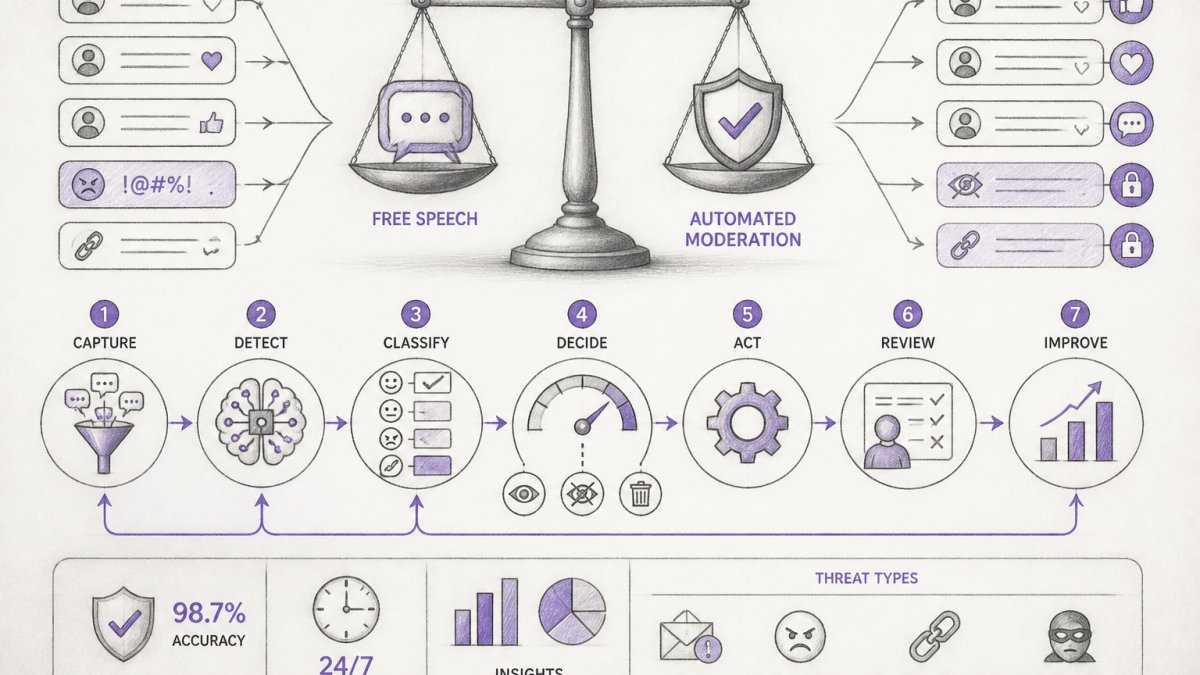
Quick Summary
| Key Insight | What You Need to Know |
|---|---|
| Tier actions by content | Tier actions by content type so spam is auto-hidden and product criticism stays published. |
| Set a higher auto-hide | Set a higher auto-hide threshold for ambiguous categories like insults than for clear ones like spam. |
| Sample published comments weekly | Sample published comments weekly to estimate the false-negative rate your filters miss. |
| Route appeals to a | Route appeals to a different reviewer and require a one-line rationale for each decision. |
| A reversal rate of | A reversal rate of zero signals a broken appeal path, not accurate moderation. |
| Why Free Speech and Automated Moderation CollideWhat Platform Responsibility Actually RequiresWhere AI Moderation Goes Wrong | False Positives and Chilling Effects |
Last Updated: November 1, 2026
Quick Summary
Balancing free speech and automated moderation means tiering responses so spam and scam links are hidden instantly while criticism of your product stays up, with ambiguous flags routed to a human reviewer. Publish clear rules, log every decision, and give users a seven-day appeal path to prevent over-removal and chilling effects.
- Tier actions by content type so spam is auto-hidden and product criticism stays published.
- Set a higher auto-hide threshold for ambiguous categories like insults than for clear ones like spam.
- Sample published comments weekly to estimate the false-negative rate your filters miss.
- Route appeals to a different reviewer and require a one-line rationale for each decision.
- A reversal rate of zero signals a broken appeal path, not accurate moderation.
Table of Contents
- Why Free Speech and Automated Moderation Collide
- Automated Content Moderation Best Practices That Protect Expression
- Content Moderation Policy Examples You Can Adapt
- Building a Human Review of AI Moderation Workflow
- Designing a Content Moderation Appeals Process Users Trust
- Metrics That Prove Your Moderation Is Fair and Effective
- Start Moderating Without Silencing Your Community
- Frequently Asked Questions
Why Free Speech and Automated Moderation Collide
Balancing free speech and automated content moderation is the central tension of running any public social channel in 2026. An AI filter that hides a slur in milliseconds can also hide a customer's angry-but-fair complaint. Free speech is the right to express ideas without government punishment.
That collision is not a bug you can eliminate. It is a design problem you have to manage.
What Platform Responsibility Actually Requires
Platform responsibility means the duty a business owes its community to keep the space usable and safe. For a brand running Instagram, Facebook, TikTok, or YouTube, that duty comes from three places:
- Community guidelines you publish and enforce
- Legal frameworks that apply to your content, including intellectual property and privacy rules
- User expectations about what counts as a safe space
The Federal Trade Commission's guidance on endorsements and advertising matters here too, because a comment section full of fake testimonials is a compliance problem, not just a vibe problem. Responsibility does not mean removing everything edgy. It means enforcing your published rules consistently.
Where AI Moderation Goes Wrong: False Positives and Chilling Effects
The biggest mistake with AI moderation is treating every flag as a win. It isn't. A false positive is a harmless comment the system hides anyway.
A common pattern we see: a filter trained on generic toxicity data flags sarcasm, slang, and cultural in-jokes as hate speech. The comment disappears.
Our breakdown of AI versus human comment moderation data covers how accuracy rates differ in practice.
Automated Content Moderation Best Practices That Protect Expression
Good automated moderation starts with narrow rules, not broad ones. The best systems classify content into clear buckets, apply different actions to each, and leave room for human judgment on anything ambiguous.
Here is how we would set it up:
- Tier the response. Spam and scam links get hidden instantly. Insults get flagged for review. Criticism of your product stays up.
- Write specific rules. "No hate speech" is too vague for a model. Define the terms and give examples.
- Keep a human escalation path. Anything the AI is unsure about goes to a person.
The FTC's consumer protection resources on deceptive content are worth reading when you write rules about fake reviews and scam links.
| Problem | Fix | Impact |
|---|---|---|
| Over-removal of criticism | Tier actions by content type | Fewer false positives |
| Spam floods | Auto-hide links and scams | Cleaner comment feed |
| Ambiguous insults | Human review queue | Fairer enforcement |
| No audit trail | Log every decision | Provable fairness |
| Stale rules | Monthly filter review | Fewer errors over time |
Content Moderation Policy Examples You Can Adapt
A usable content moderation policy answers four questions in plain language: what is allowed, what is removed, who decides, and how users appeal. Here is a short example you can adapt.
The key is to publish the policy and then enforce it the same way every time. If you want to see how automated spam hiding works in practice, hide spam comments automatically.
Building a Human Review of AI Moderation Workflow
A human review of AI moderation workflow is the safety net that keeps automated decisions honest. The AI handles volume. See FeedGuardians in action to watch how spam, toxic comments, and hate speech are detected and hidden in real time.
Step-by-Step Escalation Path
- The AI scores each comment for risk. The score should be a calibrated probability, not a raw model logit. If the score is not calibrated, the threshold is meaningless.
- High-confidence violations are auto-hidden. Set the auto-hide threshold high enough that a wrong call is rare. Set the auto-hide threshold high enough that a wrong call is rare, and use a higher threshold for ambiguous categories like insults than for clear ones like spam.
- Low-confidence flags go to a reviewer queue. Route by category, not by arrival order. A queue that mixes scam links with political sarcasm will burn reviewer attention on the wrong items.
- A human approves, reverses, or escalates. Give reviewers three buttons, not two. "Escalate" should route to a policy owner, not back to the model.
- The user is notified and can appeal. The notice and the appeal path are covered in the previous section; the workflow is incomplete without them.
Confidence Thresholds and Queue Routing
The threshold is the single most consequential setting in the workflow. Too low and reviewers drown; too high and harmful content publishes. A practical pattern is to run two thresholds per category:
- Auto-hide threshold: the score above which content is hidden without review.
- Review threshold: the score above which content enters the human queue.
Content between the two thresholds is the reviewer's workload. Content below the review threshold publishes, but should still be sampled.
Sampling for False Negatives
If your reviewers only see flagged content, they never learn what the AI missed. Sample published comments on a fixed cadence, for example, a random sample of published comments per category per week, and have a reviewer score them against the same rules. The share of sampled published content that a reviewer would have removed is your false-negative estimate. Without this step, your false-negative rate is unknown, and your fairness claims are unprovable.
When Automation Should Defer to a Human
Automation should defer whenever the cost of a wrong hide exceeds the cost of a delayed decision. That includes: content that quotes or reports on hate speech rather than endorsing it, satire and reclaimed language, political speech near an election, and any comment from a user with a pending appeal. These are exactly the cases where a model trained on generic toxicity data is most likely to be wrong.
Designing a Content Moderation Appeals Process Users Trust
An appeals process is only as good as its transparency. Users trust moderation when they know what happened, why, and how to push back. A workable appeals process specifies the notice, the window, the reviewer, and the feedback loop.
The Four Components of a Defensible Appeal
- A specific notice. Tell the user which rule was triggered and quote the exact language that matched. "Your comment was removed" is not a notice. "Your comment was hidden under Rule 3 (targeted insults) because it contained a slur directed at another user" is. The FTC's guidance on clear and conspicuous disclosures is a useful reference for how plain-language notices should read.
- A defined window. Publish the review window (for example, seven calendar days) and honor it. A window that slips is worse than no window, because it teaches users the process is theater.
- An independent reviewer. Appeals should not be re-judged by the same model or the same reviewer who made the original call. Route appeals to a second queue with a different reviewer, and require the reviewer to record a one-line rationale.
- A feedback path. Every reversal is a training signal. Log the original decision, the reversal reason, and the rule or model version involved, then route that record to whoever owns policy and whoever owns the model.
Sample Appeal Notice You Can Adapt
What happened: Your comment was hidden on [date] under Rule 3 (targeted insults). Why: The automated filter matched a phrase in our slur list. A human reviewer confirmed the match. What you can do: Request a second review within seven days using the link below. A different reviewer will look at your comment and our rule. What happens next: You will hear back within three business days.
Reversals Are Not Failures
A reversal rate that sits at zero is a red flag, not a badge of accuracy. It usually means users do not know they can appeal, the window is too short, or the reviewer is rubber-stamping the model. A healthy reversal rate is nonzero and stable; a climbing rate means filters are too aggressive, and a collapsing rate means the appeal path is broken.
When a reviewer overturns an AI decision, feed it back into your rules and your model. For a deeper look at the moderator role, our guide to the social media content moderator covers responsibilities and workflows.
Metrics That Prove Your Moderation Is Fair and Effective
You cannot claim fairness without measurement. Track these numbers and review them monthly:
- False positive rate: how often a human reverses an AI hide
- False negative rate: harmful content caught by sampling, not the AI
- Appeal reversal rate: how often users win their appeals
- Time to review: how long flagged content waits for a human
If your reversal rate climbs, your filters are too aggressive. If your false negative rate climbs, they are too loose. Either way, the numbers tell you where to tune. Explainable AI and regular external audits turn those numbers into accountability, not just dashboards.
Start Moderating Without Silencing Your Community
The hardest part of balancing free speech and automated moderation is accepting that no filter is perfect. Your goal is not zero errors.
FeedGuardians detects and hides spam, scams, hate speech, and competitor links with 98.7% accuracy, and includes a human escalation option for cases that need judgment.
Get started with FeedGuardians for free and turn your comment section into a space where customers actually want to talk.
Frequently Asked Questions
Can automated moderation protect free speech?
It can, but only when it is tuned to avoid over-removal. Automated moderation protects expression by removing spam, scams, and hate speech that drown out legitimate voices, and by applying the same rules to every comment regardless of who posted it. The risk is false positives, where lawful speech gets hidden. Set confidence thresholds high for auto-removal, route borderline cases to human review, and publish an appeals path so users can challenge enforcement decisions. That combination keeps the chilling effect low while still filtering harmful content.
How can users appeal an automated moderation decision?
A workable appeals process has four parts: a visible notice telling the user what rule was triggered and what action was taken, a one-click appeal form, a human reviewer who re-examines the decision within a stated window, and a written outcome that explains the reversal or upholds the original call. Track reversal rates by rule and by reviewer. If one rule produces a high reversal rate, the threshold is too aggressive and needs tuning. FeedGuardians includes a human escalation option so flagged comments reach a person rather than disappearing silently.
What are the risks of using AI to moderate online content?
The main risks are false positives that hide lawful speech, false negatives that let harmful content through, and algorithmic bias that hits some language groups harder than others. AI also struggles with contextual judgment: sarcasm, reclaimed language, and cultural references can trip classifiers that lack context. Mitigate these by auditing error rates on a sample of real comments, testing performance across languages and dialects, keeping a human review layer for edge cases, and documenting how each model decision was made so it is explainable during an external audit.
Should human reviewers check AI moderation decisions?
Yes, at least for borderline and high-stakes cases. A hybrid model works best: AI handles the high-volume, clear-cut calls like spam and scam links, while humans review anything near the confidence threshold, anything a user appeals, and anything involving hate speech or misinformation where context matters. FeedGuardians reports 98.7% detection accuracy on spam, hate speech, and competitor links, and its human escalation option covers the remaining edge cases. Review the human queue weekly to spot rules that need retuning.

Tired of manually moderating comments?
FeedGuardians automates spam filtering, responds to customers, and protects your brand — setup in 3 minutes.
Frequently Asked Questions
Can automated moderation protect free speech?
It can, but only when it is tuned to avoid over-removal. Automated moderation protects expression by removing spam, scams, and hate speech that drown out legitimate voices, and by applying the same rules to every comment regardless of who posted it. The risk is false positives, where lawful speech gets hidden. Set confidence thresholds high for auto-removal, route borderline cases to human review, and publish an appeals path so users can challenge enforcement decisions. That combination keeps the chilling effect low while still filtering harmful content.
How can users appeal an automated moderation decision?
A workable appeals process has four parts: a visible notice telling the user what rule was triggered and what action was taken, a one-click appeal form, a human reviewer who re-examines the decision within a stated window, and a written outcome that explains the reversal or upholds the original call. Track reversal rates by rule and by reviewer. If one rule produces a high reversal rate, the threshold is too aggressive and needs tuning. FeedGuardians includes a human escalation option so flagged comments reach a person rather than disappearing silently.
What are the risks of using AI to moderate online content?
The main risks are false positives that hide lawful speech, false negatives that let harmful content through, and algorithmic bias that hits some language groups harder than others. AI also struggles with contextual judgment: sarcasm, reclaimed language, and cultural references can trip classifiers that lack context. Mitigate these by auditing error rates on a sample of real comments, testing performance across languages and dialects, keeping a human review layer for edge cases, and documenting how each model decision was made so it is explainable during an external audit.
Should human reviewers check AI moderation decisions?
Yes, at least for borderline and high-stakes cases. A hybrid model works best: AI handles the high-volume, clear-cut calls like spam and scam links, while humans review anything near the confidence threshold, anything a user appeals, and anything involving hate speech or misinformation where context matters. FeedGuardians reports 98.7% detection accuracy on spam, hate speech, and competitor links, and its human escalation option covers the remaining edge cases. Review the human queue weekly to spot rules that need retuning.