Quick Summary
| Key Insight | What You Need to Know |
|---|---|
| Reputation Damage | It takes years to build customer trust, but only hours to shatter it. A clumsy or slow response can make your brand look incompetent, uncaring, or worse, dishonest. |
| Operational Chaos | When everyone is panicking, nobody is effective. Without clear roles, you get mixed messages, delayed approvals, and internal finger-pointing, all of which pour fuel on the fire. |
| Why You Need a Crisis Plan Before You Need It | Let’s get real for a second. We’ve all seen it happen. A single disgruntled customer post, an insensitive tweet, or a product issue can explode in... |
| Assembling Your Crisis Response Team | When a crisis ignites, time is a luxury you don't have. The first hour is everything, and you can't afford to waste it figuring out who’s in charge ... |
| Setting Up Your Early Warning System | The best way to handle a social media crisis is to catch it before it blows up. This isn't about damage control; it's about building a proactive defen... |
| Crafting Your Crisis Response Playbook | When things go sideways, your crisis response playbook is the one document you'll be glad you have. This isn't just a theoretical strategy paper; it's... |
Think of a social media crisis management plan as your brand’s fire extinguisher. You hope you never have to use it, but when a fire starts, you'll be incredibly glad it's there. It’s the playbook that guides your team on how to spot, handle, and recover from any negative event online—turning panic into a measured, effective response that protects your reputation.
Why You Need a Crisis Plan Before You Need It
Let’s get real for a second. We’ve all seen it happen. A single disgruntled customer post, an insensitive tweet, or a product issue can explode into a full-blown PR nightmare seemingly overnight. This isn't just a worst-case scenario; it's the reality of a world where news—and outrage—spreads instantly.
Without a plan, your team is left scrambling. Who's in charge? What are we supposed to say? The longer you take to figure it out, the more control you lose over the story.
The numbers back this up. The market for social media crisis management services swelled to USD 1.88 billion in 2023. Why? Because brands are finally waking up to the massive financial and reputational risks. It can take nearly 19 hours for a crisis to go from the first social media flare-up to a major news story. That’s a huge head start for a negative narrative to cement itself in the public’s mind.
The Real Cost of Being Unprepared
Flying blind during a crisis is a recipe for disaster. The fallout isn't just about a few angry comments; it’s about tangible damage to your business.
- Reputation Damage: It takes years to build customer trust, but only hours to shatter it. A clumsy or slow response can make your brand look incompetent, uncaring, or worse, dishonest.
- Financial Impact: A crisis can directly hit your bottom line through boycotts, tanking sales, and even a dip in stock price. The cost of cleaning up a mess is always higher than the cost of preparing for one.
- Operational Chaos: When everyone is panicking, nobody is effective. Without clear roles, you get mixed messages, delayed approvals, and internal finger-pointing, all of which pour fuel on the fire.
A crisis doesn't create your brand's character; it reveals it. How you act under pressure shows customers, partners, and employees what your company truly stands for.
Moving From Panic to Poise
A solid crisis plan is what takes your team from disorganized panic to calm, strategic action. It lays out the exact steps to follow, the tools to use, and the messages to deploy when things go south. For a deeper dive into this, our online reputation management guide is a great starting point.
In short, having this plan is non-negotiable. It’s the foundation that allows you to manage a tough situation with confidence and integrity, sometimes even turning a potential catastrophe into a moment that strengthens customer trust. Let's walk through how to build one.
Assembling Your Crisis Response Team
When a crisis ignites, time is a luxury you don't have. The first hour is everything, and you can't afford to waste it figuring out who’s in charge or chasing down approvals. A pre-defined crisis response team is the engine of your entire plan, built to deliver swift, coordinated action when it matters most.
This isn't about just handing out titles. It's about empowering people with clear roles and giving them the authority to act. That's how you turn chaotic reactions into a measured, strategic response.
Defining Core Roles and Responsibilities
Before a crisis ever hits, every single person on the team needs to know exactly what they’re supposed to do. The exact structure will change based on your company's size, but a solid team always has a few key players covering the essential bases.
To make this crystal clear, I've seen brands have great success by mapping out roles in a simple table. It removes all ambiguity when the pressure is on.
Crisis Response Team Roles and Core Responsibilities
| Role | Primary Responsibility | Key Skills |
|---|---|---|
| Social Media First Responder | Monitors all channels, identifies emerging threats, and deploys pre-approved initial responses. | Calm under pressure, platform expertise, strong judgment, detail-oriented. |
| Communications Lead | Owns the crisis narrative. Drafts and approves all public statements to ensure a consistent, on-brand voice. | Exceptional writing, strategic thinking, stakeholder management, decisiveness. |
| Legal Advisor | Vets all public-facing messages for potential liability and legal risks. | Risk assessment, compliance knowledge, clear communication, prudence. |
| Senior Leadership Stakeholder | Provides final sign-off on major decisions (e.g., product recalls, public apologies) and aligns the response with business goals. | Strategic oversight, authority, business acumen, availability. |
This structure ensures that everyone knows their lane, from the person watching the feeds to the executive making the final call.
The First Responder is your lookout—the one on the front lines who spots trouble brewing. This is often a social media content moderator who needs a cool head and a deep understanding of what’s normal versus what’s a real threat.
Creating Clear Escalation Protocols
Let's be real: not every negative comment is a five-alarm fire. The trick is knowing when to sound the alarm. Vague guidelines like "escalate when things get bad" are completely useless when you're in the thick of it.
Your escalation protocols need to be built on specific, measurable triggers. This takes the guesswork out of the equation and ensures you're reacting consistently every time.
An effective escalation plan is built on data, not drama. It tells your team exactly when to sound the alarm based on pre-defined metrics, ensuring you react to genuine threats, not just noise.
What does that look like in practice? Your plan could define a "Level 2 Alert" for when your monitoring tools flag any of the following:
- A 3x spike in negative mentions within a single hour.
- A sudden sentiment score drop of more than 20%.
- A post from a high-profile account (over 100,000 followers) that criticizes your brand.
- A negative hashtag about your brand starts trending in a key market.
The moment one of these triggers is hit, the First Responder immediately pings the entire crisis team on a dedicated channel, whether that's a private Slack room or a group text. This system is crucial. It lets the front-line team handle the small stuff efficiently while guaranteeing that the big, potentially damaging issues get the high-level attention they need, right away.
Setting Up Your Early Warning System
The best way to handle a social media crisis is to catch it before it blows up. This isn't about damage control; it's about building a proactive defense system. Think of it as a digital radar—a robust social listening and monitoring setup that picks up the faint blips of trouble long before they become deafening alarms.
This is so much more than just keeping an eye on your brand mentions. An effective system listens for a whole range of signals that could point to a gathering storm. You have to know what's happening not just with your brand, but across your entire industry.
Expanding Your Listening Horizons
To really build a solid early warning system, you need to monitor a few key areas. Cast a wide net. This will help you catch potential threats coming from different directions.
Here's what you should be actively tracking:
- Hot-Button Industry Keywords: What topics are sensitive in your niche right now? Monitoring terms like "product recall," "data breach," or "supply chain issues" alongside your industry can tip you off to widespread problems that could easily splash onto you.
- Your Competitors' Blunders: When a rival messes up publicly, it’s a free lesson. Even better, it can cause a ripple effect that sours customer perception of the whole industry—including your brand. Stay alert.
- Shifts in Sentiment: Don't just count mentions; you have to measure the emotion behind them. A slow, steady dip in positive sentiment around your products is a massive red flag. It’s a sign you need to start digging, and fast. For a complete overview of this process, check out our guide on social media monitoring.
Using powerful AI brand monitoring tools is a non-negotiable part of this. They act as your early warning system, tracking mentions and sentiment across countless platforms. These tools do the heavy lifting, freeing up your team to analyze what's happening instead of getting lost in manual searches.
The Power of AI in Proactive Monitoring
Let’s be real: you can't manually track every conversation. It's just not possible. This is where AI-powered tools become your best friend in a crisis management plan. They can sift through insane amounts of data in real-time and flag oddities that a human team would probably miss until it’s way too late.
A good AI-driven dashboard gives you an instant, at-a-glance view of your comment volume, sentiment scores, and what new keywords are popping up. This kind of visualization lets you immediately spot unusual activity, like a sudden spike in angry comments that signals a crisis is kicking off.
An unmonitored Reddit thread can quickly escalate into a full-blown crisis. Brands that neglect social listening are essentially playing ostrich, hoping problems will just go away. They won't.
Building Your Digital Paper Trail
Monitoring is only half the battle. You also have to actively shape the narrative around your brand on channels you own, like your blog and press releases. This work creates a solid foundation of positive, factual content that acts as a powerful counterweight when misinformation inevitably pops up.
This "digital paper trail" is your first line of defense. PR pros will tell you that having a history of transparent communication makes it much harder for false stories to gain traction. When a problem does hit, you can control the story by pushing out fast, multi-channel rebuttals across your social media, blog, and official statements. By pairing proactive listening with a strong content foundation, you build resilience. You ensure you’re not starting from scratch when a crisis finally hits.
Crafting Your Crisis Response Playbook
When things go sideways, your crisis response playbook is the one document you'll be glad you have. This isn't just a theoretical strategy paper; it's your team's step-by-step guide for what to do and say when the pressure is on. It turns high-level plans into confident, real-time actions.
A solid playbook takes the guesswork out of a stressful situation. It ensures everyone, from your newest social media moderator to the CEO, is on the same page and delivering a consistent message. That kind of unity shows you're in control, builds public trust, and stops a manageable problem from spiraling into a full-blown catastrophe.
Developing Scenario-Specific Templates
You can’t see the future, but you can definitely anticipate the most likely storms to hit your e-commerce brand. Start by brainstorming potential fires you might have to put out, then build pre-written (and pre-approved!) messaging templates for each one.
Think about the common scenarios that keep you up at night:
- Product Recalls or Safety Issues: Your statements have to be direct, empathetic, and crystal clear about what customers need to do next. No fluff.
- Website/Service Outages: Acknowledge the problem immediately, give an honest ETA for a fix (even if it's just "we're working on it"), and point people to a status page if you have one.
- A Customer Review Goes Viral (and not in a good way): This is a delicate dance. You need to acknowledge the issue publicly while moving the specific conversation to a private channel like DMs or email to resolve it.
- Employee Misconduct: Responses here must be swift and decisive, aligning with HR and legal. The goal is to reinforce your company values without getting into private details.
To get these templates right, you need to understand how to write a Standard Operating Procedure that people can actually follow under pressure. These SOPs are the bones of your playbook, making every action clear and repeatable.
The absolute key here is getting these templates pre-approved by your legal and leadership teams. When a crisis hits, you don’t have time to wait three hours for someone to sign off on a single tweet. Pre-approval empowers your team to act in moments, not hours.
The Art of the Public Response
Knowing what to say is half the battle. Knowing how and when to say it is the other half. Your playbook needs to spell out your core communication principles—things like transparency, empathy, and speed. It should also provide a clear framework for making the tough calls that often freeze teams in their tracks.
The biggest mistake you can make in a crisis isn't saying the wrong thing—it's saying nothing at all. Silence creates a vacuum that gets filled with speculation, anger, and misinformation faster than you can blink.
A really practical tool to include is a simple decision tree. This helps your team quickly tell the difference between a legitimate customer complaint and a malicious troll trying to stir up trouble. Real feedback, even when it's harsh, deserves a helpful and empathetic response. Trolls, on the other hand, should be handled according to your platform moderation rules. Getting these guardrails in place is a core part of effective social media content moderation.
The process for identifying and preparing for these situations really boils down to three simple steps.
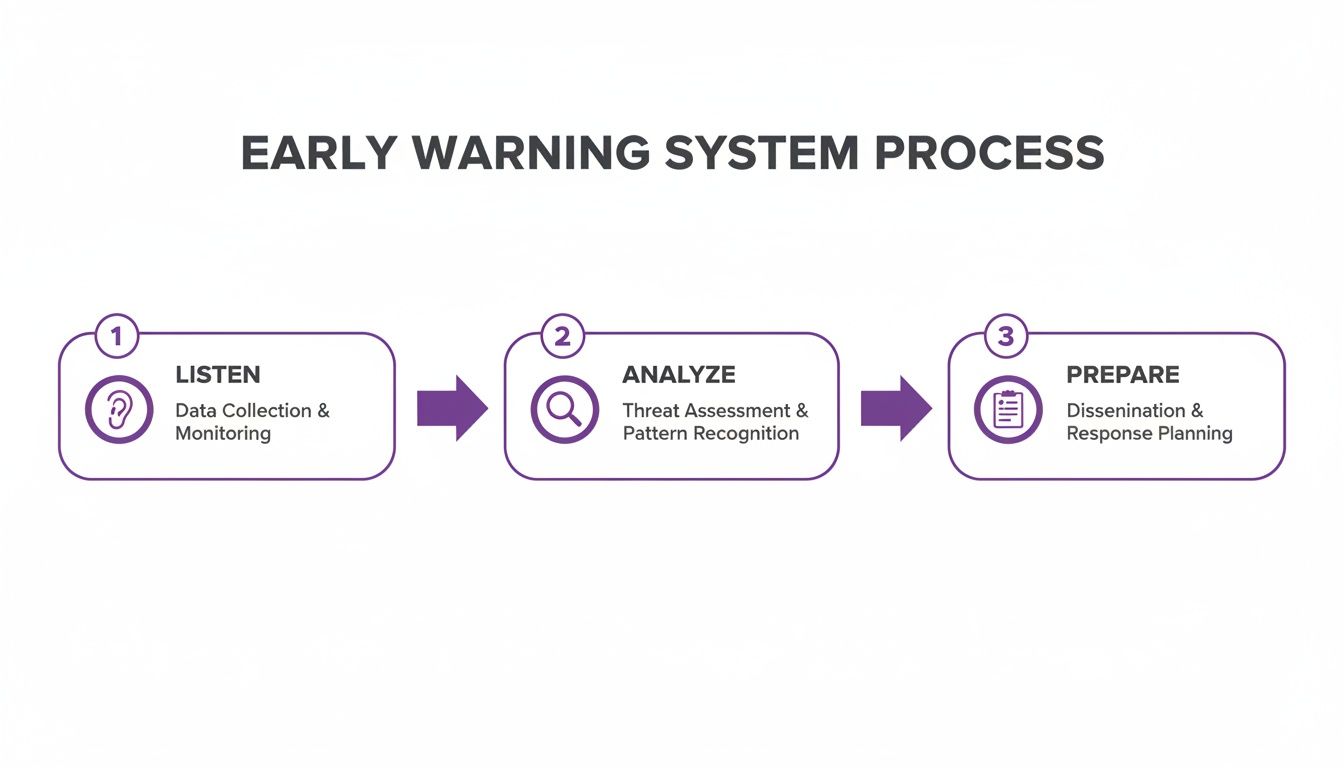
This Listen > Analyze > Prepare flow is the bedrock of a fast, effective response. It ensures your actions are driven by what's actually happening, not by panic.
Don't Just Write a Plan—Practice It
Let’s be honest: a crisis plan gathering dust in a Google Drive folder isn't a plan at all. It's just a document. Its real power comes alive when your team knows it inside and out, and that only happens through practice. You can't afford to improvise when your brand's reputation is tanking in real-time. This is where you move from theory to reality, turning that static plan into pure muscle memory for your team.
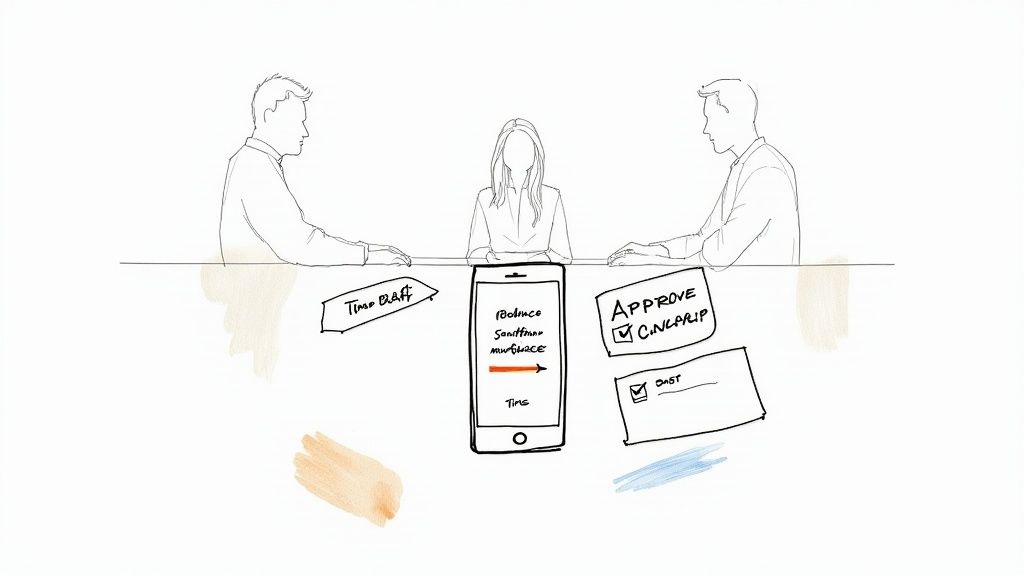
Think of drills not as stress tests, but as stress removers. By running through scenarios in a safe space, your team builds the confidence to act decisively when a real crisis hits. We’ve seen that AI-powered tools can slash response times by as much as 40%, but that only works if your team has actually been trained on how to use them under pressure.
How to Run a Realistic Crisis Drill
You don't need a Hollywood-level production for this. The goal is to pressure-test the most critical parts of your plan: how you communicate, who approves what, and whether your pre-written responses actually work. A simple, well-designed drill will quickly show you where the cracks are.
Here’s how we've seen brands run their first successful drill:
- Cook up a believable scenario. It has to feel real. Think about what keeps you up at night. Maybe it’s a fake (but plausible) product recall that starts gaining steam on TikTok, or your website crashing during a Black Friday flash sale, sparking outrage on X.
- Assign roles and get started. Pick a "Drill Master" to throw curveballs at the team, like a fake news article or a negative post from a major influencer. Everyone else should jump into their assigned crisis roles and use your dedicated emergency channel (like a private Slack room).
- Use your actual tools and templates. Have the team "track" the fake crisis with your real monitoring software. Instruct them to pull and adapt the response templates from your playbook. This is the only way to know if your plan works in practice, not just on paper.
A drill is designed to find the breaking points in your plan so a real crisis doesn't. It's a low-stakes chance to fix what could become a very high-stakes problem.
The Post-Drill Teardown: Where the Real Learning Happens
Once you call an end to the simulation, the most valuable part begins: the debrief. This is your chance to figure out what went right and—more importantly—what fell apart.
Get the team together and start asking tough questions.
- Where did communication break down? Did someone get left out of the loop? Was it unclear who to contact for a specific approval?
- Did our approval process hold up? Were we able to get messages signed off on quickly, or did it become a bottleneck that would have cost us precious time?
- How useful were the response templates? Did they actually fit the scenario, or did they feel so generic that they needed a total rewrite?
- What was the single biggest moment of confusion? Find that one thing, and you've found the first, most important fix for your plan.
Remember, training isn't just about the "what"—it's also about the "how." It's about coaching your team to stay calm, be empathetic, and never get defensive. Regular drills build the composure needed to turn chaos into a controlled, professional response. It’s what keeps your plan ready for anything.
Learning and Adapting After the Crisis
You’ve weathered the storm. The immediate chaos has subsided, and your team is breathing a collective sigh of relief. But the work isn't done—in fact, some of the most important work is just beginning.
The moments right after a social media crisis are a goldmine for learning. This isn't about pointing fingers or dwelling on what went wrong. It's your single best chance to dissect the event and use those insights to make your crisis plan—and your entire brand—more resilient.
Measuring the Impact and Your Response
Before you can improve, you need to understand what actually happened. That means digging into the data to get a clear, unbiased picture of the crisis from start to finish. Gut feelings are useful, but hard metrics are what drive real improvement.
Start pulling reports on these key indicators:
- Sentiment Recovery Time: How long did it take for the general conversation about your brand to return to its normal, pre-crisis baseline? This is a fantastic measure of how effective your response really was.
- Engagement on Official Statements: Look at your apology or explanation posts. Were people engaging? Were the comments mostly supportive, or was the anger still boiling over?
- Shift in Brand Mention Volume: A spike in mentions is expected. What you need to watch is how quickly that volume drops back to normal. A long tail of negative mentions is a clear sign the issue is still simmering.
This data provides a solid, objective foundation for your review. It shifts the conversation from "I feel like we handled that okay" to "Here's the data showing where we excelled and where we have room to grow."
Conducting the Post-Mortem Review
Once you have the numbers, get your crisis team in a room for a debriefing. The only rule for this meeting should be radical honesty. Think of your crisis management plan as a living document; this is its scheduled evolution.
After a crisis, the most critical step is to review what worked and what didn't. This analysis feeds directly back into your playbook, ensuring your organization gets stronger with every incident it faces.
To keep the discussion focused and productive, guide your team with a few direct questions.
- Detection Speed: How fast did we actually spot the problem? Did it sneak up on us, or did our monitoring tools flag it early?
- Response Time: What was the lag between identifying the issue and getting our first public statement out? Where did we lose precious time?
- Communication Clarity: Was our messaging actually clear and empathetic? Did it land the way we intended, and was it consistent everywhere we posted it?
- Internal Bottlenecks: Did approvals get stuck somewhere? Was there a single person or department that slowed everything down?
- Plan Effectiveness: Let's be real. Which parts of our crisis plan were a lifesaver, and which parts completely fell apart under pressure?
Tackling these questions head-on is the only way to find the cracks in your strategy. This isn't just about closing the book on one bad week; it's about making sure you're even better prepared for the next time things go sideways.
Common Questions About Crisis Planning
Even with a detailed guide, a few questions always pop up when it's time to actually build a social media crisis management plan. Let's run through some of the most common ones we hear from brands getting serious about protecting their reputation.
How Often Should We Update Our Plan?
Think of your crisis plan as a living document, not something you write once and file away. It needs to evolve right along with your business.
We recommend a full-scale review at least twice a year.
That said, certain events should trigger an immediate update. Don't wait for the six-month review if:
- You just navigated a crisis (or a near-miss). This is the best, most painful, and most valuable learning opportunity you'll ever get. Bake those lessons into your plan right away.
- Your team has changed. New people in key roles? A different leadership structure? Your contact lists and approval chains are now obsolete and need updating.
- You're launching a major product or campaign. New ventures introduce new risks. Your plan needs to account for them before you go live.
What Is the Biggest Mistake in a Crisis?
Hands down, the single most damaging mistake is a slow response. Or even worse, no response at all.
Online, a narrative—whether it's true or not—forms in minutes. Every second you stay silent, you're letting misinformation and negative sentiment dig in. This makes it a thousand times harder to get back in the driver's seat.
A fast acknowledgment is always better than a perfect but late response. Even just saying, "We're aware of this and looking into it. We'll have an update by 3 PM," shows you’re on it and taking things seriously.
Can Small Businesses Really Use This Plan?
Absolutely. The core ideas behind crisis management work for everyone, regardless of size. A small e-commerce shop might not have a twenty-person command center, but the fundamentals are just as crucial—maybe even more so.
Your "crisis team" might just be you and one social media manager. Your monitoring might be more focused on specific keywords. But you still need to know who does what, when to escalate an issue, and have a few response ideas ready to go. The key is to scale the plan to fit your team and your specific risks.
Stop wasting time fighting fires in your comments section and start protecting your brand's reputation today. With FeedGuardians, you can automate comment moderation so your team can focus on what really matters—growing your business. Discover how our AI-powered tool can keep your social media safe and positive.
Tired of manually moderating comments?
FeedGuardians automates spam filtering, responds to customers, and protects your brand — setup in 3 minutes.