
Quick Summary
| Key Insight | What You Need to Know |
|---|---|
| Audience Research | Who are your customers, really? Where do they spend their time online, and what kind of content actually gets them to stop scrolling? |
| Competitive Analysis | We look at what your competitors are doing right (and wrong) to find gaps and opportunities for your brand to shine. |
| Goal Setting | We define clear, measurable objectives (KPIs). Are we aiming for more leads, more website traffic, or just getting your name out there? |
| Platform Selection | You don't need to be everywhere. We pinpoint the right social media channels where your investment will pay off the most. |
When you're trying to nail down the cost of social media management, you'll find it's a bit like asking, "How much does a car cost?" The answer is always, "It depends." You could be looking at anything from $500 to over $7,000 per month, and sometimes even more.
The final price tag really boils down to who you hire and what you're asking them to do. A freelance social media manager might be on the lower end of that scale for some basic help, while a full-service agency or building your own in-house team represents a much bigger investment for a far more comprehensive approach.
Demystifying the Price Tag on Social Media Management
When you pay for social media management, you’re not just buying posts. You're investing in expertise, time, and ultimately, results. It’s a service, not a product, so there’s no one-size-fits-all price.
Think of it like hiring a contractor to work on your house. A simple paint job is one thing, but a full kitchen remodel is a completely different project with a much different price. The same logic applies here. Basic post scheduling is a simple task, but a multi-platform strategy that includes custom content, paid ads, and constant community management is a whole different ball game.
The cost directly reflects the complexity of the work and the potential return you're aiming for. A small local bakery might just need a clean, simple presence to connect with the neighborhood. But a national e-commerce brand needs a sophisticated, data-driven machine to drive sales and keep thousands of customers engaged.
A Snapshot of Monthly Costs
To give you a clearer idea of what to expect, here’s a quick breakdown of typical monthly management fees. This table gives you a good starting point for your budget, but just remember: these numbers don't include what you'll actually spend on ads.
Quick Guide to Social Media Management Costs
Here's a summary of what you can expect to pay per month for the management fee, depending on the provider.
| Provider Type | Typical Monthly Cost Range (Management Fee) | Best For |
|---|---|---|
| Freelancer | $500 – $2,500 | Small businesses or startups needing targeted support on one or two platforms. |
| Agency | $2,000 – $10,000+ | Growing businesses that need a strategic, multi-platform approach with a team of specialists. |
| In-House Team | $4,000 – $7,000+ (per employee) | Large companies that need deep brand integration and dedicated, full-time focus. |
These are just benchmarks, of course. The exact cost will vary based on your specific goals and needs.
It's also worth noting that these figures are shaped by what's happening in the broader industry. With global social ad spend expected to rocket past $276.72 billion in 2025, the baseline for professional help is naturally rising.
For most small to mid-sized businesses, agency retainers usually land somewhere between $1,000–$3,500 per month. But for larger brands with bigger needs, costs can easily jump past $10,000. These packages typically bundle strategy, content creation, and reporting, but if you need specialized services, that will almost always add to the final bill. Digging into these pricing trends can give you a better feel for the market.
Understanding What You’re Actually Paying For
When you get a quote for social media management, it can feel like a single, hefty price tag. But it’s much more like building a custom car—the final cost is a sum of all the individual parts. You're not just paying someone to post a few things online; you're investing in a whole system designed to move your brand forward.
Let's pop the hood and see exactly where your money goes. Breaking it down helps you figure out what's essential for hitting your goals versus what’s just a nice-to-have. This way, every dollar you spend is put to good work.
The Engine: Strategy and Planning
This is the absolute core of any social media effort, and honestly, it’s a huge chunk of what you pay for. Long before a single post sees the light of day, hours are spent digging into your brand, your audience, and your competitors. It's the blueprint for everything that comes next.
This foundational work includes:
- Audience Research: Who are your customers, really? Where do they spend their time online, and what kind of content actually gets them to stop scrolling?
- Competitive Analysis: We look at what your competitors are doing right (and wrong) to find gaps and opportunities for your brand to shine.
- Goal Setting: We define clear, measurable objectives (KPIs). Are we aiming for more leads, more website traffic, or just getting your name out there?
- Platform Selection: You don't need to be everywhere. We pinpoint the right social media channels where your investment will pay off the most.
Without a solid strategy, you're just making noise. You're paying for the expertise to build a focused plan that ties every action back to real business results.
The Chassis: Content Creation and Design
This is the part everyone sees—the "body" of the car. It’s the graphics, the videos, and the words your audience actually interacts with. The cost here can swing wildly depending on how complex and high-quality you want the content to be.
For instance, a simple text post is cheap and easy. A professionally shot and edited video? Not so much. In today's crowded feeds, high-quality visuals are non-negotiable for grabbing attention, so this piece often makes up a big part of the total social media management cost. This also covers building out content calendars and scheduling everything, often using specialized social media management software for small business to keep things consistent.
A well-crafted content strategy is about more than just filling a calendar; it’s about telling a consistent brand story that builds trust and drives engagement, one post at a time.
This is where skilled creators take the strategy and turn it into tangible assets that your audience will see, love, and share.
The Fuel: Your Ad Spend
It's crucial to understand that your management fee and your ad spend are two totally different buckets of money. The management fee is what you pay an agency or freelancer to run your campaigns. The ad spend is the cash you give directly to platforms like Meta, LinkedIn, or TikTok to get your content in front of a bigger, more targeted audience.
The platform you choose makes a huge difference. For example, the cost-per-click (CPC) on LinkedIn can hover around $5–$6, while on Facebook, it might be less than $1. That means a $10,000 ad budget will get you very different mileage depending on where you spend it. With 65% of marketing leaders demanding a clear link between social campaigns and business goals, there's immense pressure to spend this money wisely. That’s why management fees often account for the intense work of optimizing bids and testing creative to squeeze out the best possible return. You can learn more about how platform costs impact management fees and ROI to get a deeper sense of this dynamic.
The Dashboard: Analytics and Reporting
Finally, you’re paying for the "dashboard"—the analytics and reporting that show whether your investment is actually working. This isn't just a spreadsheet of numbers. It’s about tracking the right metrics, analyzing what they mean, and turning that data into smart, actionable insights.
A good report tells a story. It shows you what’s working, what’s not, and why. This constant feedback loop allows us to tweak and improve the strategy over time, ensuring your results keep getting better. It’s what justifies the budget and proves the ROI of all your social media efforts.
Choosing Your Team: Agency vs. Freelancer vs. In-House
Figuring out who will run your social media is one of the biggest decisions you'll make, directly hitting your social media management cost and, ultimately, your success. This isn't just about delegating tasks; it's about finding the right pilot for your brand's voice online. You really have three main options: hiring an agency, partnering with a freelancer, or building your own team from scratch.
Let's use an analogy. An agency is like hiring a general contractor to build a house. They bring in the plumbers, electricians, and designers—a full crew of specialists—all managed under one roof. It’s a complete package, but it comes with a premium price.
A freelancer is like hiring a master carpenter for a specific job, like building custom cabinets. You get a specialist with deep expertise, more flexibility, and often a more manageable cost. Then there's the in-house team. That's the DIY approach. You have total creative control and the team lives your brand, but you're on the hook for every salary, software subscription, and training session.
There's no single "right" answer. The best fit really comes down to your budget, your goals, and the kind of company you are.
The Full-Service Agency Approach
Going with a social media agency is the classic move for businesses that need a wide array of skills but don't want the headache and expense of hiring a full-time marketing department. Agencies give you a whole team for the price of one retainer: you get a strategist, a copywriter, a designer, and a paid ads expert ready to go.
This model is built to grow with you. If you need to ramp up for a product launch, a good agency can allocate more resources without you having to post a single job opening. They also have a bird's-eye view from working with clients in different industries, bringing fresh ideas to the table. Of course, that all-in-one service makes them the most expensive of the outsourced options.
The Flexible Freelancer Partnership
For businesses that need specific expertise without the long-term commitment of an agency contract, a freelance social media manager is a fantastic choice. Freelancers bring agility and are usually more budget-friendly, which is perfect for startups or companies testing the waters.
You can hire a freelancer for a single, focused project—maybe to run a specific ad campaign or get your LinkedIn profile humming. You pay for exactly what you need, when you need it. The catch? You're often relying on one person's skillset. If they're a brilliant content creator, you might still need to find someone else to handle the nitty-gritty of performance analytics. Juggling several freelancers can quickly become its own part-time job.
By selecting a skilled freelancer, you gain direct access to an expert who can integrate closely with your team, often providing a highly personalized level of service that larger agencies might struggle to match.
One critical area where a specialist can make a world of difference is community management. Responding to every comment, DM, and mention is a job in itself. To get a better sense of what this involves, it's worth understanding the role of a social media content moderator, which is a unique mix of customer support, brand protection, and community building.
Building Your In-House Team
Bringing your social media management in-house means hiring your own employees to run the show. This path offers the tightest possible integration with your brand. Your team is in the office (or virtual office) with you every day, breathing the same air and living the company culture. This almost always leads to more authentic, on-brand, and quick-to-respond social media.
That said, it’s usually the most expensive option. When you add up salaries, benefits, training, and the cost of all the necessary software, it can far exceed an agency retainer. For large companies where social media is a core pillar of the business, however, that investment pays off in total control and perfect brand alignment.
This flowchart can help you visualize where the money goes in a typical campaign, whether it's run by an agency, freelancer, or in-house team.
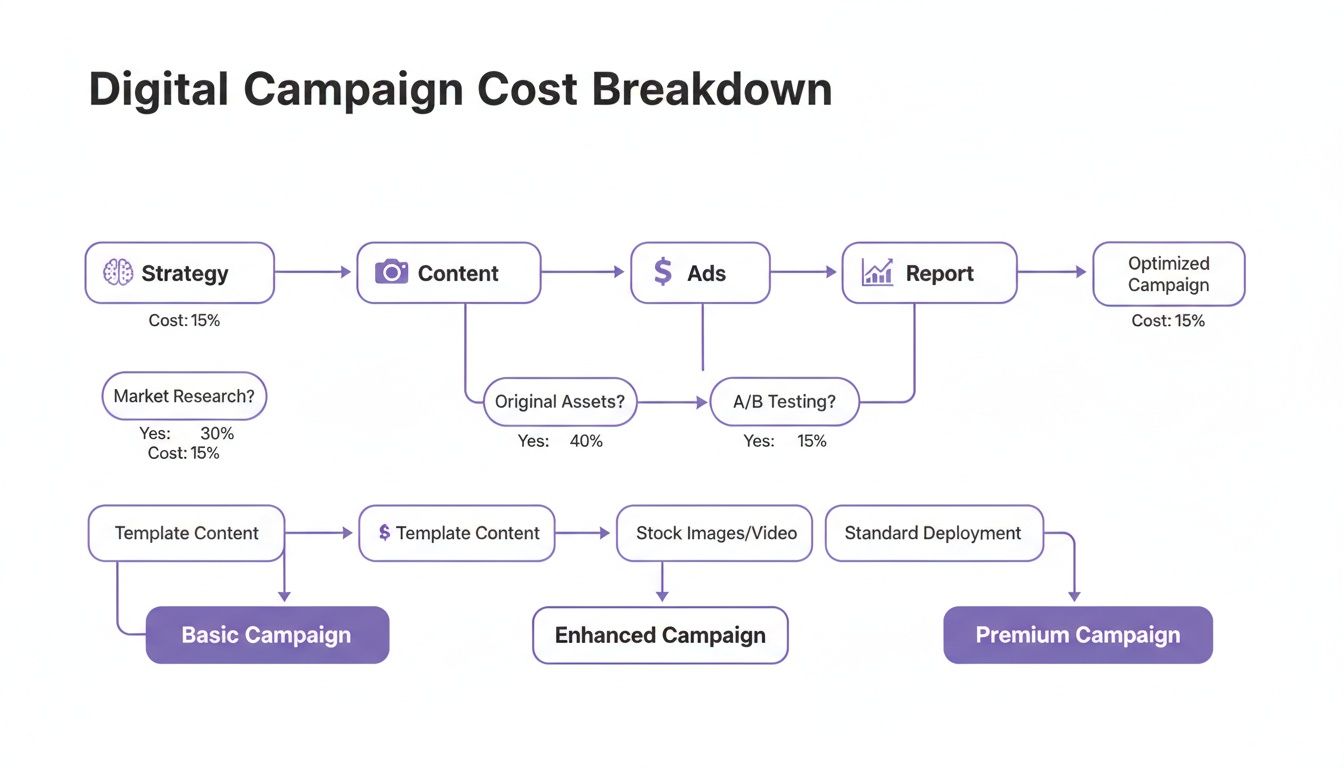
As you can see, costs are spread across strategy, content creation, ad spend, and reporting—all things your chosen team will need to handle.
Agency vs. Freelancer vs. In-House Cost and Benefit Analysis
To help you decide, let's put these three models head-to-head. This table breaks down the pros and cons across the factors that matter most when you're making this choice.
| Factor | Social Media Agency | Freelance Manager | In-House Team |
|---|---|---|---|
| Cost | High (retainer-based) | Low to Medium (hourly or project) | Highest (salaries, benefits) |
| Expertise | Broad team of specialists | Specialized in specific areas | Deep brand-specific knowledge |
| Scalability | High (easy to scale services up or down) | Medium (limited by individual capacity) | Low (requires new hires to scale) |
| Integration | Medium (external partner) | Medium to High (can be very integrated) | Highest (fully part of the company) |
| Flexibility | Medium (bound by contract terms) | High (project-based or short-term) | Low (full-time employment) |
At the end of the day, there isn't a one-size-fits-all answer. A scrappy startup might get the best bang for its buck with a talented freelancer. A growing business ready to scale might find an agency is the perfect partner. And a large corporation will likely need the dedication and deep integration of its own in-house team. Your choice here is a foundational piece of your social media management cost and your brand's future online.
Figuring Out How You'll Pay: Common Social Media Pricing Models
How you get billed for social media management is just as crucial as the final number on the invoice. Getting your head around the different ways agencies and freelancers charge helps you find a setup that feels transparent, predictable, and actually fits your budget. It’s a bit like picking a cell phone plan—some folks love the stability of a fixed monthly bill, while others prefer to only pay for what they actually use.
Each model is built for a different kind of need, and they all come with their own pros and cons. Learning to spot the differences is your best bet for confidently reading through proposals and making sure you’re getting real value for your money. To see what’s out there, it’s worth exploring different social media management pricing models to understand how fees are structured across the industry.
The Monthly Retainer Model
This is the bread and butter of the industry. The monthly retainer is by far the most common model, especially when you're looking for someone to handle everything, all the time. Think of it as a subscription for your social media presence. You pay a set amount each month, and in return, you get a clearly defined list of services—like a certain number of posts, community management, and monthly reports.
This model is a fantastic fit for businesses that need consistent, long-term help. The biggest win here is predictability. You know exactly what you're spending every single month, which makes budgeting a breeze. It also helps build a real partnership, as your social media manager gets to know your brand inside and out. The only real catch is making sure the scope of work is crystal clear from day one, so you don't end up paying for things you don't need.
A monthly retainer transforms your provider from a simple service vendor into a strategic partner, deeply invested in your brand's continuous growth and online presence.
This steady-as-she-goes approach is perfect for building momentum and keeping your brand’s voice consistent across all your channels.
The Hourly Rate Model
Paying by the hour gives you ultimate flexibility. It’s the perfect choice for one-off tasks or quick consultations. Need an expert to run a social media audit, train your in-house team, or help manage a short-term spike in customer service messages? An hourly rate is your best friend. These rates can be all over the map, ranging from $50 to over $150 per hour, depending on who you hire and what they bring to the table.
The beauty of it is simple: you only pay for the time someone actually works on your account. The downside, however, is that it can get unpredictable for ongoing management. Those hours can add up fast, and your monthly bill can swing wildly. It’s best reserved for projects with a clear and finite time commitment, not for running your entire social media strategy day in and day out.
The Project-Based Fee Model
With project-based pricing, you agree on a single, flat fee for a specific job that has a clear start and finish line. This is the go-to model for things like a big product launch campaign, promoting a major event, or getting your social media profiles built from the ground up.
The main advantage is cost certainty. You know the exact price for the exact outcome before any work begins, so there are no nasty surprises waiting for you at the end. The biggest risk? Scope creep. If the project starts to expand beyond what you originally agreed on, it can lead to awkward conversations about additional charges.
The Performance-Based Model
This is the most results-focused way to pay. Here, part of the fee is tied directly to hitting specific, measurable goals. For instance, a manager might charge a small base fee plus a bonus for every qualified lead they generate, every sale they drive, or every 10,000 new followers they attract.
This model is powerful because it aligns your goals with your provider’s goals—they only make more money if you make more money. It’s a great way to ensure you're paying for tangible results, not just for someone being busy. The catch is that it requires a huge amount of trust and rock-solid tracking to work. It’s less common, but for businesses obsessed with ROI, it can be a game-changer. With so many moving parts, the right software is a must. This social media automation tools comparison for 2025 is a good place to start for seeing how tech can help you track performance.
Smart Ways to Optimize Your Social Media Budget
Running a killer social media program doesn't mean you need a bottomless budget. In fact, some of the most effective strategies come from smart planning and being clever with your resources. It’s all about making every dollar count, ensuring your spending drives real growth, not just operational costs.
Think of your budget as fuel in a car. You can floor it and burn through a full tank in no time, or you can drive efficiently and get way more mileage. By focusing on proven, high-impact tactics, you can stretch your budget further than you thought possible.
Embrace Automation and AI Tools
One of the biggest drains on any social media budget is manual labor. All those hours spent scheduling posts, hunting for brand mentions, and sifting through comments really add up. This is where automation tools become your best friend.
Modern AI-powered platforms can take over these repetitive tasks for a fraction of what it costs to have a human do them. For instance, AI comment moderation can instantly hide spam, flag angry comments for a human to review, and even answer common questions. This frees up your team to do what they do best: think strategically and create amazing content.
By automating routine tasks, you're not replacing the human element; you're empowering your team to focus on the strategic work that machines can't do, directly improving both efficiency and campaign effectiveness.
Repurpose Your Best Content
Constantly creating brand-new, high-quality content is easily the most expensive part of social media management. But you don't have to reinvent the wheel every single day. Your best-performing content is a goldmine—it's time to start digging.
Instead of always starting from scratch, get more mileage out of your greatest hits.
- Turn a blog post into a series of tweets: Pull the key takeaways from a popular article and chop them into a compelling Twitter thread.
- Convert a video into an audiogram: Take the audio from a webinar and turn it into a podcast-style clip perfect for LinkedIn.
- Create quote graphics from testimonials: Grab powerful customer quotes and design them into eye-catching graphics for Instagram.
This isn't just about saving money on production. It reinforces your core message across different channels and formats, reaching people in the way they prefer to consume content. It’s the definition of working smarter.
Strengthen Your Organic Strategy
Paid ads are great for reaching new people, but a powerful organic strategy means you won't be completely dependent on them. When you build a loyal community that genuinely loves and shares your content, you get something priceless: free marketing.
Focus on creating stuff your audience actually finds valuable and wants to share. A huge piece of this puzzle is nurturing real conversations in the comments. The more engaged your audience is, the more the algorithm will show them your content for free. Want to learn more? Check out our guide on how to improve social media engagement.
Understanding marketing budget allocation best practices is the final piece of the puzzle. By blending smart automation, savvy content repurposing, and a strong organic game plan, you can turn your social media program into a lean, mean, growth-generating machine.
How to Set Your Budget and Prove Your ROI
Alright, let's talk about the final piece of the puzzle: moving past guesswork with your social media spending. A smart, well-defined budget—paired with a clear way to prove its worth—is what turns social media from a line-item expense into a serious, revenue-driving machine. This isn't just about spending money; it's about making every dollar work toward a real business goal.
Think of it like a recipe. You can’t just throw ingredients in a bowl and hope for the best. You need a plan. A structured budget takes the anxiety out of spending and gives you a clear roadmap to follow.
Crafting Your Social Media Budget
The easiest way to build your budget is to break it down into three main buckets. This simple approach helps you see exactly where your money is going and stops one area from accidentally eating up all your resources.
Management Fees: This is what you pay for the brainpower and the hands-on work. It could be an agency's monthly retainer, a freelancer's hourly rate, or the salary for your in-house social media manager. It covers the strategy, content creation, and day-to-day management.
Ad Spend: This is the cash you give directly to platforms like Meta or LinkedIn to get your content in front of the right people. It's a separate line item from management for a reason—it's the fuel for growth.
Tools and Software: This bucket covers all your subscriptions. Think scheduling platforms, analytics suites, and design software. These are the tools that make your team efficient, and they often pay for themselves many times over in saved time and better results.
By splitting your budget this way, you gain incredible clarity. It becomes much easier to see what's working and adjust on the fly. Maybe a campaign is crushing it and you want to pour more into ad spend, or perhaps a new tool could automate a tedious task. This structure makes those decisions simple.
Proving the value of your social media spend isn't about chasing vanity metrics like likes and followers. It's about drawing a straight line from your social media activity to tangible business outcomes—leads in the pipeline, closed sales, and higher customer lifetime value.
Proving Your Return on Investment
Measuring your Return on Investment (ROI) is how you justify your budget to the higher-ups. It’s how you prove that this stuff actually works. This means tracking Key Performance Indicators (KPIs) that connect directly to your company's bottom line, not just social media fluff.
First, define what success actually looks like. Are you trying to get more leads for the sales team? Drive direct online sales? Or just make sure more people know your brand exists? Once you have your primary goal, you can zero in on the metrics that truly matter.
- For E-commerce: You'll want to watch your Conversion Rate from social ads, the Average Order Value (AOV) from customers who came from social, and the total Revenue you can attribute to your social channels.
- For Lead Generation: Keep a close eye on your Cost Per Lead (CPL), the number of Marketing Qualified Leads (MQLs) coming from social, and the rate at which those leads turn into paying customers.
- For Brand Awareness: Here, you’ll measure things like Reach, Impressions, and Share of Voice to gauge how much of the conversation in your industry you actually own.
You can't track what you can't see, so you'll need the right tools for the job. There are some fantastic platforms out there that pull all this data together for you. If you're looking for a place to start, you can explore some of the best tools for social media analytics to find a good fit.
When you can connect your social metrics to real business results, you can walk into any meeting and confidently prove your ROI. That's how you secure more budget and make even smarter decisions next quarter.
Common Questions About Social Media Costs, Answered
Let's cut through the noise. When you're trying to figure out social media management costs, a few key questions always come up. Here are some straightforward answers to help you budget wisely.
What Should a Small Business Actually Expect to Pay?
For most small businesses, a realistic budget for professional social media management lands somewhere between $500 and $2,500 a month.
On the lower end of that spectrum, you're likely looking at a skilled freelancer focusing on one or two of your most important social channels. As you move toward the higher end, you'll find small agencies that can offer a more comprehensive package, including strategy, content creation, and reporting.
Just remember, this price tag is for the management service—the expertise, time, and labor. Your ad budget is a separate line item.
How Does Ad Spend Fit into the Management Fee?
It's helpful to think of these as two different buckets of money. The ad spend is what you pay directly to platforms like Meta or TikTok to get your posts in front of more people. The management fee is what you pay the agency or freelancer to make sure that money is spent effectively.
They're the ones building the campaigns, targeting the right audience, and tweaking everything to get you the best possible results. Agencies typically charge for this in one of two ways: a flat monthly retainer or a percentage of your ad spend, which usually falls between 10-20%.
Choosing a partner isn’t just about finding the lowest price. It’s about investing in someone who can turn your budget into real growth and stop you from wasting money on ads that don't perform.
Are Super Cheap Management Services Worth the Risk?
It's tempting, I get it. But those "too good to be true" low-cost options often come with hidden costs. You might end up with an inexperienced manager, generic template-based content, or zero actual strategy behind the posts.
This kind of approach doesn't just lead to poor results; it can actively damage your brand's reputation and waste your entire budget. You're almost always better off investing a little more with a real professional who can deliver results on one or two key platforms, rather than spreading a tiny budget thin with a low-quality service.
Ready to eliminate spam and capture every sales opportunity in your comments? FeedGuardians uses powerful AI to moderate your comment sections in real time, protecting your brand and boosting conversions. See how FeedGuardians can help you today.
Tired of manually moderating comments?
FeedGuardians automates spam filtering, responds to customers, and protects your brand — setup in 3 minutes.