
Quick Summary
| Key Insight | What You Need to Know |
|---|---|
| Major Review Platforms | Think Google Business Profile, Yelp, and Trustpilot. Don't forget industry-specific hubs, like G2 for software or TripAdvisor for travel. |
| Social Media Channels | Go beyond your own profiles on Facebook, Instagram, or TikTok. Look at public groups, communities, and even Reddit subreddits where your target audience hangs out. |
| Search Engine Results Pages (SERPs) | Search for your brand name, key product names, and even your executives. Scour the first three pages of results for news articles, blog posts, and forum threads. |
Improving your online reputation isn't a one-and-done task. It's a continuous cycle of listening, engaging, and building. Think of it as a four-part loop: you audit where you stand, monitor conversations as they happen, respond to feedback, and proactively generate positive stories. Getting this rhythm right turns reputation management from a reactive headache into a powerful way to build trust and grow your business.
Why Your Digital Reputation Is Your Most Valuable Asset
Before a customer ever lands on your product page, they’ve probably already looked you up. Your online reputation—that mix of Google reviews, social media chatter, forum posts, and news mentions—is your real storefront. It’s the first impression, and often, the last one that matters.
The game has changed. We can no longer just push out ads and control the story. Today, what your customers say about you carries more weight than any marketing campaign you could dream up. In fact, a staggering 85% of people trust online reviews as much as a recommendation from a friend. For any e-commerce owner or social media manager, that statistic should hit home. Your reputation isn't just a vanity metric; it directly impacts your bottom line.
This constant process of shaping your online presence can be broken down into a clear, repeatable workflow.
As you can see, this isn't about putting out fires. It's a strategic cycle that moves from understanding where you are today to actively building the reputation you want for tomorrow.
To tackle this effectively, we'll focus on the core areas that deliver the biggest impact. This playbook is built around these key pillars.
The Core Pillars of Modern Reputation Management
| Pillar | Objective | Key Action |
|---|---|---|
| Audit | Get a clear, honest picture of your current online reputation. | Analyze reviews, social media sentiment, and search results. |
| Monitor | Stay on top of brand mentions and conversations in real-time. | Set up automated alerts and social listening tools. |
| Respond | Engage with all feedback—positive and negative—effectively. | Create response templates and clear escalation paths. |
| Generate | Actively build a positive narrative and gather social proof. | Encourage reviews, share customer stories, and create great content. |
This framework provides a roadmap for moving from a defensive, reactive position to a proactive, strategic one.
From Defense to Offense
The real shift happens when you stop just reacting to negative comments and start building a positive presence. This means having a system in place to hear what people are saying, wherever they're saying it. This practice is often called social listening, and it’s the foundation of any good reputation strategy.
A great reputation isn't just about damage control. It's about building an online presence so positive and authentic that it becomes a competitive advantage. It's the social proof that convinces new customers to choose you.
To do this efficiently, you'll need the right tools in your corner. Exploring the best reputation management software options can help automate the tedious parts of monitoring and responding, freeing you up to focus on building a brand people genuinely love.
Conducting a Realistic Digital Reputation Audit

Before you can even think about improving your online reputation, you have to get an honest, unfiltered look at where you stand right now. This isn't just about a quick Google search. It's a deep dive to uncover what people—customers, employees, the public—are actually saying about you. A solid audit is the bedrock of any smart reputation strategy.
Think of it as a health check-up for your brand. You can't prescribe a cure until you know the symptoms. This initial diagnosis will show you where you're shining and where you're vulnerable, giving you a clear baseline to measure your progress against.
Mapping Your Digital Footprint
First things first: you need to figure out every single place online where conversations about your brand could be happening. It's almost always a bigger list than you'd expect. Start with the obvious places and then dig into the niche corners of the web.
Here’s a practical checklist to get you rolling:
- Major Review Platforms: Think Google Business Profile, Yelp, and Trustpilot. Don't forget industry-specific hubs, like G2 for software or TripAdvisor for travel.
- Social Media Channels: Go beyond your own profiles on Facebook, Instagram, or TikTok. Look at public groups, communities, and even Reddit subreddits where your target audience hangs out.
- Search Engine Results Pages (SERPs): Search for your brand name, key product names, and even your executives. Scour the first three pages of results for news articles, blog posts, and forum threads.
This initial sweep gives you the raw material you'll be working with. Don't worry about judging the content just yet—the goal here is simply to collect everything for a complete picture of your digital presence.
Categorizing and Analyzing Sentiment
Once you have all that data, the real work begins. You need to understand the feeling behind the mentions. Is the chatter positive, negative, or just neutral? This is where modern tools can be a lifesaver.
You might discover that your Instagram comments are glowing, but a specific Reddit community is full of complaints about your shipping times. That's a critical insight you can act on. Trying to sift through thousands of comments by hand is a recipe for burnout, which is why so many managers turn to social media sentiment analysis tools. They automate the process and deliver accurate, high-level insights in a fraction of the time.
As you analyze, start grouping the feedback into common themes. Are people consistently praising your customer service but knocking your product quality? Do they love your branding but get lost on your website?
Your digital reputation audit isn’t about hunting down every single negative comment. It’s about spotting the patterns—the recurring themes that truly define how people see your brand today.
Identifying Strengths and Vulnerabilities
With your feedback sorted and categorized, you can build a simple but incredibly powerful summary. A straightforward table works great for outlining your reputational assets and liabilities at a glance.
| Area of Feedback | Key Strengths | Urgent Vulnerabilities |
|---|---|---|
| Product Quality | "Durable," "high-end materials" | "Sizing is inconsistent" |
| Customer Service | "Fast response times," "friendly staff" | "Refund process is slow and confusing" |
| Shipping & Delivery | "Well-packaged" | "Frequent delays without notification" |
| Brand Perception | "Ethical," "innovative" | "Seen as overpriced by some" |
This organized view transforms a messy pile of data into an actionable game plan. You now know exactly what to double down on (your strengths) and what needs immediate attention (your vulnerabilities). This data-backed baseline is the starting point for every action you'll take, ensuring your efforts are focused where they’ll make the biggest difference.
From One-Off Audits to an Always-On Watchtower
A reputation audit gives you a fantastic snapshot, a solid starting point. But your brand's reputation isn't static—it's a living, breathing thing being shaped in real-time by customer comments, reviews, and social media chatter. To get ahead, you need to shift from occasional check-ins to a system that’s constantly listening.
This isn’t about creating more work for your team. It’s about building an intelligent, automated system that acts like a digital smoke alarm. You wouldn’t wait until the building is in flames to call for help, right? You want an alert at the very first whiff of smoke. That's exactly what a real-time monitoring system does for your brand, flagging new reviews, social mentions, and forum discussions the moment they appear.
Assembling Your Monitoring Toolkit
Getting this set up doesn't have to break the bank. The smartest approach is usually layering a few different tools to cover all your bases, from the free and simple to more sophisticated, AI-powered platforms.
For your first layer, start with the essentials—they're free and incredibly useful:
- Google Alerts: This is non-negotiable. Seriously, go set it up right now. Create alerts for your brand name, product names, and even your CEO’s name. It’s the easiest way to get an email whenever you’re mentioned in a new article or on a website.
- Built-in Social Media Tools: Don't overlook the native features on platforms like X (formerly Twitter). Their search functions are powerful. You can create saved searches for your brand name or key hashtags to keep a constant eye on the conversation.
These free tools are great for casting a wide net, but they generate a lot of noise. They can’t always tell you what’s an urgent five-alarm fire and what’s just harmless chatter. That’s where you need to get more specialized.
I see so many brands make the mistake of treating every single mention with the same level of urgency. A single, well-written negative review on a major site can do far more damage than 100 neutral social media comments. Your monitoring system needs the brains to spot the difference.
Why AI Is a Game-Changer for Monitoring
To cut through that noise, modern monitoring platforms use AI to analyze both sentiment and intent. They don't just tell you that you were mentioned; they tell you how. Is the customer thrilled, furious, or just asking a question? For a much deeper look at the tools and strategies involved, check out our complete guide to social media monitoring.
This kind of analysis is incredibly powerful. An AI tool can instantly tell the difference between "Your shipping is a joke!" (clearly negative with a complaint) and "Are you guys releasing a joke product for April Fools?" (neutral and just a question). This lets your team instantly prioritize what matters and tackle the most urgent issues first.
Automate Your First Line of Defense
One of the best uses of AI for reputation management is handling the endless flood of spam and toxic comments. If you've ever run paid ads, you know they are absolute magnets for scams, hate speech, and weird, irrelevant promotions. Deleting these one by one is a soul-crushing task.
An AI-driven comment moderation tool can step in and handle this automatically. It can:
- Identify and Hide Spam: Instantly zaps comments with shady links or classic scam phrases.
- Flag Harmful Content: Hides comments filled with profanity, hate speech, or personal attacks, based on rules you set.
- Filter Out the Noise: Gets rid of off-topic comments or competitors trying to hijack your post, keeping the conversation clean.
By automating this, you're not just protecting your audience from garbage content; you're buying back precious time for your team. Instead of playing digital whack-a-mole all day, they can focus on what they do best: talking to real customers, answering questions, and building a positive community. Your monitoring system goes from being purely defensive to a proactive tool for growth.
Developing a Practical Response Playbook
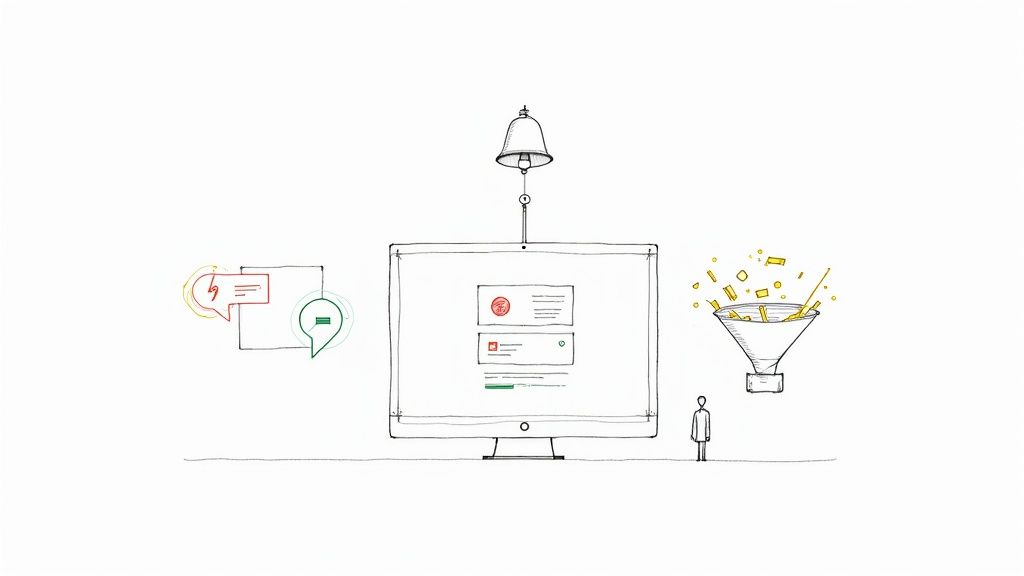
This is where the rubber meets the road. How you actually respond to customer feedback—good, bad, or ugly—is what truly defines your brand’s reputation. A generic, copy-pasted "we're sorry" just doesn't work anymore. Your customers can spot a canned response from a mile away, and it often does more harm than good.
What you need is a response playbook. This isn't about creating rigid scripts that suck the life out of your team's interactions. Think of it more as a set of smart guidelines that empower everyone with the right tone, key messages, and clear next steps for any situation. It’s the difference between a chaotic scramble and a calm, coordinated, on-brand conversation.
Crafting Scenarios for Common Feedback
First, let's map out the kinds of feedback you see most often. By bucketing these comments into common scenarios, you can build a core strategy for each one, ensuring nothing falls through the cracks.
Your playbook should cover these situations at a bare minimum:
The Glowing Positive Review: A happy customer just took the time to praise you. Don't just "like" it and scroll on. Thank them personally and mention something specific they said. Instead of "Thanks for the review," try something like, "So glad you loved the quick delivery and our new eco-friendly packaging! Thanks for noticing." This small touch makes your advocate feel genuinely appreciated and encourages others to share their good experiences, too.
The Mildly Disappointed Comment: This isn't a five-alarm fire, but it's a customer who was let down. Maybe a package arrived a day late or a product color was a bit off from the picture. Your job is to acknowledge their frustration, apologize for that specific issue, and give them a clear path forward. A simple, "We're so sorry to hear your order was delayed—that's not the standard we aim for. Could you DM us your order number so we can look into this for you?" shows you're listening and ready to fix it.
The Angry Negative Review: This is the one that makes your stomach drop. The customer is furious and publicly detailing a major problem. You need to act fast, but stay calm. Empathize with their anger, take ownership without making excuses, and quickly move the conversation out of the public eye. A response like, "This is completely unacceptable, and we are so sorry for this experience. We want to make this right immediately. Please email us at [email protected] so our senior team can personally handle this," de-escalates the public drama and shows everyone watching that you take serious issues seriously.
If you're looking to really nail your approach to criticism, it's worth digging into some effective negative review response strategies.
To make it even clearer, here’s a quick-reference table that breaks down the approach for different types of feedback.
| Response Strategy Quick Reference | |||
|---|---|---|---|
| Feedback Type | Primary Goal | Key Action | Tone |
| Positive Praise | Amplify and Appreciate | Thank personally, reference specifics | Enthusiastic, Grateful |
| Mild Complaint | Resolve and Retain | Acknowledge, apologize, offer solution | Empathetic, Helpful |
| Serious Complaint | De-escalate and Solve | Take ownership, move to private channel | Urgent, Accountable, Calm |
Having this simple framework helps ensure your team’s responses are consistent, on-brand, and effective every single time.
Setting Up a Clear Escalation Path
Not every comment should be handled by the same person. Your social media coordinator is perfect for engaging with happy customers, but they shouldn't be the one fielding a potential legal threat. Your playbook needs to draw these lines clearly.
The worst thing you can do in a high-stakes situation is leave your team guessing. A clear escalation path ensures the right people are alerted instantly, preventing delays that can turn a problem into a catastrophe.
A simple escalation flowchart is a game-changer here. It could look something like this:
- Level 1 (Social Media Team): Handles all positive, neutral, and mildly negative comments.
- Level 2 (Customer Support Manager): Tagged when a Level 1 issue isn't resolved or involves complex product or shipping problems.
- Level 3 (Senior Leadership/PR): Immediately looped in for any legal threats, accusations of harm, or comments that are going viral for the wrong reasons.
The weight of a single bad review is staggering—it can take 40 or more positive reviews to undo the damage of one negative one. And it’s not just about sales. With 86% of job seekers checking company reviews before they even apply, your reputation is a massive factor in attracting top talent.
This kind of structure removes all the guesswork and empowers your team to act with confidence. For brands juggling a huge volume of comments, a playbook is an absolute necessity. You can find more on that in our guide to social media content moderation. When you create these clear guidelines, you turn potential crises into opportunities to prove just how much you care about your customers.
Proactively Generating Positive Brand Signals
So far, we’ve been playing defense—auditing your brand, listening in on conversations, and handling what comes your way. Now it’s time to go on offense. The single best way to manage your reputation is to create a powerful current of positivity that naturally drowns out the negative noise and lets you control your own story.
A great reputation isn't just about having no bad reviews. It's about having an overwhelming wave of good ones. This means getting your happiest customers to talk, turning up the volume on their stories, and strategically using your own content to dominate your brand's search results.
Turning Happy Customers into Vocal Advocates
Let's be honest: your most satisfied customers are your best marketing tool, but most of them won't leave a review unless you ask. The trick is asking at just the right moment and making it ridiculously easy for them.
Timing is everything. A generic "please review us" email a month after their purchase is just spam. You have to catch them when the positive feelings are still fresh.
Here are the moments that work:
- Right After Delivery: A few days after their package arrives is the sweet spot. They've had a chance to open it and get excited, but the newness hasn't worn off. A quick email or SMS then is perfect.
- After a Great Service Interaction: Did your support team just save the day for a customer? When that ticket is marked "resolved," that’s your golden opportunity. Send an automated request asking them to share how great the experience was.
- When They Tag You on Social: If a customer posts a photo with your product and tags your brand, that's a massive green light. Jump on their post publicly, then slide into their DMs to thank them and gently ask if they'd be willing to turn that love into a formal review.
The goal is to make leaving a review feel like a natural, easy next step in a great customer journey, not a chore. Friction is the enemy of feedback.
Amplifying User-Generated Content
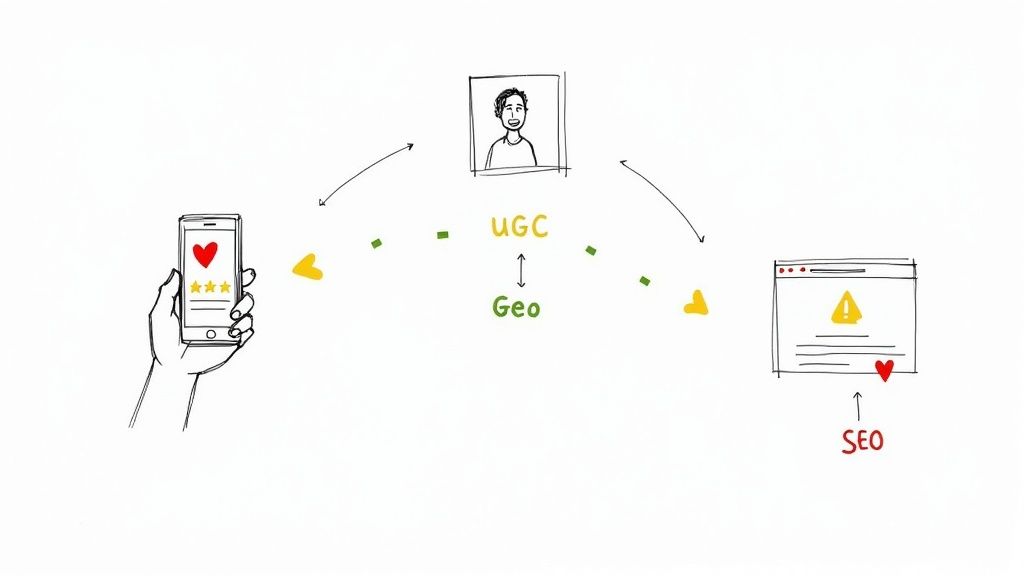
When you get those glowing reviews and social media shout-outs, don't just let them sit there. That user-generated content (UGC) is the purest form of social proof you can get, and it needs to be everywhere.
Think bigger than just hitting "retweet." Turn that positive energy into hard-working marketing assets:
- Website Testimonials: Add a scrolling carousel of your best 5-star review quotes right on your homepage or key product pages.
- Social Media Graphics: Design some simple, eye-catching graphics that feature a customer's quote. Always tag them to show your appreciation—they’ll love it.
- Email Newsletters: Create a "Customer Love" or "Review of the Week" section in your newsletters. It breaks up the sales pitch and shows real people love what you do.
This approach hits two birds with one stone. It gives potential new buyers the confidence to make a purchase, and it rewards the customers who gave you the feedback in the first place, creating a cycle of positivity.
Owning Your Brand's Search Results with SEO
What pops up when someone Googles your brand name? That's the ultimate test of your online reputation. The good news is you can directly influence this by creating high-quality, positive content that you control.
The game plan is to publish valuable content that ranks for your own brand name, pushing any negative or irrelevant results down to the second page where they go to die. Your content marketing should be a mix of:
- Authoritative Blog Posts: Write the definitive guides that answer your customers' most burning questions.
- Detailed Case Studies: Show, don't just tell. Break down real success stories that prove your product's value.
- Positive Press Releases: Got a new hire, a company milestone, or a community event? Announce it. Get that positive news out there.
This SEO-focused strategy ensures that when people look you up, they find the story you want them to see. It’s the digital equivalent of putting your best foot forward.
Unfortunately, this proactive stance is more critical than ever, especially with the rise of fake reviews. A joint 2025 analysis by Fakespot and ReviewMeta revealed that over 30% of all online reviews are inauthentic. That means a huge chunk of the review ecosystem is totally unreliable. By focusing on generating and amplifying genuine praise, you build a fortress of authenticity that stands out from all the noise. You can discover more insights about these reputation management statistics and see just how much they impact consumer trust.
Measuring the ROI of Your Reputation Efforts
You can't manage what you don't measure. After putting in all the work to monitor your brand, respond to customers, and build a positive presence, you have to connect those actions to real business results. This is how you stop reputation management from being seen as a "cost center" and prove it’s a powerful revenue driver.
The key is to move past vanity metrics and zero in on the key performance indicators (KPIs) that actually reflect how customers feel about your brand. These are the numbers that tell the real story.
Identifying Your Core Reputation KPIs
To get a clear picture of your progress, you need a simple dashboard that tracks a handful of core metrics. Think of it as your command center, giving you an at-a-glance view of what's working and where you might need to tweak your approach.
Your essential reputation dashboard should include:
- Average Star Rating: Keep a close eye on this across all the big platforms like Google, Yelp, or Trustpilot. I've seen brands jump from a 3.8 to a 4.2-star rating, and the impact on customer trust and clicks is immediate and significant.
- Sentiment Score: Most monitoring tools will give you this. It boils down all the online chatter into a simple score (e.g., 75% positive, 15% neutral, 10% negative). The goal is simple: make that positive number climb month over month.
- Review Velocity: How many new reviews are you getting each month? A steady stream of recent feedback signals that your business is active and relevant. Stale reviews don't inspire confidence.
- Response Rate and Time: This is a big one. Track how quickly and consistently you're replying to feedback. You should be aiming for a 100% response rate to negative reviews, ideally within 24 hours. It shows you care.
These metrics give you a solid foundation. If you want to dig even deeper, you can check out some of the best tools for social media analytics to get more granular insights.
Connecting Reputation to Revenue
Okay, here's the most crucial part: tying those KPIs directly to your bottom line. This is where you demonstrate the real return on investment (ROI) to your team, your boss, or your clients.
Your reputation isn't just about warm fuzzy feelings; it's a direct influence on your financials. A higher star rating doesn't just look good—it actively lowers customer acquisition costs and boosts conversion rates.
Start looking for direct correlations. For instance, did your conversion rate on a popular product page jump by 5% the same quarter your Google rating improved? Did your customer acquisition cost (CAC) drop as your positive sentiment score went up? These aren't coincidences.
When you track these connections, you can build an incredibly powerful case. Imagine walking into a meeting and showing a chart that links faster response times to a higher customer lifetime value (LTV). That’s a world away from just saying, "we answered more comments." This data-first approach proves that online reputation management isn't just a defensive tactic—it's a core part of your growth strategy.
Frequently Asked Questions
When you start digging into reputation management, a lot of the same questions tend to pop up. Let's tackle some of the most common ones we hear from e-commerce owners and marketing managers just like you.
How Long Does It Take to Improve an Online Reputation?
Honestly, it depends on where you're starting. If you're just trying to clean up a few dings on your record, you could see a real difference in your star ratings and overall sentiment in as little as 3-6 months with a solid, consistent plan.
But if you're facing a bigger uphill battle—say, recovering from a PR mess or wading through a sea of negative feedback—you're likely looking at a year or more. This isn't about a quick fix. It’s about committing to the long game of listening, responding, and actively building a positive presence.
The key takeaway is that consistency beats intensity. A steady, ongoing effort will always outperform short, reactive bursts of activity when it comes to building lasting trust with your audience.
Should I Respond to Every Single Review?
In a perfect world, yes, but in reality, you have to prioritize. You absolutely must respond to 100% of negative and neutral reviews. These are your golden opportunities to turn a bad experience around, show you care, and prove to everyone watching that you take feedback seriously.
Responding to positive reviews is great for building community and making your fans feel seen, but it's okay to be more selective if you're swamped. The only comments you should never engage with are the obvious trolls or spam—just report and remove them. Don't feed the trolls.
What Is the Best Way to Handle Fake Negative Reviews?
The first rule is: don't get emotional. Never fire back with an angry reply.
Instead, post a calm, professional public response. Something simple like, "We've checked our records and can't seem to find a transaction or customer account matching your details. We take this seriously and would love to investigate further. Please contact our support team directly so we can help."
This shows other potential customers that you're reasonable, while gently casting doubt on the review's legitimacy. At the same time, immediately report the review to whatever platform it's on (Google, Trustpilot, you name it) and provide any evidence you have that it's fake.
Ready to stop wasting time on spam and start engaging with real customers? See how FeedGuardians uses AI to automatically protect your comment sections and uncover sales opportunities.
Tired of manually moderating comments?
FeedGuardians automates spam filtering, responds to customers, and protects your brand — setup in 3 minutes.