
Quick Summary
| Key Insight | What You Need to Know |
|---|---|
| Protect Your Reputation | Catch negative feedback the moment it appears and jump in before a minor issue snowballs into a full-blown crisis. |
| Improve Customer Experience | Pinpoint exactly what customers love (and what drives them crazy) to make meaningful improvements. |
| Make Smarter Decisions | Let real-world sentiment guide everything from product development to your next marketing campaign. |
Ever wonder what people really think about your brand? Social media is buzzing with opinions, but how do you make sense of it all? This is where sentiment analysis comes in.
It’s the tech that deciphers the emotional tone behind all those posts, comments, and mentions. In simple terms, it automatically sorts online conversations into three buckets: positive, negative, or neutral.
What Is Social Media Sentiment Analysis?
Imagine walking into a massive room where everyone is talking about your brand. Instead of just hearing the noise, you could instantly sense the overall mood—happy, frustrated, or just indifferent. That’s the magic of social media sentiment analysis.
It’s not just about counting how many times your brand is mentioned. It’s about understanding the feeling behind those mentions. This technology essentially acts as an emotion detector for the digital world, turning messy, unstructured text into clear, actionable insights.
For instance, a comment like, "Your new feature is a total game-changer!" is an obvious win. On the flip side, "I can't believe the app crashed on me again" is a clear signal of frustration. By gathering thousands of these data points, you get a real-time snapshot of how people feel about your brand.
The Business Impact of Understanding Emotion
This isn't just some fancy tech trend; it's a fundamental tool for staying in tune with your audience. When you can accurately gauge the emotional pulse of your brand online, you can start making much smarter moves.
- Protect Your Reputation: Catch negative feedback the moment it appears and jump in before a minor issue snowballs into a full-blown crisis.
- Improve Customer Experience: Pinpoint exactly what customers love (and what drives them crazy) to make meaningful improvements.
- Make Smarter Decisions: Let real-world sentiment guide everything from product development to your next marketing campaign.
This whole process is a cornerstone of social listening, which is all about tapping into the unfiltered voice of the customer.
Sentiment analysis gets to the 'why' behind the words. It gives brands a direct line to what customers feel, not just what they say. This emotional context is the secret to building stronger, more authentic connections with your audience.
The value of this technology has exploded. The global social listening market, which leans heavily on sentiment tracking, was projected to leap from $9.61 billion in 2025 to $18.43 billion by 2030. This massive growth shows just how crucial these real-time signals have become. You can dig deeper into these trends and what they mean for brand strategy with insights from Sprout Social.
How Does Sentiment Analysis Actually Work?
At its heart, sentiment analysis is all about teaching a machine to read between the lines—to understand the emotional tone behind a comment, post, or review. It's the technology that translates raw, unstructured human language into clean, measurable data. But how does it learn to tell an ecstatic customer from a seriously frustrated one? It all comes down to a few different approaches, each with its own pros and cons.
This visual map shows the core categories that any good sentiment analysis tool is trying to pinpoint.
No matter the method, the goal is always to sort social media chatter into these fundamental buckets, giving you a clear snapshot of how people truly feel.
The Lexicon-Based Approach (The Word Scorekeeper)
The simplest method is often called lexicon-based or rule-based analysis. Think of it like a giant, digital dictionary where every word has a score. Words like "love," "excellent," or "perfect" get positive points (+1, +2), while words like "terrible," "hate," or "broken" get negative points (-1, -2).
When a comment comes in, the system scans it, adds up the scores of all the emotional words it finds, and spits out a final sentiment rating. It’s fast, straightforward, and easy to understand. The big downside? It's easily confused by the tricky parts of human language, like sarcasm, idioms, or context.
The Machine Learning Approach (The Pattern Finder)
This is where things get a bit smarter. Instead of just following a pre-set list of rules, Machine Learning (ML) models learn from experience. It’s like training a new employee by showing them thousands of examples of customer comments that have already been labeled as positive, negative, or neutral.
After analyzing enough data, the model starts to recognize the patterns on its own. It learns what combinations of words usually signal happiness, frustration, or indifference. This makes it far more adaptable and accurate than the simple lexicon method because it's trained on real-world language, not just a static word list.
A machine learning model can understand that the phrase "not bad" is actually positive. A basic lexicon-based system would probably see the word "bad" and mistakenly flag the whole comment as negative. It's this ability to grasp the relationship between words that makes all the difference.
The Transformer Model Approach (The Language Expert)
At the very top of the food chain are transformer models, like the well-known BERT from Google. These are the true language experts of the AI world. They don't just read a sentence word-by-word; they analyze the entire thing at once, looking both forward and backward to grasp the complete context.
This deep understanding allows them to nail the nuance, sarcasm, and complex phrasing that trip up other systems. For example, a transformer model can easily tell the difference between "This new feature is sick!" (positive slang) and "I feel sick from this update" (very negative). This is the kind of sophisticated engine that powers a tool like FeedGuardians, delivering incredibly precise insights from social media conversations.
To make it easier to see how these methods stack up, here’s a quick comparison.
Comparison of Sentiment Analysis Techniques
This table breaks down the three main approaches, comparing them on key factors like accuracy, speed, and cost to help you understand which one might be right for different needs.
| Technique | How It Works (Analogy) | Pros | Cons | Best For |
|---|---|---|---|---|
| Lexicon-Based | The Word Scorekeeper | Fast, cheap, and transparent. Easy to understand how it reaches a conclusion. | Low accuracy. Easily confused by sarcasm, slang, and context. | Quick, high-level analysis where precision isn't the top priority. |
| Machine Learning | The Pattern Finder | More accurate and adaptable. Learns from real data to understand context better. | Requires a lot of labeled training data. Can be a "black box" (hard to know why it made a decision). | Most common business applications, offering a good balance of accuracy and performance. |
| Transformer Model | The Language Expert | Highest accuracy. Understands deep nuance, sarcasm, and complex sentences. | Slower and more expensive to run due to its complexity. | Critical applications like brand safety, moderation, and in-depth customer feedback analysis where accuracy is everything. |
Ultimately, the best technique depends on the job at hand. While a simple lexicon might be fine for a quick gut check, the deep contextual understanding from a transformer model is what gives you the reliable, actionable insights needed to manage a brand's reputation effectively.
Putting Sentiment Analysis to Work for Your Business
Knowing the theory behind sentiment analysis is one thing, but watching it deliver real business results is where things get exciting. This isn't just about collecting interesting data; it's about building a core engine for growth, customer loyalty, and brand protection. When you can translate online emotions into strategic actions, you can get ahead of problems and jump on opportunities faster than your competitors.
Let's break down some of the most powerful ways businesses are using sentiment analysis right now.

Proactive Customer Service and Reputation Management
The days of waiting for a customer to fill out a support ticket are long gone. Think of sentiment analysis as an early warning system that automatically flags negative comments the second they pop up.
Imagine someone tweets, "Just tried your new software and it's so buggy I can't even log in." An AI tool like FeedGuardians can spot that frustration instantly and create a high-priority ticket for your support team. This flips customer service on its head, moving from reactive to preventative.
A quick, helpful response can turn an angry user into a loyal fan, proving that you're actually listening. For a deeper look at this, our guide on customer service automation walks you through the entire process. Many brands also use this for more effective review management strategies, turning raw feedback from Google and Yelp into genuine improvements.
Real-Time Brand Health and Campaign Monitoring
Are you launching a new product or a big marketing campaign? Sentiment analysis lets you see how people are reacting in real time, rather than waiting weeks for sales reports to trickle in.
- Product Launches: See if customers are genuinely excited about new features or if they're totally confused by the new UI.
- Marketing Campaigns: Find out if your message is landing as intended or if it’s being completely misinterpreted.
- Crisis Management: Instantly get a read on public opinion during a PR crisis to figure out your next move.
This gives you the flexibility to change your strategy on a dime—doubling down on what people love and fixing what they don't.
By monitoring sentiment, you're not just counting mentions; you're measuring impact. You get a clear, unfiltered view of how the market really sees you, allowing you to make decisions based on data, not just guesswork.
Moderation and Purchase Intent Detection
A positive online community is vital for your brand's image. Sentiment analysis can automatically identify and hide toxic comments, keeping your comment sections a safe and constructive place for your real audience.
But it works both ways. The same technology can pinpoint buying signals. When someone posts, "Wow, I've been looking for a solution like this everywhere!" that glowing sentiment is a clear sign of purchase intent. Your team can then step in with a helpful link or a special offer to close the deal.
This dual ability to filter out the bad while amplifying the good transforms your social media from a simple broadcast channel into a powerful community and sales tool. It fundamentally changes how you can interact with your audience at scale.
How Do You Know If Your Sentiment Analysis Is Accurate?
The insights you get from sentiment analysis are only as good as the system’s accuracy. If your tool can’t tell a happy customer from a furious one, you’re just looking at meaningless data. But how do you actually measure something as nuanced as emotional tone? It really boils down to a few key metrics.
Let's use an analogy. Imagine you're using a net to catch only the "negative" fish in a pond full of positive, negative, and neutral fish.
You’d want to know how well your net is working. That’s where these metrics come in:
- Precision: Of all the fish you caught, how many were actually the "negative" ones you wanted? High precision means your net is great at avoiding the wrong fish. When your system says a comment is negative, it's almost always right.
- Recall: Of all the "negative" fish in the entire pond, how many did your net actually catch? High recall means your net is wide and effective, catching most of the negative comments out there, even if it accidentally snags a few positive ones.
- F1-Score: This is the ultimate balancing act. The F1-Score combines both Precision and Recall into a single number, giving you a much more complete picture of your model's performance. A high F1-Score tells you the system is both accurate and thorough.
Why Context Is Everything
Good scores on these metrics are a great start, but they don't tell the whole story. A model is only as smart as the data it was trained on.
Think about it this way: an AI trained only on movie reviews would learn that words like "explosive" and "shocking" are positive things. Now, apply that same model to feedback for your new banking app. A customer describing the app as "explosive and shocking" is definitely not a good thing, but your generic model might flag it as a glowing review.
This is exactly why one-size-fits-all models so often miss the mark. Context is king.
To get sentiment analysis you can actually trust, the AI needs to understand the slang, shorthand, and specific language of your industry. "Sick" means something amazing in the gaming world and something awful in healthcare. Without that contextual awareness, you’re flying blind.
Keeping a Human in the Loop
No AI is flawless. The most effective sentiment analysis strategies always involve a "human-in-the-loop" to keep things on track. This simply means having a real person periodically review what the AI has classified, correct its mistakes, and help it learn.
For example, your social media manager might spot a bunch of comments the AI flagged as "neutral." But after reading them, they realize they’re actually dripping with sarcasm. By re-labeling those comments as "negative," they’re actively teaching the AI to spot that kind of nuance in the future.
This cycle of feedback and refinement is what turns a decent model into a truly powerful one. Many of the best tools for social media analytics build this capability right in. This process ensures the insights you use to make business decisions are insights you can actually count on.
Common Challenges and How to Overcome Them
Sentiment analysis is an incredible tool, but let's be honest—it’s not magic. Human language is messy, and algorithms can get tripped up by the same nuances that make our conversations interesting. Knowing what these hurdles are is the first step to building a system you can actually trust.
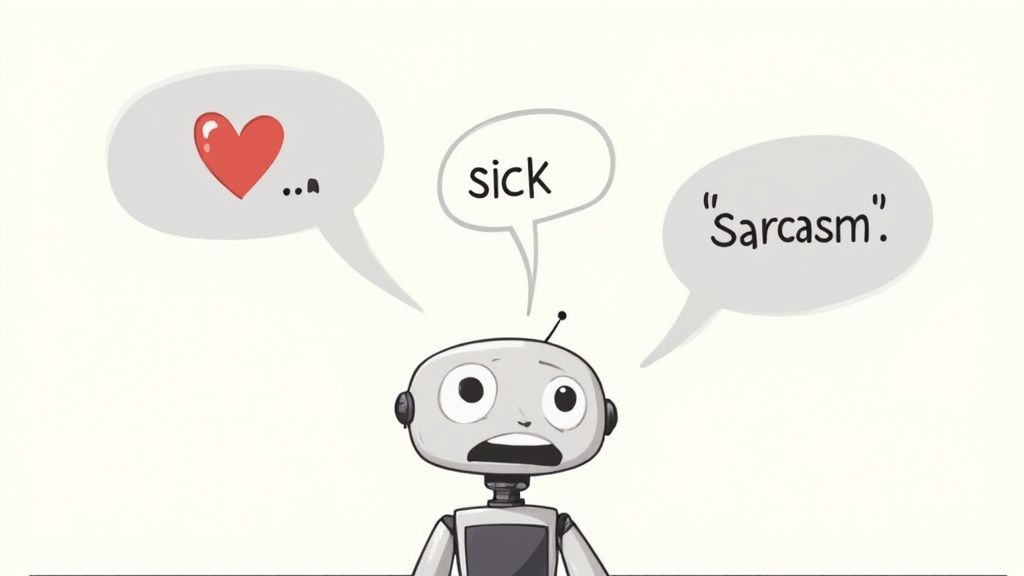
Think about it. An AI sees the word "sick" and might immediately flag it as negative. But if you’re a streetwear brand, a comment like "Those new high-tops are sick!" is the highest form of praise. Without that industry context, the machine gets it completely wrong.
Decoding Sarcasm and Industry Jargon
Sarcasm is the ultimate headache for any sentiment analysis model. It lives in tone and shared context—two things machines find notoriously difficult to grasp. Someone might comment, "Oh, great. Another software update I didn't ask for," and a basic tool will just see the word "great" and miss the negative sentiment entirely.
Then you have industry-specific slang. In the gaming world, calling a new release "broken" could be a factual, negative critique of its bugs. In finance, a "broken" model might mean something completely different. Your tool needs to know your world.
The real challenge isn't just about scoring individual words. It's about teaching the machine to understand the relationship between words and the unique context of your business. That's where you get truly accurate insights.
How to Get Around These Nuances
So, how do you handle all this complexity? You have to move past the generic, out-of-the-box tools and get a little more specific.
Here are a few ways to build a smarter system:
- Build a Custom Dictionary: Create a lexicon that’s unique to your brand. Add industry slang, your product names, and common acronyms. This is how you teach your model that for your sneaker brand, "sick" is a positive term.
- Use Context-Aware Models: This is a big one. Advanced platforms like FeedGuardians don't just look at keywords in isolation. They analyze the whole sentence to pick up on sarcasm and subtle shifts in meaning, making them far more reliable.
- Don't Forget Emojis: Emojis are pure emotional data. A comment like "The shipping took forever 😠" is clearly negative, and a good tool will weigh that angry-face emoji heavily in its final score.
Getting this right is about more than just accurate reports; it's fundamental to protecting your brand. The same principles that lead to better sentiment analysis are crucial for effective social media content moderation. When you fine-tune your system to understand how your audience actually talks, you end up with a much sharper and more insightful strategy.
Weaving Sentiment Analysis Into Your Workflow
Gathering sentiment data is one thing, but the real magic happens when you actually use it. The goal is to plug these insights directly into your day-to-day operations, turning a sea of data into a smart, automated system that protects your brand and streamlines your work.
Think of it as moving from just looking at a report to building a responsive machine. When sentiment analysis runs in the background, your team can stop hunting for problems and start solving them the moment they appear.
Set Up Real-Time Alerts and Rules
The first, and most powerful, step is setting up real-time alerts. Imagine a high-profile influencer posts something negative about your brand. Instead of finding out hours later, you get a notification instantly. That's your chance to get ahead of the story and manage the situation before it spirals.
But you can go deeper by creating automated rules that handle the grunt work for you. For example, you can set up your system to:
- Assign Negative Comments: Automatically send any comment with a highly negative sentiment score straight to your customer support team's inbox.
- Flag Purchase Intent: Tag positive comments with phrases like "I need this!" or "where to buy?" and route them to your sales team.
- Escalate Urgent Issues: If a comment mixes negative sentiment with words like "unsafe" or "recall," it can be instantly flagged as a top priority for immediate review.
Integrating sentiment analysis means your tools do the heavy lifting. Instead of you searching for problems, the problems find the right person on your team to solve them.
Connect Sentiment Data to Your Other Tools
Sentiment data becomes exponentially more valuable when it’s not stuck in a silo. By connecting it with the other tools you use, you get a much clearer picture of your customer. For instance, feeding sentiment data into your CRM adds crucial emotional context to customer profiles. Now your support team can see a customer's recent frustrations before they even start typing a reply.
This is how sentiment analysis for social media becomes more than just a reporting metric—it becomes an engine for growth. And don't forget video! A huge amount of customer opinion is locked away in video comments and spoken content. A key part of a modern workflow is converting social media video content to text using AI tools like Whisper, which lets you analyze sentiment everywhere.
To get started, you'll need the right platform. Our guide to the top social media sentiment analysis tools can help you find one with the integration features you need.
Got Questions? We've Got Answers
Thinking about how sentiment analysis could work for your brand? You're not alone. Here are a few of the most common questions we get, with straight-to-the-point answers.
Just How Accurate Is This Stuff, Really?
The honest answer? It varies—a lot. You'll see accuracy figures anywhere from a shaky 60% to an impressive 90% or more.
Why the huge range? Simple, dictionary-based tools often miss the point and get things wrong. But a sophisticated AI model that's been trained specifically on data from your industry? That’s where you start seeing incredibly high accuracy.
It really boils down to a few things:
- The Brains Behind It: Newer transformer models are just miles ahead of older methods.
- The Data Diet: An AI is what it eats. High-quality, relevant training data makes for a smarter, more accurate tool.
- Human Nuance: This is the tricky part. Sarcasm, inside jokes, and slang can trip up any system.
The big takeaway here is that accuracy isn't just a static number. It’s a reflection of how well the tool truly gets the unique language of your audience. The best systems are always learning and improving.
Can It Actually Get Sarcasm and Emojis?
Yes, though it's still one of the toughest nuts for AI to crack. Modern systems have gotten much better at spotting sarcasm by looking at the whole picture, not just isolated keywords. A comment like, "Awesome, my order is delayed again," used to fly under the radar. Now, a good model can see the context and flag it as negative.
And emojis? They're practically a cheat sheet for sentiment. A smart system knows that emojis like 👍, ❤️, or even 😠 are powerful clues that can sometimes tell you more than the words themselves. They add a critical layer of emotional context.
What’s the Smartest Way to Get Started?
Don't try to boil the ocean. The best way to begin is to start small and have a clear plan.
First, decide what you want to achieve. Is your main goal to jump on customer service issues faster? To see if your latest campaign is landing well? Or to keep your brand's reputation squeaky clean? Pick one to start.
Then, find a tool that fits that specific job. You want something that understands context, not just keywords, and can be tuned into the language of your specific corner of the world. Finally, plug it into your daily routine. Set up alerts and automated rules so that you're not just collecting data—you're actually using it to make smarter decisions in real time.
Ready to stop guessing and start understanding what your audience is really saying? FeedGuardians uses advanced AI to analyze sentiment, spot buying signals, and protect your comments from spam and negativity. See how FeedGuardians can work for your brand.
Tired of manually moderating comments?
FeedGuardians automates spam filtering, responds to customers, and protects your brand — setup in 3 minutes.