
Quick Summary
| Key Insight | What You Need to Know |
|---|---|
| Run language identification token | Run language identification token by token, not post by post, and normalize lookalike scripts. |
| Annotation cost is the | Annotation cost is the main reason low-resource languages lag in dataset coverage. |
| Hold out one language | Hold out one language entirely to measure how much cross-lingual transfer you actually get. |
| A model scoring 0.88 | A model scoring 0.88 F1 overall may score only 0.61 on Urdu and 0.55 on code-mixed text. |
| Set decision thresholds per | Set decision thresholds per language and re-check them after every model update. |
| Why Detecting Hate Speech | Why Detecting Hate Speech in Multilingual Social Media Posts Is HardLanguage Diversity and Low-Resource LanguagesHate Speech Versus Offensive Language |
Last Updated: October 31, 2026
Quick Summary
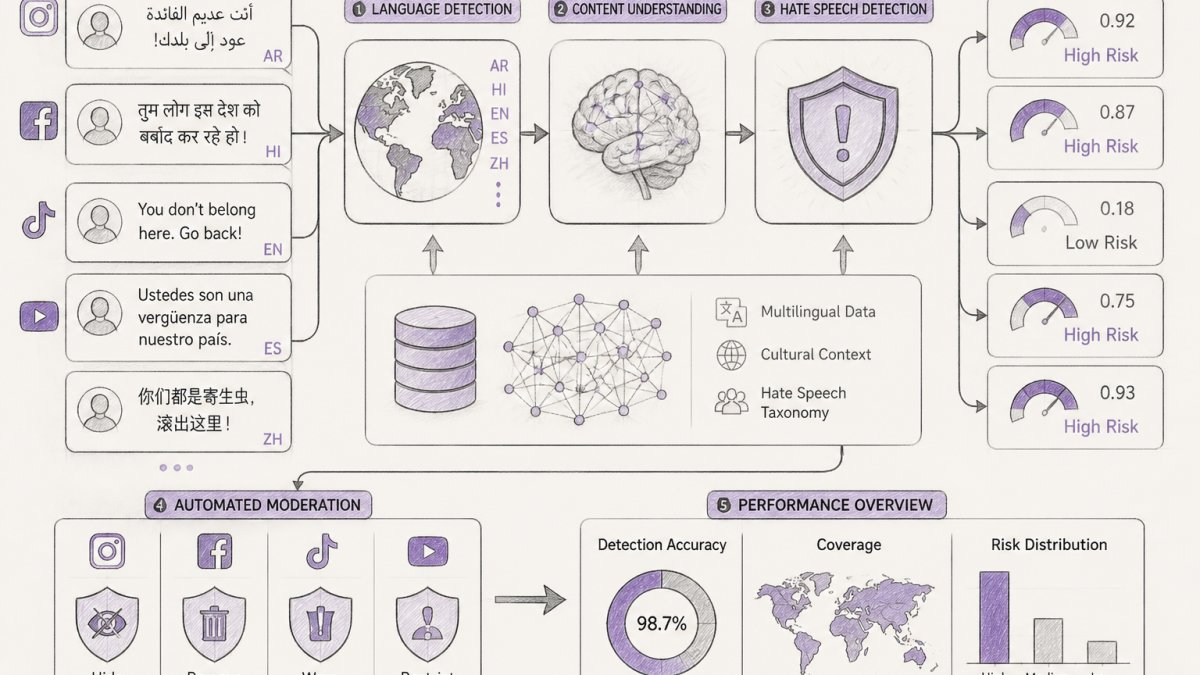
Detecting multilingual hate speech means training models to spot abusive content across many languages, dialects, and writing styles at once. It is hard because most training data covers English, low-resource languages get little coverage, and code-mixed posts blend languages and scripts in a single sentence. Compare model tiers on one fixed evaluation set and report precision, recall, and F1 per language rather than as one blended score.
- Run language identification token by token, not post by post, and normalize lookalike scripts.
- Annotation cost is the main reason low-resource languages lag in dataset coverage.
- Hold out one language entirely to measure how much cross-lingual transfer you actually get.
- A model scoring 0.88 F1 overall may score only 0.61 on Urdu and 0.55 on code-mixed text.
- Set decision thresholds per language and re-check them after every model update.
Table of Contents
- Why Detecting Hate Speech in Multilingual Social Media Posts Is Hard
- Hate Speech Detection in Code-Mixed Text: Preprocessing That Holds Up
- Hate Speech Detection Datasets: What You Need to Train a Model
- From Machine Learning to Transformers: Model Approaches That Work
- Social Media Hate Speech Examples: Where Models Fail
- Multilingual Content Moderation Tools: Evaluating and Comparing Models
- Responsible Deployment: Human Review and Operational Monitoring
- Putting Multilingual Moderation to Work for Your Brand
- Frequently Asked Questions
Why Detecting Hate Speech in Multilingual Social Media Posts Is Hard
Multilingual hate speech detection in social media posts is the practice of training models to spot abusive content across many languages, dialects, and writing styles at once. Readers new to the topic can start with a guide to social media content moderation for a broader grounding. It is hard because language is messy.
Language Diversity and Low-Resource Languages
Most training data covers English. Spanish, French, and Urdu get far less attention, and smaller languages get almost none. A model trained mostly on English tends to miss abuse written in low-resource languages. Language diversity is the core problem, not a side detail.
Hate Speech Versus Offensive Language
Hate speech targets a group based on identity. Offensive language is rude but not always targeted. Models confuse the two constantly. A slur used between friends reads differently than the same word aimed at a group. That line is blurry, and it changes by culture.
Hate Speech Detection in Code-Mixed Text: Preprocessing That Holds Up
Hate speech detection in code-mixed text starts with preprocessing that respects how people actually write. Code-mixed text blends two or more languages in one post, often with mixed scripts. Clean it badly and the model learns noise.
A common mistake is stripping everything that looks "wrong." That deletes real signal.
- Run language identification token by token, not post by post
- Normalize scripts: map lookalike characters to one form
- Keep emojis and hashtags, which often carry intent
Language Identification and Script Normalization
Language identification tags each token with its language. Script normalization then folds lookalike characters, like Cyrillic letters posing as Latin ones, into a single form. Skip this step and your model sees two words where there is one.
Hate Speech Detection Datasets: What You Need to Train a Model
Hate speech detection datasets determine what your model can and cannot learn. Annotated tweets and forum posts are the backbone, but coverage is uneven. Most public sets lean English, and multilingual hate speech datasets are smaller and costlier to build.
Manual annotation is slow and expensive. Annotation cost is the main reason low-resource languages lag.
- Combine public benchmark datasets with your own labeled posts
- Balance classes: hate, offensive, and neutral need fair counts
- Track language and dialect per example
Annotation Guidelines and Disagreement Resolution
Clear guidelines beat clever models. Write rules with examples for each label, then have two annotators label the same posts. Where they disagree, a third person resolves the case and the rule gets updated. This cuts bias and makes labels reproducible.
From Machine Learning to Transformers: Model Approaches That Work
Transformer models are widely used, but older machine learning still earns a place. The practical question is not which family is newest. It is which family gives you the best per-language recall at a cost and latency you can run in production. That is a comparison question, and most write-ups skip it.
The Four Model Tiers Worth Comparing
Build your comparison around four tiers, from cheapest to most expensive:
- Keyword and lexicon baseline. A blocklist of slurs and phrases per language, with simple matching rules. It is fast, fully auditable, and easy to explain to reviewers. It also misses sarcasm, reclaimed language, and any spelling variation it was not written for.
- Classical machine learning. Logistic regression or a linear support vector machine on character n-grams and word n-grams. Character n-grams matter for multilingual text because they survive some spelling variation and transliteration. These models train in minutes on a laptop and give you a strong, cheap benchmark.
- Multilingual transformers. Fine-tuning a multilingual model like XLM-RoBERTa research from Meta AI gives strong cross-lingual transfer with far less per-language data. BERT-based multilingual checkpoints are the common starting point. The cost is compute, latency, and a larger operational surface.
A Reproducible Comparison Protocol
The gap in most published comparisons is that each model is tested on a different dataset with a different label scheme. Close that gap by holding everything constant except the model:
- Fix one evaluation set. Use the same held-out posts for every tier, with the same label definitions (hate, offensive, neutral) and the same language tags.
- Split by language, not just at random. Report results for English, Spanish, French, Urdu, and code-mixed text separately. A blended score hides the languages where a model fails.
- Train each tier on the same data budget. If the transformer gets 50,000 labeled posts and the baseline gets 5,000, you are measuring data, not architecture. Run a low-data and a high-data condition for each tier.
- Hold out one language entirely. Train without French, then test on French. That single run tells you how much cross-lingual transfer you actually get, which is the claim most multilingual model write-ups make but rarely test.
- Log latency and cost per 1,000 posts. A model that gains two points of F1 but triples inference cost may not be the right production choice.
Run the keyword baseline first. If a fine-tuned transformer cannot beat a well-built lexicon on your own data by a meaningful margin on the languages you care about, you have a data problem, not a model problem.
Cross-Lingual Transfer and Multilingual Models
Cross-lingual transfer trains on high-resource languages and applies the result to low-resource ones (Cross-Lingual Transfer Robustness to Lower-Resource Languages on Adversarial Datasets). Fine-tune XLM-RoBERTa on English and Spanish, and it often handles French or Urdu reasonably well.
A common pattern is to use the multilingual transformer as the base and add a small amount of labeled data in the target language.
Choosing Between Tiers
Use the baseline for high-precision blocklist cases and as a regression check. Scaling these systems across diverse regions often requires integrating automatic translation for communication to ensure that nuanced linguistic markers of hate speech remain detectable even when the primary model lacks native training data.
The article lays out four model tiers to compare, from cheapest to most expensive.
| Model tier | Strengths | Limits |
|---|---|---|
| Keyword and lexicon baseline | Fast, fully auditable, easy to explain | Misses sarcasm, reclaimed language, spelling variation |
| Classical machine learning | Character n-grams survive spelling variation; trains in minutes | Strong cheap benchmark only |
| Deep learning without pretraining | Improved on classical baselines, especially longer posts | Needs more labeled data per language; harder to audit |
| Multilingual transformers | Strong cross-lingual transfer with less per-language data | Compute, latency, larger operational surface |
Social Media Hate Speech Examples: Where Models Fail
Social media hate speech examples show the failure modes fast. Sarcasm reads as praise. A reclaimed slur used inside a community reads as hate to a model that never learned the context.
False positives silence innocent users. False negatives let abuse through. For a closer look at handling abusive comments in practice, our guide to managing trolling on social media covers the response side.
Multilingual Content Moderation Tools: Evaluating and Comparing Models
Multilingual content moderation tools should be judged per language, not on one blended score. A model that looks strong overall can be weak exactly where you need it.
Metrics That Matter: Precision, Recall, and F1 by Language
Precision measures how many flagged posts were truly hateful. Recall measures how much hate you caught. F1 score balances the two (f1_score).
A worked example of why the split matters: suppose a model scores 0.88 F1 overall but 0.61 F1 on Urdu and 0.55 F1 on code-mixed text. The blended number says ship it.
Setting Thresholds per Language
A single decision threshold across all languages is a common and costly mistake. Precision and recall trade off differently in each language because the base rates of hate speech and the model's confidence calibration differ. Set the threshold per language against your moderation policy:
- For languages where a false positive silences a marginalized community, raise the threshold and route more cases to human review.
- For languages where a false negative lets coordinated abuse through, lower the threshold and accept more review volume.
- Re-check thresholds after every model update, because calibration shifts even when F1 holds steady.
Do not tune thresholds on the same data you report results on. Hold out a per-language calibration set, or your reported precision will be optimistic and your production precision will disappoint.
Comparing Models Fairly
To compare two tools or two model versions, hold the evaluation set, label definitions, and language tags constant. Then report, per language: precision, recall, F1, the false-positive rate on neutral posts, and the share of posts routed to human review. The last two numbers are what operations teams actually feel. A model that catches more hate but doubles review volume may cost more than it saves.
Reading the Results
A few patterns show up again and again in per-language comparisons. Code-mixed text usually scores lowest because intent is split across languages and scripts. Low-resource languages often show high precision but low recall, meaning the model flags only the cases it is sure about and misses the rest. Keyword baselines can beat transformers on narrow, well-defined slurs but collapse on paraphrase and spelling variation.
Operational Monitoring After Deployment
Evaluation does not end at launch. Language drift, emerging slurs, and new code-mixing patterns degrade a model quietly. Track per-language precision and recall on a sample of human-reviewed posts every month, watch the share of appeals that overturn an automated decision, and retrain when a language's recall drops below your agreed floor.
Responsible Deployment: Human Review and Operational Monitoring
Human review is not optional. Route borderline and high-stakes cases to a person, and log every automated decision. Monitor for bias and drift, since a model that worked last quarter can fail after a slang shift. For a deeper look at the risks, read the ethical risks of automated hate speech filtering and whether AI social moderation is safe to use.
Putting Multilingual Moderation to Work for Your Brand
Multilingual moderation only pays off when it runs in production, on real comments, every day. Social media managers can learn how AI comment moderation fits their role. FeedGuardians detects and hides spam, scams, hate speech, and competitor links with 98.7% accuracy, and replies 24/7 in your brand voice. Human escalation is available, so your team can handle only the cases that need a person.
Frequently Asked Questions
How can you detect hate speech in multilingual social media posts?
Start with a multilingual model such as XLM-RoBERTa fine-tuned on annotated data in each target language, then add language-specific preprocessing for code-mixed and informal text. Evaluate precision and recall separately per language instead of relying on one aggregate score, and route low-confidence predictions to human reviewers. No single model handles every language equally well, so plan for per-language thresholds and ongoing error analysis rather than a one-time setup.
What makes hate speech detection difficult across languages?
Most labeled training data exists in English, so low-resource languages like Urdu or code-mixed text get far less coverage. Slang, sarcasm, and cultural context shift meaning between languages, and the same phrase can be a slur in one community and neutral in another. Class imbalance compounds the problem because hateful posts are a small share of total volume. These gaps show up as higher false negatives in under-resourced languages unless you collect and annotate data specifically for them.
How can you distinguish hate speech from offensive language or criticism?
Define the boundary in your annotation guidelines before labeling begins. Hate speech targets a protected group or individual based on identity; offensive language may be profane without targeting anyone; criticism attacks ideas, products, or behavior. Give annotators concrete examples for each category and a separate label for ambiguous cases. When annotators disagree, resolve it through discussion and record the decision so future labeling stays consistent. This upfront work reduces false positives that would otherwise silence legitimate customer complaints.
How can you evaluate a hate speech detector across different languages?
Report precision, recall, and F1 score per language rather than as one blended number, and include false positive and false negative rates for each. Build a held-out test set that reflects your actual comment mix, including code-mixed posts and informal language. Compare models on the same benchmark datasets so results are reproducible. Track performance over time after deployment, because language use shifts and a model that scored well in testing can drift once real traffic arrives.
The hard part is not building one model. It is keeping multilingual detection accurate as languages, slang, and code-mixing shift under you. FeedGuardians handles that load with real-time comment moderation, AI replies in your brand voice, and a human escalation option when a call needs judgment. Get started with FeedGuardians and turn your comment sections into a safe, on-brand channel.

Tired of manually moderating comments?
FeedGuardians automates spam filtering, responds to customers, and protects your brand — setup in 3 minutes.
Frequently Asked Questions
How can you detect hate speech in multilingual social media posts?
Start with a multilingual model such as XLM-RoBERTa fine-tuned on annotated data in each target language, then add language-specific preprocessing for code-mixed and informal text. Evaluate precision and recall separately per language instead of relying on one aggregate score, and route low-confidence predictions to human reviewers. No single model handles every language equally well, so plan for per-language thresholds and ongoing error analysis rather than a one-time setup.
What makes hate speech detection difficult across languages?
Most labeled training data exists in English, so low-resource languages like Urdu or code-mixed text get far less coverage. Slang, sarcasm, and cultural context shift meaning between languages, and the same phrase can be a slur in one community and neutral in another. Class imbalance compounds the problem because hateful posts are a small share of total volume. These gaps show up as higher false negatives in under-resourced languages unless you collect and annotate data specifically for them.
How can you distinguish hate speech from offensive language or criticism?
Define the boundary in your annotation guidelines before labeling begins. Hate speech targets a protected group or individual based on identity; offensive language may be profane without targeting anyone; criticism attacks ideas, products, or behavior. Give annotators concrete examples for each category and a separate label for ambiguous cases. When annotators disagree, resolve it through discussion and record the decision so future labeling stays consistent. This upfront work reduces false positives that would otherwise silence legitimate customer complaints.
How can you evaluate a hate speech detector across different languages?
Report precision, recall, and F1 score per language rather than as one blended number, and include false positive and false negative rates for each. Build a held-out test set that reflects your actual comment mix, including code-mixed posts and informal language. Compare models on the same benchmark datasets so results are reproducible. Track performance over time after deployment, because language use shifts and a model that scored well in testing can drift once real traffic arrives.